Before you spend a single dollar on music promotion, you have questions. Good ones, mostly — the exact questions that sellers of bad promo are trained to answer with fog, and sellers of fake promo answer with lies. "Will this make my song blow up?" "Can I get 100K streams for $30?" "How do I know you won't just take my money?" Here are those questions with the honest answers attached — including the two answers almost nobody selling promotion will say out loud: "no", and "we don't know". You won't like all of it. That's roughly how you'll know it's true.
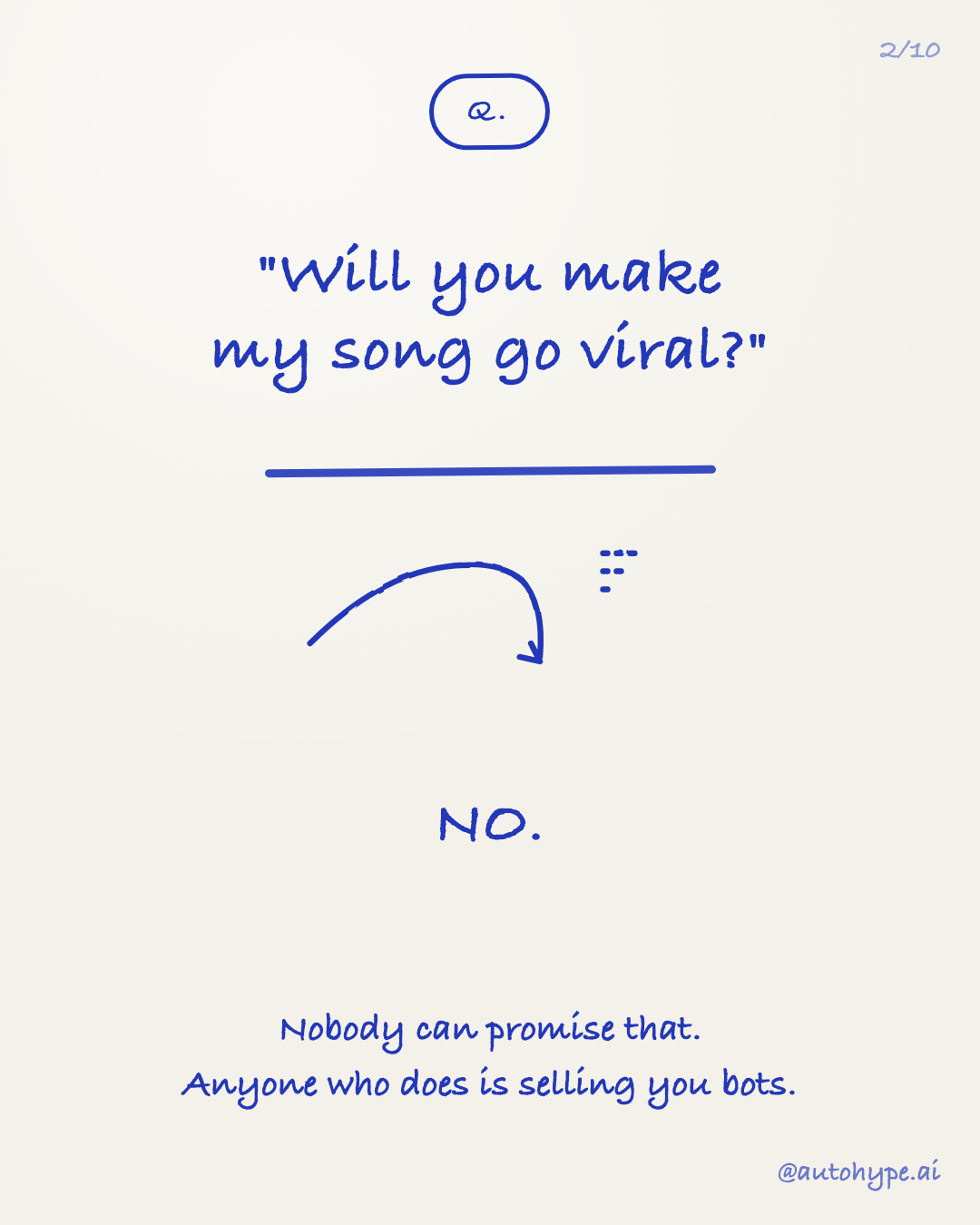
"Will you make my song go viral?" — No.
No. Full stop, no asterisk. Nobody can promise virality — not a marketplace, not a label, not a creator with two million followers. Viral is an outcome produced by thousands of independent human decisions, and nobody sells control over strangers. Anyone who does promise it is answering a different question: "will you sell me bots?" Yes. They will.
What paid promotion actually does is narrower and more honest: it buys work and a shot. A real creator makes a real video for your song and their real audience sees it. A curator actually listens to your pitch. Your song gets in front of humans who weren't going to hear it otherwise. That's the product. It's real, it's useful, and it is not a miracle.
The practical consequence: treat any viral promise as a disqualifier. Not a maybe, not a "worth a try" — a disqualifier. The people who can't deliver it are the only ones promising it.
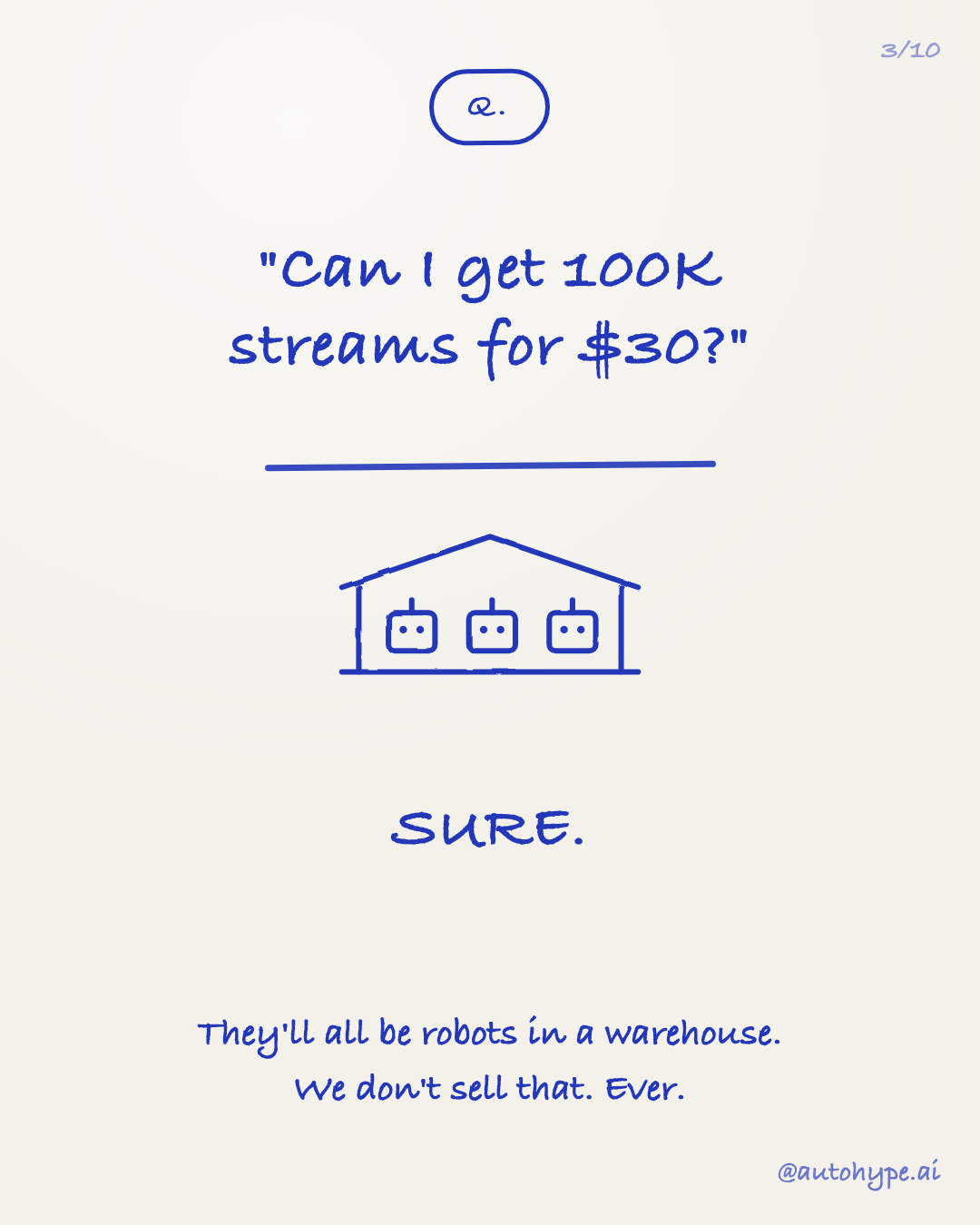
"Can I get 100K streams for $30?" — Sure. They'll be robots.
Sure you can! They'll all be robots in a warehouse. The arithmetic allows nothing else: $30 for 100,000 streams is three-hundredths of a cent per listen. No human's attention costs that little; scripts' attention does, because it's worthless.
And the purchase is worse than useless: streaming platforms detect artificial streaming, wipe the fake numbers, and withhold or reverse the royalties — with track removal and distributor trouble on the table for repeat cases. You'd be paying $30 to make your profile look radioactive to every playlist curator who checks your stats. We don't sell that. Ever.
The honest version of "big number for small money" doesn't exist, but the honest version of "small money" does: real services from real humans start around $10-$20. The numbers they produce are smaller and they're real, which makes them the only numbers worth having.
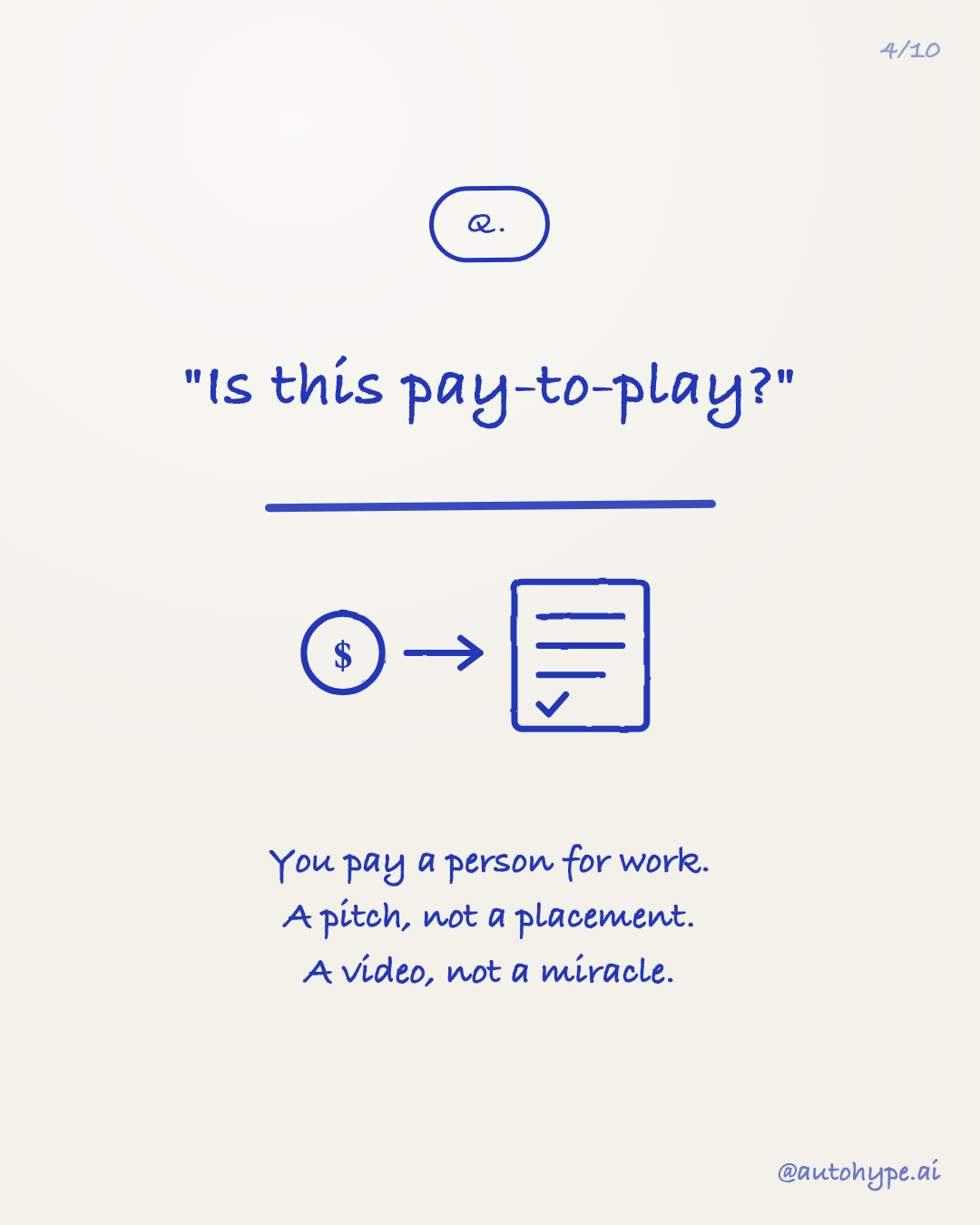
"Is this pay-to-play?" — You pay a person for work.
Fair question, because the phrase covers two completely different things. Paying for outcomes that are supposed to be earned — chart positions, editorial placements, rigged spins — is the sleazy kind, and mostly the fictional kind: editorial playlist access, for instance, cannot be bought from anyone, and everyone selling it is lying.
Paying a person for their labor is the other thing, also known as: the economy. A creator spends hours making a video with your song. A curator spends real time listening to and evaluating your pitch for their own playlist. A blogger writes an actual article. You pay for a pitch, not a placement; a video, not a miracle. The work is guaranteed. The outcome is earned or it isn't.
The line to hold: if you're buying effort, it's promotion. If you're buying a result that's supposed to come from listeners' free choices, someone is defrauding either you or the audience — usually both.
Compare Instagram repost campaigns and independent Spotify curator submissions. See which format fits your release, the deliverables, service fees and terms before ordering. No guaranteed views, streams or playlist placement.
"What if the seller ghosts me? What if the work is bad?" — Then they don't get paid.
On a pay-per-order marketplace, ghosting has a structural answer, not a customer-service one: money is released on delivery. Your payment sits in escrow, the seller sees it's real, and they collect it when the work ships. Deadline passes with nothing delivered? Automatic refund. Ghosts work for free here, which is why they work elsewhere.
Quality has a structural answer too: every seller wears their reviews in public, written by artists who actually ordered. Read them before you order — really read them, it takes two minutes. Consistently bad work collects consistently bad reviews, and sellers who can't deliver stop getting orders. Bad work doesn't survive in the open. Bad sellers either.
Notice what both answers have in common: neither asks you to believe anyone. The escrow doesn't care about anyone's intentions, and the reviews weren't written by the seller. Systems, not promises.
"Do you guarantee results? Why should I trust you?" — Delivery. And don't.
We guarantee delivery, not results. The video gets made, the pitch gets heard, the post goes live — by the deadline, or your money comes back automatically. That's a real guarantee about things a seller actually controls. Results — streams, saves, new fans — depend on how real listeners react to your song. That part was always yours. Anyone who claims otherwise is back at question one, selling bots.
As for trust: don't. Seriously. Trust is what got you scammed last time. Trust the written price instead — it can't quietly change. Trust the delivery date — it either passes or it doesn't. Trust the refund policy and the escrow — they execute regardless of anyone's mood. Trust reviews from strangers with no stake in your order.
A structure that works when nobody trusts anybody is the only structure worth paying into. Sellers who ask for your faith are asking precisely because they've given you no mechanism.
When paid promotion does NOT work — the answer no seller volunteers
Paid promo fails predictably in a few situations, and you should know them before spending. One: the song isn't ready — rough mix, no mastering, or you already know it's not your best. Promotion is an amplifier; it multiplies what's there, and it multiplies zero perfectly. Two: there's nowhere for new listeners to land — no other releases, dead profiles, no way to become a fan even if the video hits. You paid for a door into an empty room.
Three: the mismatch problem — a metal track pitched to lo-fi playlists, a creator whose audience has zero overlap with your genre. Read the seller's audience and playlist before ordering; relevance beats size, every time. Four: expecting one $20 order to change your life. One video is a test, not a career. The artists who get real value treat small orders as experiments: try, read the reaction, adjust, repeat what worked.
And five, the human one: spending money you can't afford to lose. Even honest promotion is a bet on audience reaction — delivery is certain, outcomes are not. If losing the stake would hurt, the stake is too big. Floors on AutoHype start at $10-$20 precisely so the experiments can stay cheap; the $10 playlist pitch (real, listed prices as of July 2026) exists so that finding out is never a financial event.
"Is my song even good enough?" — We don't know. Neither do you.
This is the question under all the other questions, and here's the only honest answer anyone can give you: we don't know. Neither do you — until people hear it. Not your producer, not your friends, not a paid "expert reviewer", and definitely not a stranger in your DMs with a rocket emoji. The audience is the answer key, and there is no way to peek.
That reframes what a small promo order actually buys: information. Twenty dollars puts your song in front of a real slice of real listeners and shows you what they do — skip, save, follow, replay, nothing. Whatever comes back, you know something true about the song that no amount of theorizing in your bedroom could tell you. Cheap truth is the best product in music promotion, and almost nobody markets it.
So: no more questions? Good. One small order answers most of them better than another month of wondering. The song in your drafts isn't getting any more finished — and the honest sellers, unlike the DM guys, will still be here at the same written price tomorrow.
Choose the next step for your release.
Compare Instagram repost campaigns and independent Spotify curator submissions. See which format fits your release, the deliverables, service fees and terms before ordering. No guaranteed views, streams or playlist placement.
Compare artist campaigns →Frequently asked questions
Does paid music promotion actually work?
It works at what it actually is: paying real people for real work — a creator's video, a curator's listen, a blogger's article — that puts your song in front of humans who'd never hear it otherwise. It does not work as a virality machine or a shortcut past the audience's opinion. Delivery can be guaranteed; results depend on how listeners react to your song, and no honest seller claims otherwise.
How much should I spend on my first music promotion?
Start at the floor, not the ceiling: single services from real sellers start around $10-$20 (playlist pitches from $10, TikTok videos from $20, as listed in July 2026). Treat the first order as an experiment that buys information about how real listeners react. Scale up only on evidence — repeat what worked, drop what didn't.
When should I NOT pay for music promotion?
When the song isn't finished or isn't your best; when new listeners would land on an empty profile with nothing else to hear; when the seller's audience doesn't match your genre; when you're spending money you can't afford to lose; and always when the offer guarantees streams, followers or virality — that last one isn't promotion, it's bots.
What results can I realistically expect from a $20 promotion order?
Guaranteed: the work itself — a real video posted, a real pitch reviewed, delivered by the deadline or automatically refunded. Realistic but not guaranteed: some genuine listens from a real audience and honest data on how strangers react to your track. Not realistic: a guaranteed number of anything. One order is a test; the value compounds when you run several and follow the evidence.