Every industry has jargon, but music promotion jargon is special: it's load-bearing. Remove the fog from words like "exposure", "guaranteed" and "viral", and half the offers in your DMs collapse on the spot, because the vagueness was the product. Scams don't survive contact with precise language — which is exactly why nobody selling one will ever define their terms. So here's the dictionary they'd rather you didn't own. Each entry: the word, its official-sounding usage, its actual definition, and — the part that pays for itself — what to say when someone serves it to you. Learn these and you become a genuinely terrible customer for bad promo. That's the goal. Welcome to Vol. 1.
Why the jargon exists at all
Precise offers can be compared, checked and refused. Vague offers can only be felt. That's the entire function of promo-speak: replace checkable claims ("I will make one video, posted on this account, by Friday, for $20") with unfalsifiable vibes ("we'll push your track to our network for maximum exposure"). You can't dispute a vibe. You can't refund one either.
Notice the direction of the fog: it always thickens around the two things you most need to know — what exactly you get, and what exactly it costs. Everything else in the pitch can be crisp: your genre, their enthusiasm, the deadline pressure. When only the deliverable and the price are blurry, the blur is the business model.
The defense isn't cynicism, it's translation. Every term below has a real meaning hiding under the shiny one. Read the real one, memorize the reply, and the word stops working on you.
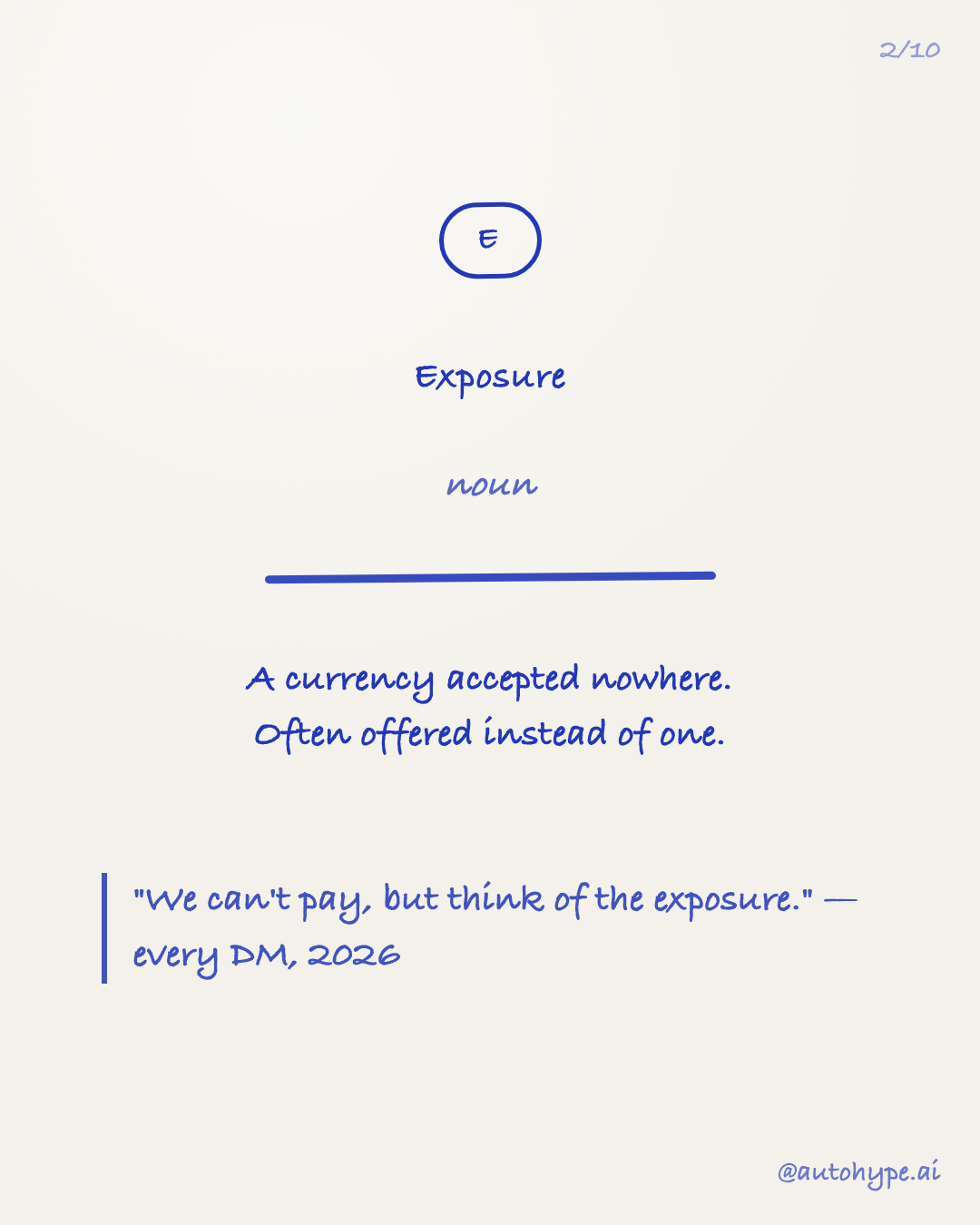
Exposure (n.) — a currency accepted nowhere
Official usage: "We can't pay, but think of the exposure." Actual definition: working for free while the other party gets paid, gift-wrapped as opportunity. Exposure is a currency accepted nowhere — often offered instead of one. Your distributor doesn't take it. Neither does rent.
To be fair to the word: visibility can have real value, when the audience is large, relevant and verifiable, and when you decided the trade was worth it. The scam version skips all three checks and adds urgency — the audience is always "huge", never shown, and the offer always expires soon.
How to respond when served: "What are the money terms?" Five words, complete sentence. If the answer contains a number, you have a negotiation. If it contains the word "exposure" again, you have your answer.
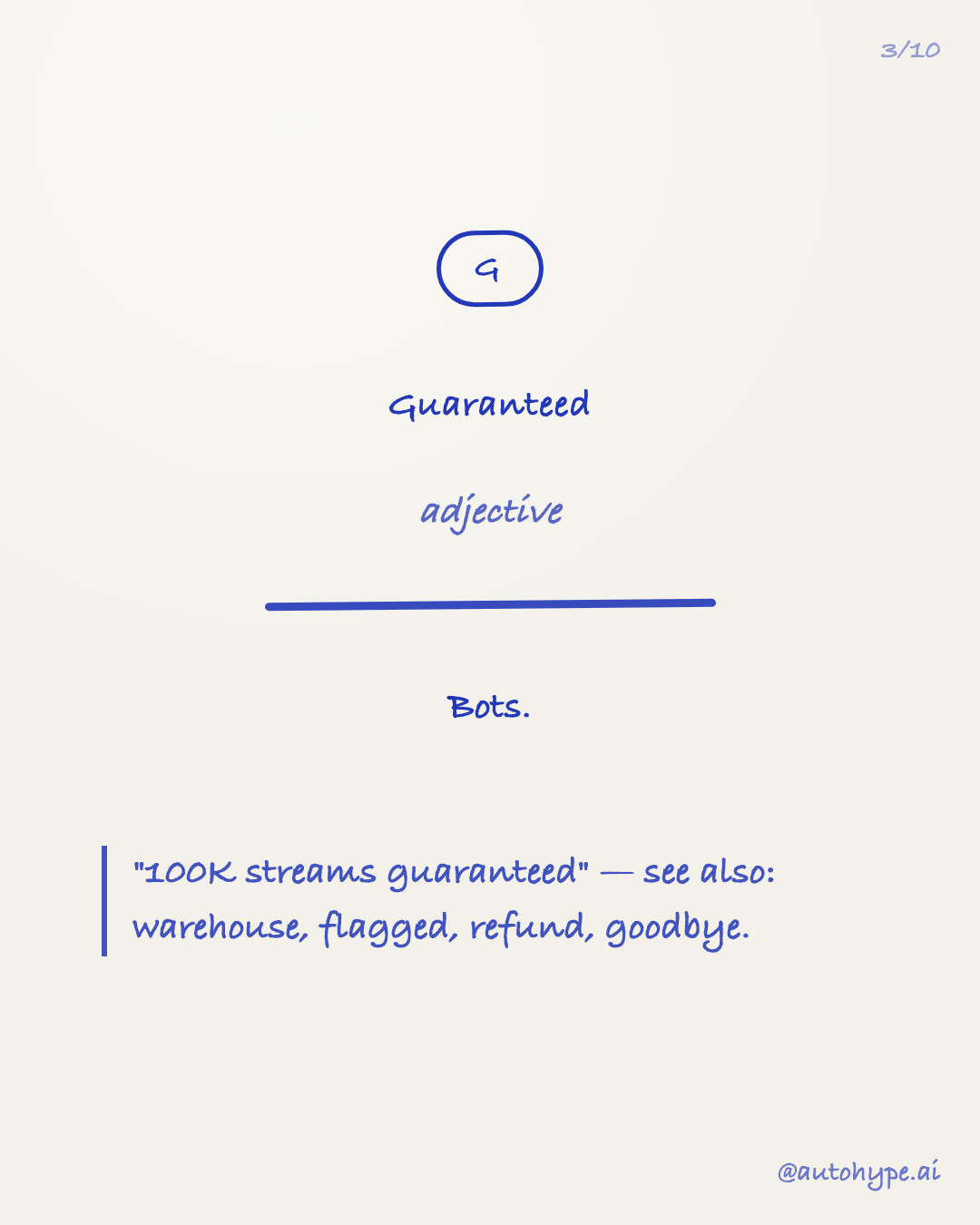
Guaranteed (adj.) — bots
The shortest definition in the dictionary, and the most reliable. "100K streams guaranteed" — see also: warehouse, flagged, refund, goodbye. A guarantee is a promise about the future, and nobody can promise the behavior of thousands of human strangers. The only crowd that follows a script is, literally, a script.
The word survives because it answers the question artists actually have — "will this work?" — with the answer they want. Honest sellers can't answer that question, and the gap between honest uncertainty and dishonest certainty is where every bot package on earth is sold.
How to respond when served: "Guaranteed by whom, doing what?" There's exactly one honest answer available: the seller guarantees their own work — made, shipped, on time, refunded otherwise. We guarantee delivery, not results. Anything guaranteeing the audience's reaction is selling you the warehouse.
Compare Instagram repost campaigns and independent Spotify curator submissions. See which format fits your release, the deliverables, service fees and terms before ordering. No guaranteed views, streams or playlist placement.
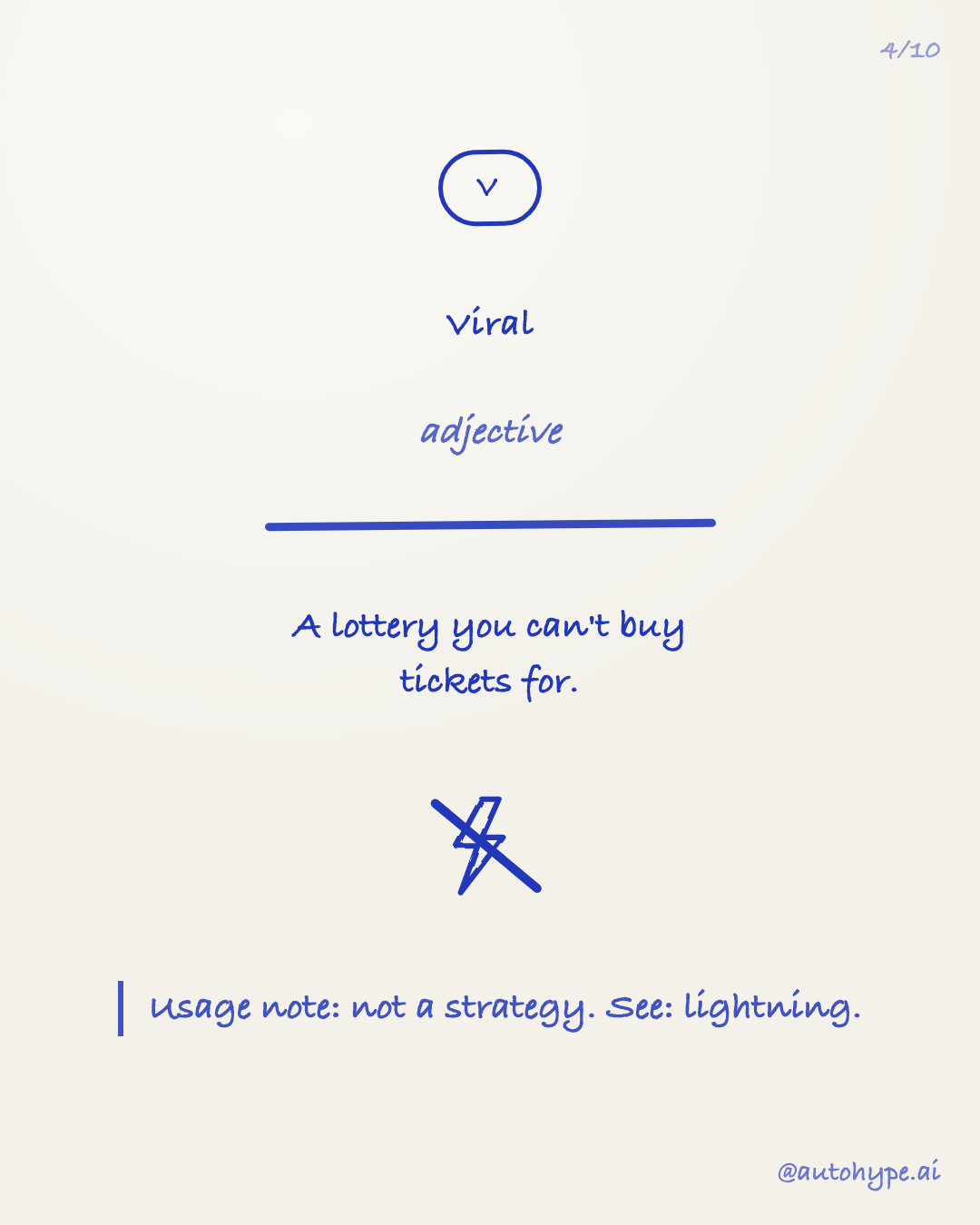
Viral (adj.) — a lottery you can't buy tickets for
Actual definition: an outcome, retroactively visible, never purchasable in advance. Usage note: not a strategy. Millions of well-made videos with great songs go nowhere; occasionally one explodes, and afterwards everyone constructs the reason. Selling "viral" is selling lightning; renting the word is free, which is why it's everywhere.
The trap isn't just buying fake virality — it's building your entire release plan around hitting the jackpot. Artists skip every reliable, boring, compounding move (consistent releases, real fans, small paid pushes that ship actual work) while waiting for the lottery numbers to hit. The lightning bolt on this entry is crossed out for a reason.
How to respond when served: "What's the mechanism?" A real seller describes work: a video made, a playlist pitched, a post published. A viral merchant describes outcomes with no path to them. Work can be bought. Weather cannot.
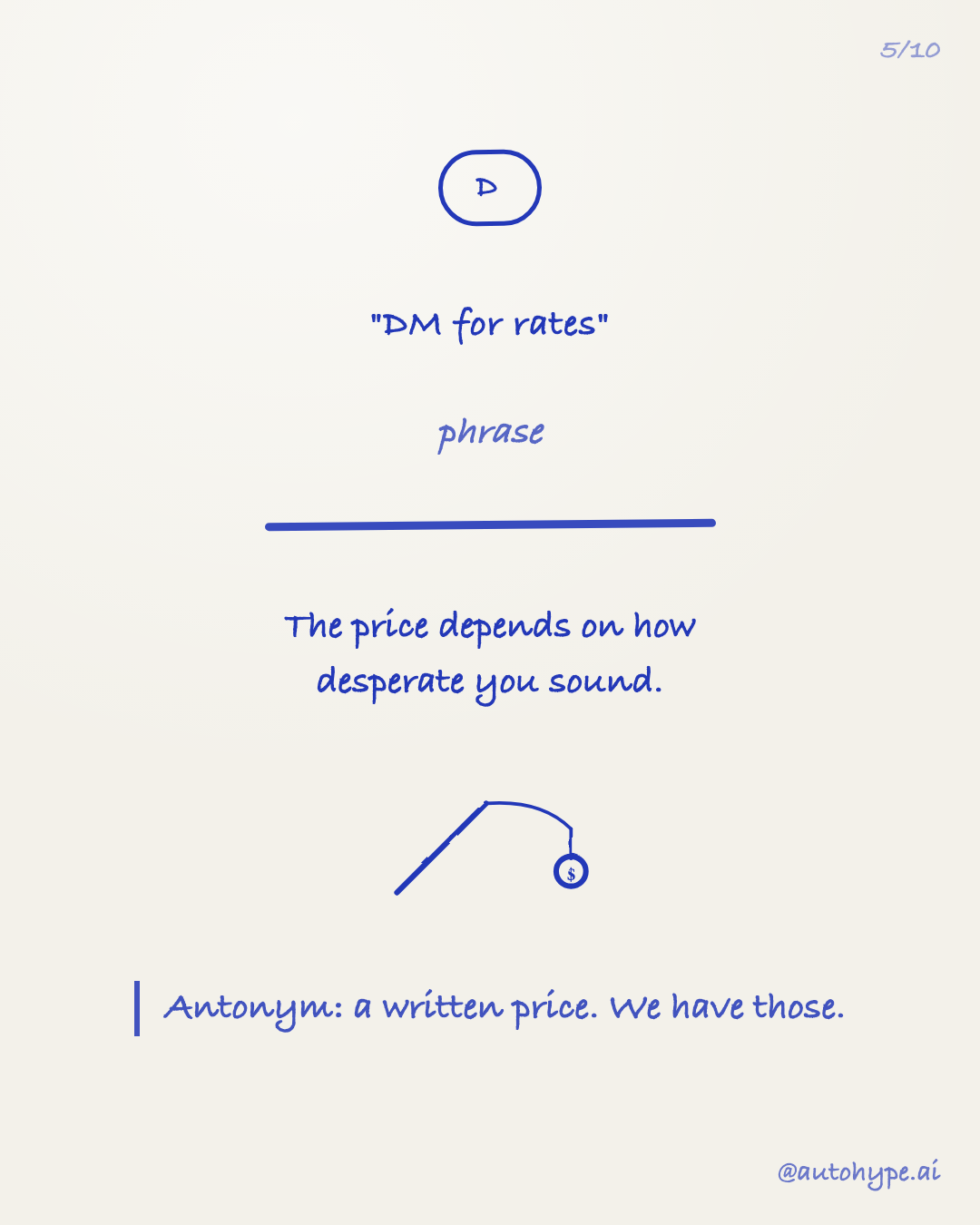
"DM for rates" (phrase) — the adjustable price
Actual definition: the price depends on how desperate you sound. A rate that lives only in private conversations is a rate that changes per customer, and the variable being measured is you — your eagerness, your inexperience, your budget, all read from your replies and priced accordingly.
Antonym: a written price. The two phrases describe opposite business models. A published rate says "the deal is the deal, for everyone." A DM-only rate says "the deal is whatever we think you'll pay" — which is why the fishing rod is this entry's official illustration.
How to respond when served: "Where are your public rates?" Then watch. A legitimate seller links a list in seconds, because it exists. Everything else — "depends on your needs", "let's hop on a call", "prices vary" — is the sound of a hook being baited.
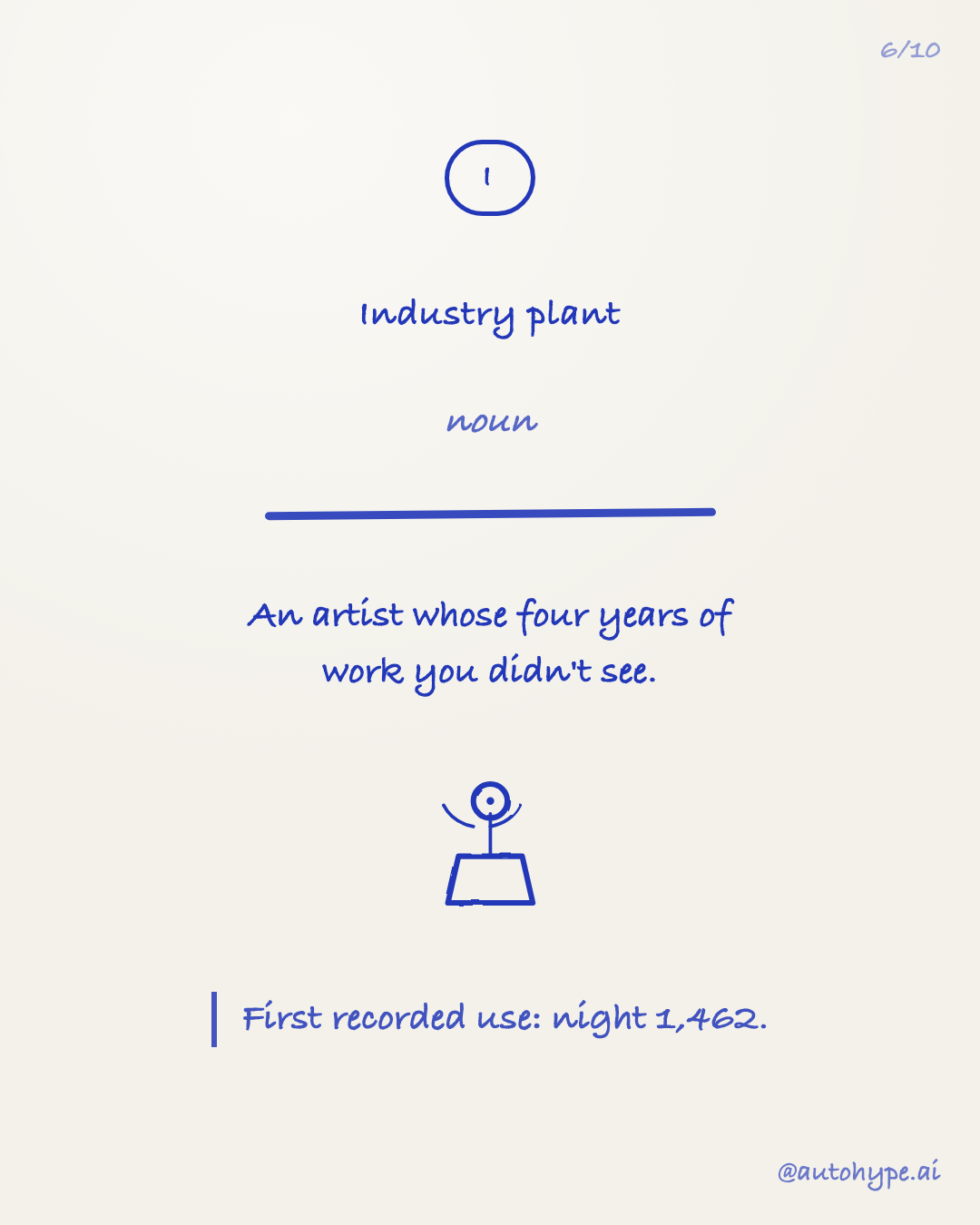
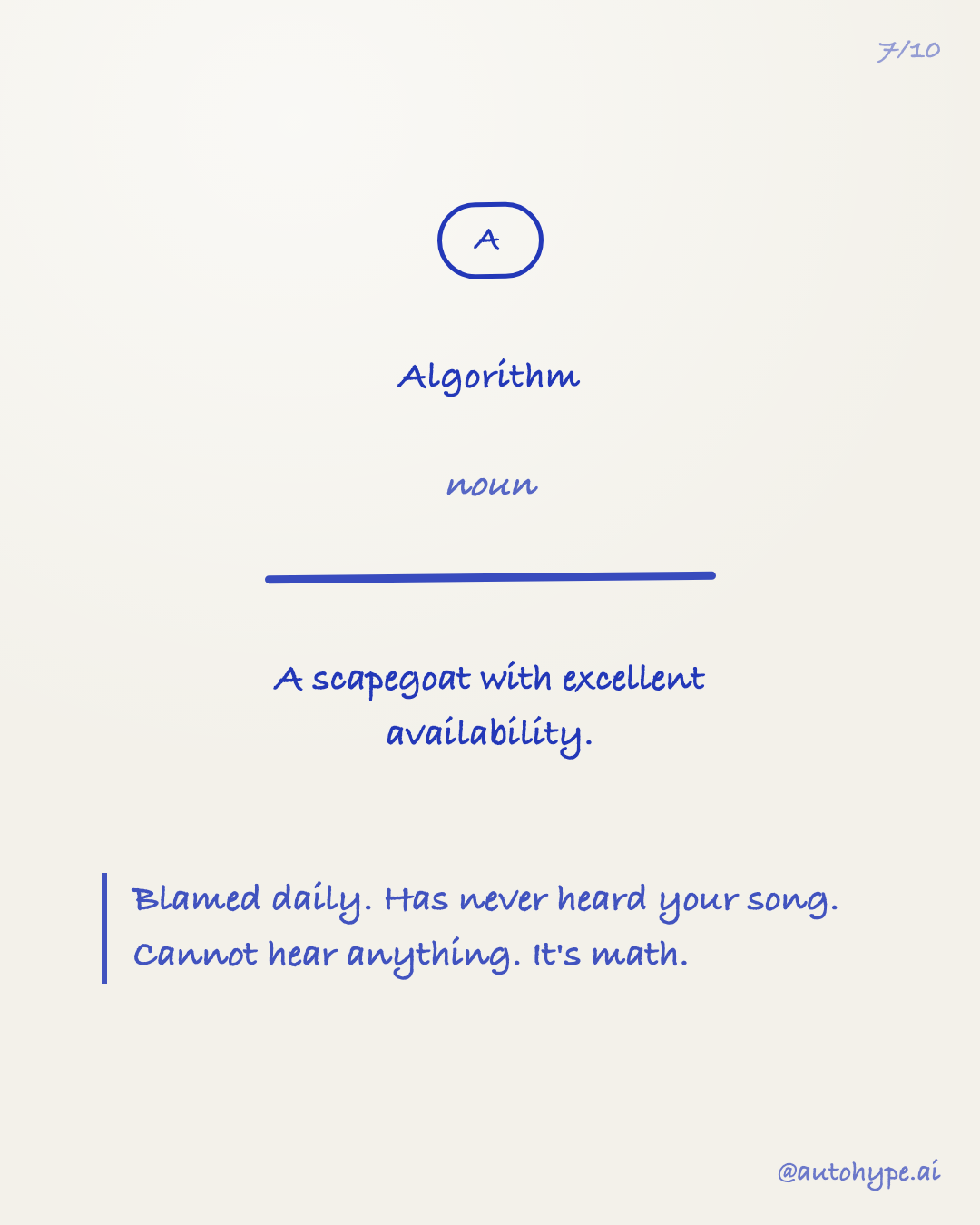
Industry plant (n.) & Algorithm (n.) — the two great scapegoats
Industry plant, actual definition: an artist whose four years of work you didn't see. The overnight success narrative is almost always a decade of drafts, day jobs and empty rooms, compressed by hindsight into a single lucky morning. The term mostly functions as anesthetic — if everyone who made it was planted, your own numbers stop being your problem.
Algorithm, actual definition: a scapegoat with excellent availability. Blamed daily; has never heard your song; cannot hear anything — it's math. Recommendation systems distribute music based on how real listeners respond to it. That's genuinely more uncomfortable than a villain, because it means the inputs are yours: the song, the consistency, the real humans who save it.
How to respond — mostly to yourself, since these two words are usually self-served: replace "the algorithm buried me" with "my track needs more real-listener signals" and suddenly there's a to-do list instead of a conspiracy. Scapegoats are comfortable. To-do lists pay better.
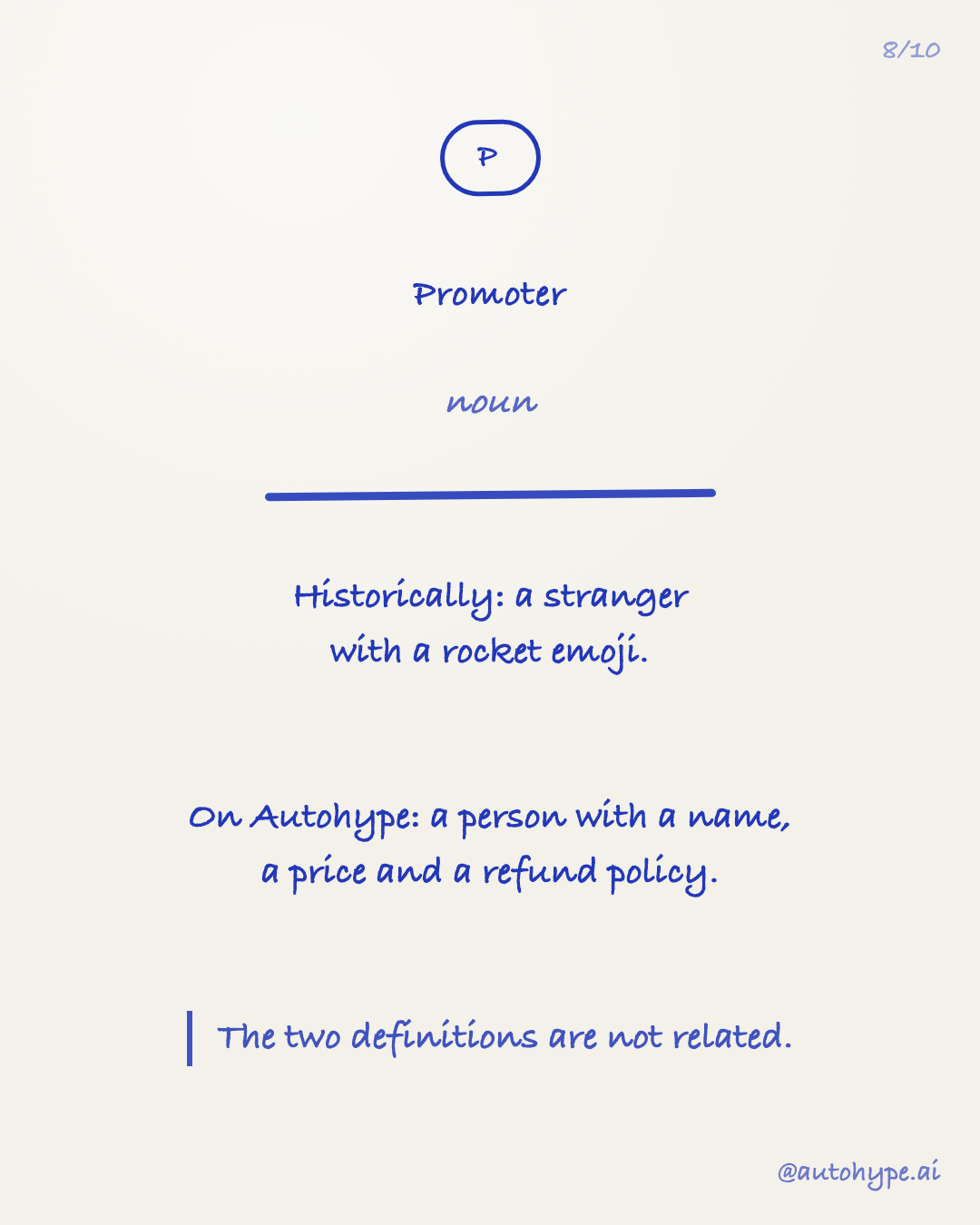
The words a real offer uses: Promoter, Delivery
Promoter (n.), historically: a stranger with a rocket emoji. On a pay-per-order marketplace like AutoHype: a person with a name, a price and a refund policy — a verified TikTok creator, playlist curator, DJ or blogger whose reviews are public and whose rates are written down (playlist pitches from $10, TikTok videos from $20, with 17 services under $20 as of July 2026, prices set by the sellers themselves). The two definitions are not related.
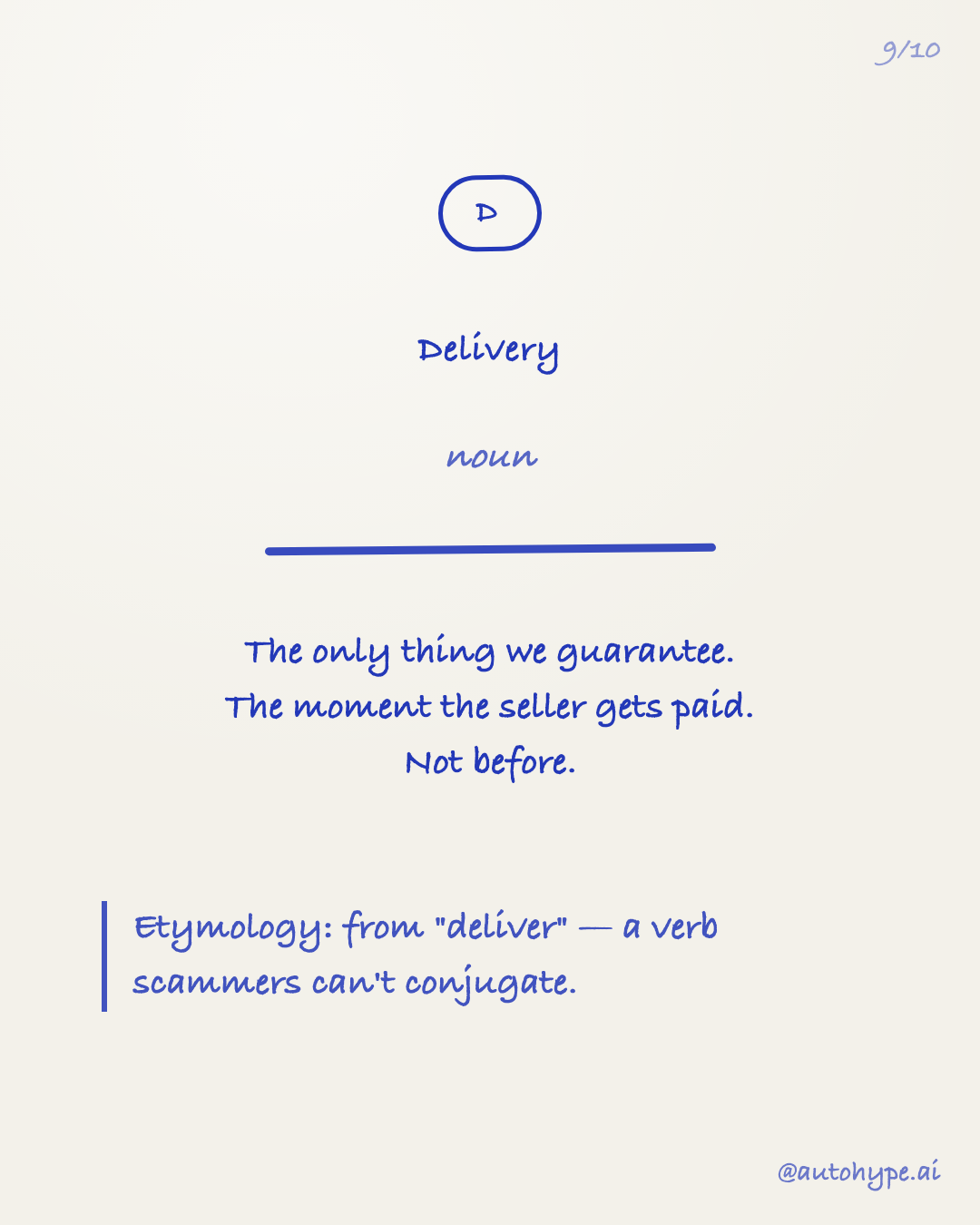
Delivery (n.): the only thing we guarantee. The moment the seller gets paid — not before. Money waits in escrow until the work ships; if nothing ships on time, it comes back to you automatically. Etymology: from "deliver", a verb scammers can't conjugate.
Use this pair as your vocabulary test for any offer, anywhere: can you name the person, read the price, and point to what happens if nothing ships? If all three answers are yes, you're reading a real offer. If any answer is a vibe — well. You own the dictionary now. Look it up.
Choose the next step for your release.
Compare Instagram repost campaigns and independent Spotify curator submissions. See which format fits your release, the deliverables, service fees and terms before ordering. No guaranteed views, streams or playlist placement.
Compare artist campaigns →Frequently asked questions
Is the word "guaranteed" always a scam in music promotion?
Depends what's being guaranteed. Guaranteed work — a video made, a pitch sent, delivered by a deadline, refunded otherwise — is a normal, honest commercial promise. Guaranteed results — any specific number of streams, followers or placements — can only be fulfilled by bots, because real listeners can't be pre-ordered. The grammar test: honest guarantees cover the seller's behavior, scams guarantee strangers' behavior.
What should I actually reply to "DM for rates"?
Ask one question: "Where are your public rates?" A legitimate seller links a written price list immediately. Deflection — 'depends on the project', 'let's discuss' — means the price will be calculated from your apparent desperation. You're allowed to just leave; a hidden price is itself the information.
Is exposure ever actually worth it?
Occasionally — when the audience is real, large, relevant to your genre, and verifiable, and you concluded the trade beats a fee. That's a deal you evaluate with numbers, not a favor you accept with gratitude. Rule of thumb: if 'exposure' is offered before any specifics about the audience, it's the unpaid-work version, not the deal version.
What terms should appear in a legitimate promotion offer?
A named person you can verify, a written final price, a concrete deliverable (which video, which playlist, which post), a delivery date, and refund terms if nothing ships. Bonus signal: public reviews from other artists. Every one of those is checkable — which is exactly why scam offers contain none of them.