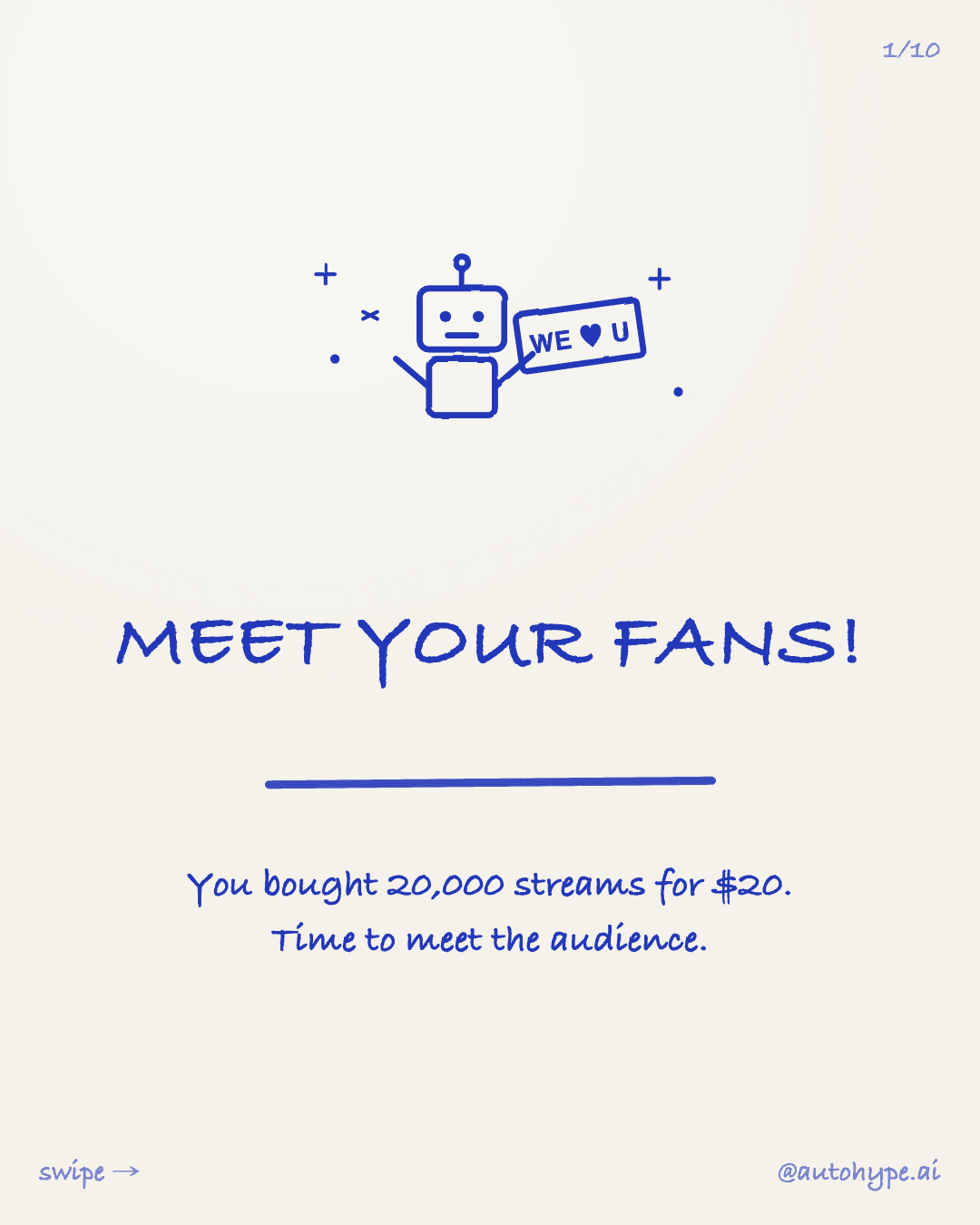
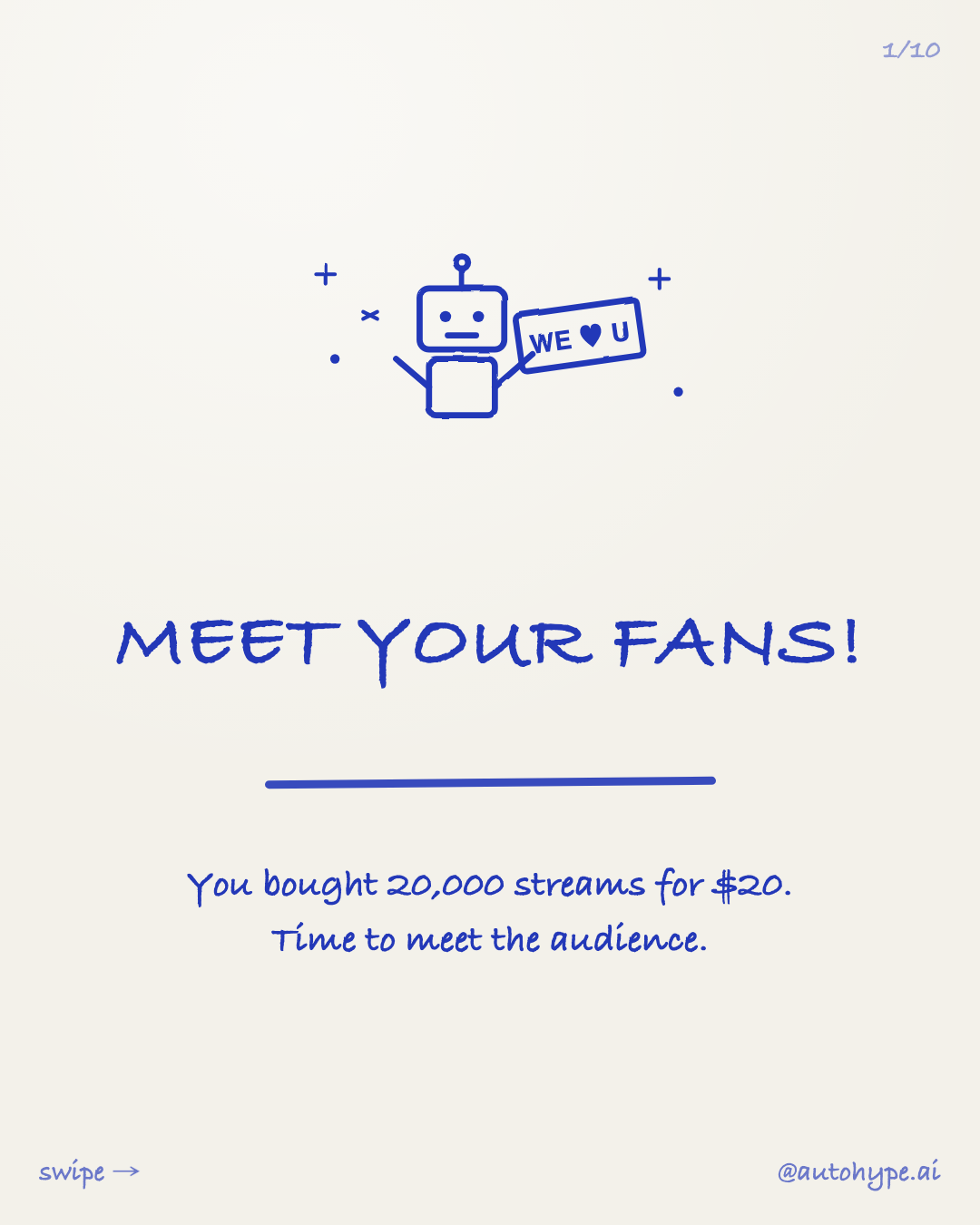
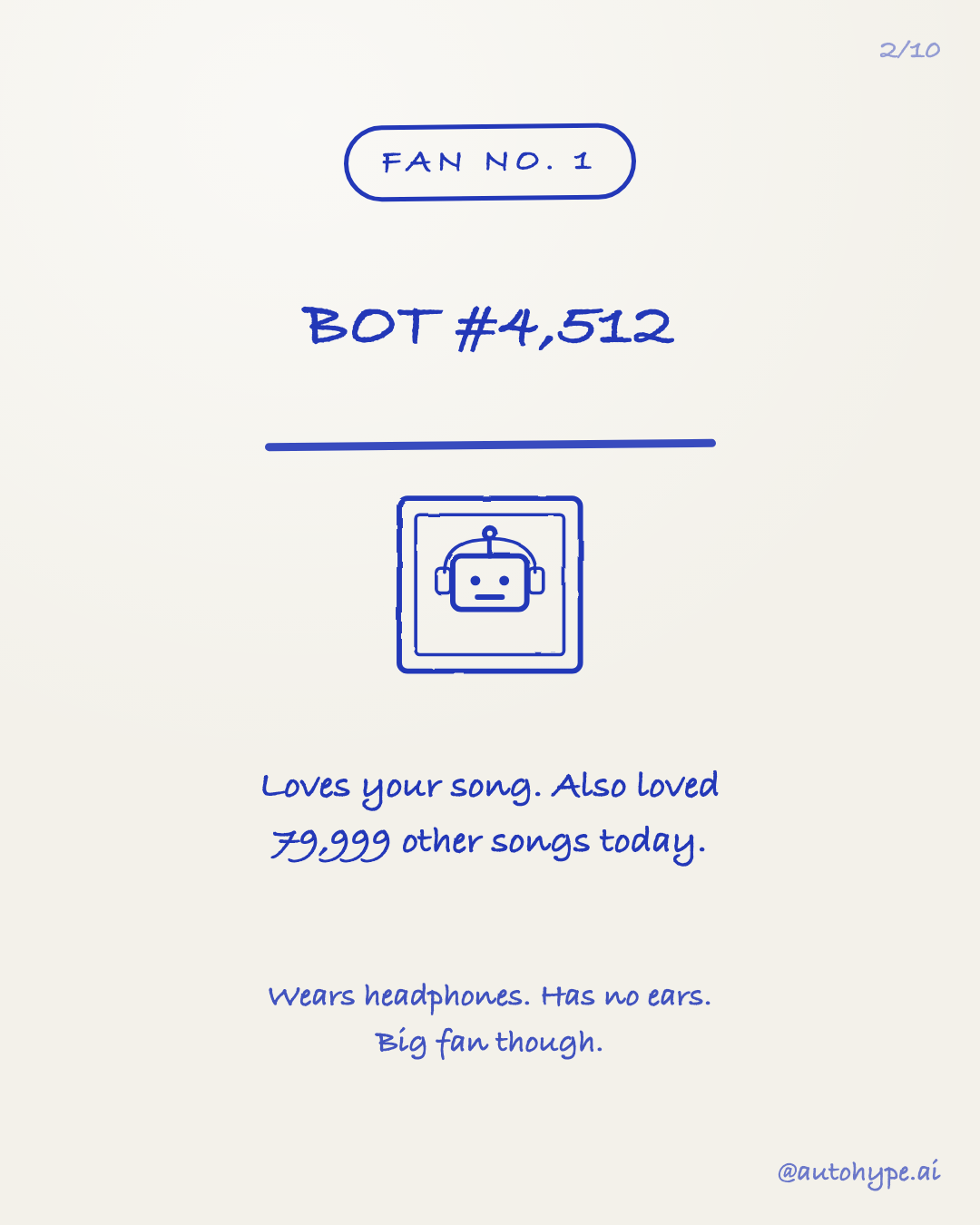
Congratulations on your purchase! You bought 20,000 streams for $20, and it's time to meet your new audience. There's Bot #4,512, who loved your song today along with 79,999 others. There's Server Rack B, your most loyal listener, streaming you around the clock from a warehouse with excellent air conditioning. And there's Emma_Music_Lover_88293, who joined Tuesday, followed 4,000 artists Wednesday, and was deleted Thursday. You two were so close. The fan-magazine tour is a joke; the mechanics underneath it are not. When you buy streams, this is literally — not figuratively — what you're buying. This article walks the farm floor: who "listens" when you pay for streams, why the math cannot work any other way, what streaming platforms do when they find out (they find out), and what the same $20 buys when you spend it on a heartbeat instead.

Who's actually listening: a staff directory
A stream farm is exactly what the name says: racks of devices or virtual machines in a warehouse, each running scripts that open songs, play them just long enough to register, and move on. One operation "listens" to tens of thousands of tracks a day. Your song isn't being heard; it's being processed, in a queue, between a phonk beat and someone's meditation album.
The more sophisticated farms decorate the bots with fake profiles — a name, a default avatar, a burst of activity to look human at a glance. But the lifecycle gives them away: created in batches, hyperactive for a few days (following thousands of artists, streaming around the clock), then wiped when platforms sweep. Your "new fan" has a shorter lifespan than your Instagram story.
The one thing no bot has ever done: cared. It wears headphones and has no ears. It cannot save your song, tell a friend, come to a show, or buy a shirt. Every downstream thing you actually wanted from an audience is structurally impossible for the audience you bought.
The math that makes it bots, every time
You don't need insider knowledge to know a $20-for-20,000-streams package is fake — you need division. That's a tenth of a cent per stream. No seller can pay real humans to give your song three minutes of genuine attention at that price and survive. The only "listener" that cheap is a script, because a script's attention costs nothing and is worth exactly that.
Run the same math from the seller's side and it gets uglier: streaming payouts per play are fractions of a cent, so farms sometimes even pitch stream-buying as "profitable." If that loop actually worked, the seller would run it on their own tracks and keep the money. They sell shovels because there's no gold.
This arithmetic is the universal detector, and it works on every package regardless of what the label says. "Real people, organic, high-retention" — the description is marketing; the price-per-stream is testimony. If real human attention can't possibly cost that little, it isn't real human attention.
Plot twist: the platforms met your fans too
Streaming platforms run detection on exactly the patterns farms produce: identical play durations, synchronized behavior, clusters of accounts with no saves, no playlists, no history, streaming in perfect unison from suspicious infrastructure. The listening party where 20,000 attendees do the wave in perfect sync is easy to spot precisely because nothing human is ever that tidy.
What happens next is standard industry practice across platforms: artificial streams get wiped from your counts, associated royalties get withheld or reversed, and repeat offenses can get tracks removed or accounts penalized — distributors enforce this too, and some will drop an artist over it. "But I didn't know the streams were fake" is a hard defense when the purchase is in your inbox.
So here's the final bill, itemized: royalties — reversed. Playlist chances — burned. Your $20 — gone. The bots' opinion of your song — none; they never had one. Bots are the only promo where losing is guaranteed. Finally, a real guarantee.
Compare Instagram repost campaigns and independent Spotify curator submissions. See which format fits your release, the deliverables, service fees and terms before ordering. No guaranteed views, streams or playlist placement.
The hidden cost: you poisoned your own data
The subtler damage is what fake streams teach the recommendation systems. Streaming platforms decide who to show your music to by studying who already listens: their tastes, their playlists, what they play next. Feed that system 20,000 accounts with no taste, no history and no behavior, and you've taught it that your audience is... nobody, located nowhere, who likes nothing.
That's why bought streams don't just fail to help — they actively bury you. Your real potential fans get harder to find because the signal pointing toward them is drowned in noise. You paid to make your own discovery data worthless.
It leaks into human decisions too. Curators, bookers, labels and playlist editors read profiles for a living, and 20,000 streams next to 12 followers and zero saves reads like a fire alarm. The numbers you bought to look bigger are the exact numbers that make professionals close the tab.
What "real people" actually means
Every stream seller on earth claims "real people." Since the words are free, here's what they concretely mean when true: a person with a name and a face, whose audience chose to follow them, doing visible work you can inspect — a video on their actual account, a pitch to a playlist they actually run, a post their actual followers will see.
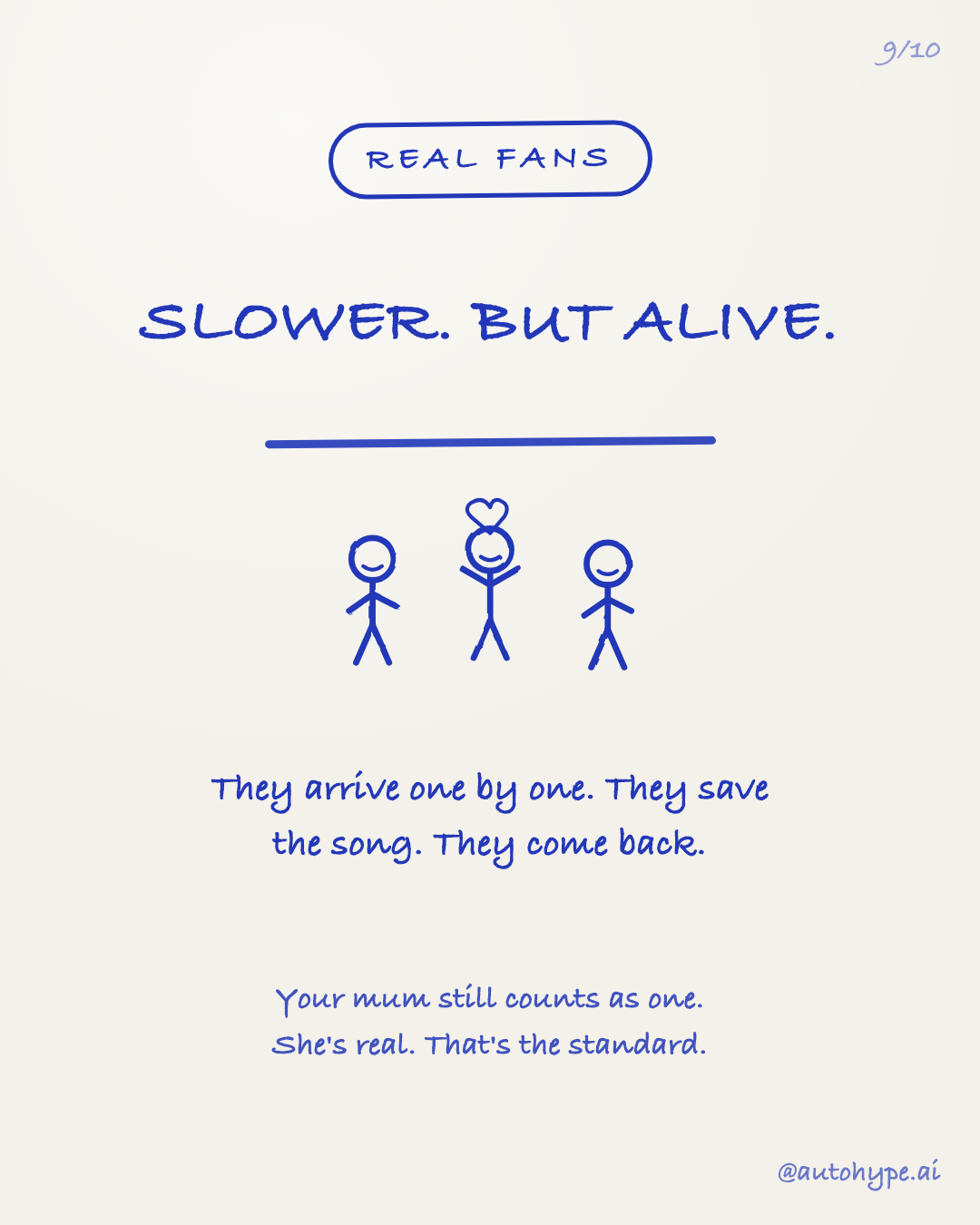
Real audiences also behave in ways farms can't fake: unevenly. They arrive one by one. Some skip after ten seconds, a few save the song, one adds it to a gym playlist, someone comes back on Thursday. It's slower and messier than a graph of bought streams — and it's the only pattern that compounds, because platforms read those signals as "humans like this" and show your song to more humans.
Your mum still counts as one of them, by the way. She's real. That's the standard — a heartbeat, not a headcount.
Same $20, different universe
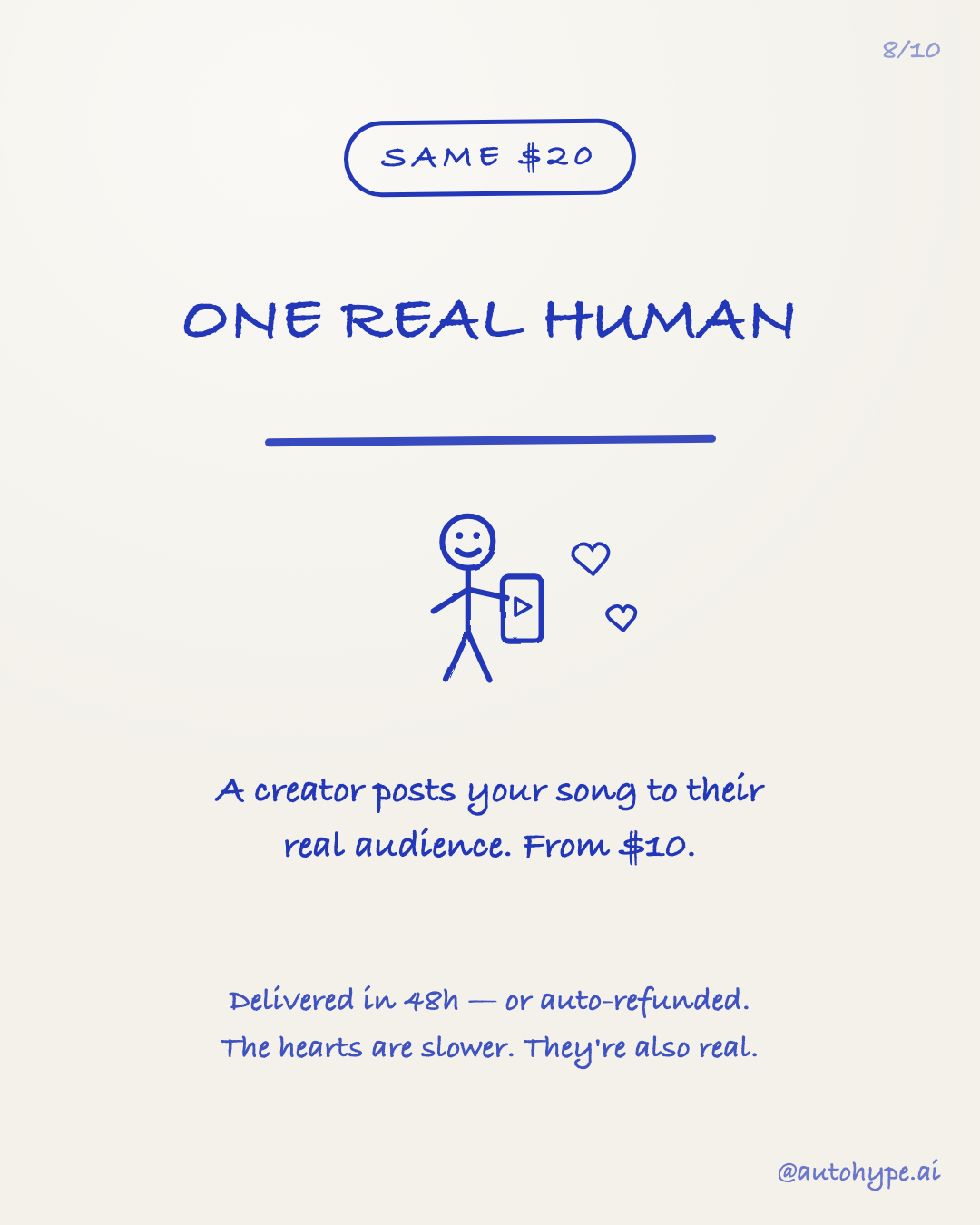
Here's the same banknote spent on the other side of the wall: on a pay-per-order marketplace like AutoHype, $20 hires an actual human — a TikTok or Instagram creator making a video with your song (from $20), a playlist curator reviewing your pitch (from $10), a YouTube or X account featuring your track (from $10). Prices are written and public, set by the sellers themselves; as of July 2026, 17 different services start under $20.
The structure is what makes it the opposite of the farm: your money sits in escrow and the seller gets paid on delivery — if nothing ships on time, you're refunded automatically. Every seller is verified and wears their reviews in public. We guarantee delivery, not results: a real human will really do the work, and what real listeners do next depends on your song. Nobody honest can promise more, and after this tour, you know exactly what the people promising more are running.
So: fire your robots. They won't take it personally. They can't.
Choose the next step for your release.
Compare Instagram repost campaigns and independent Spotify curator submissions. See which format fits your release, the deliverables, service fees and terms before ordering. No guaranteed views, streams or playlist placement.
Compare artist campaigns →Frequently asked questions
Can Spotify and other platforms really detect bought streams?
Yes. Farms produce statistically unmistakable patterns — synchronized plays, identical durations, accounts with no saves or history — and platforms invest heavily in catching exactly that. Standard consequences across the industry: artificial streams removed, royalties withheld or reversed, and possible track removal or distributor action for repeat cases.
I bought streams once. Is my artist profile ruined forever?
Usually not, if it stops there. Expect the fake numbers to be wiped, don't buy 'cleanup' services (that's a second scam), and rebuild with real signals — genuine listeners, saves and playlist adds. Platforms punish patterns of fraud far more harshly than a single historical mistake that stopped.
The package says "100% real users, no bots." How do I check?
Do the division first: if the price per stream is far below what a few minutes of real human attention could plausibly cost, the label is fiction. Then apply the identity test — real promotion names the humans doing the work and shows you where it happens (a creator's account, a curator's playlist). "Real users" with no names, no faces and no location is a bot farm with better copywriting.
What does legitimate paid promotion deliver, if not streams?
Work, from an identifiable person: a creator's video, a curator's genuine review of your pitch, a post to a real audience — with a written price, a delivery deadline and a refund if it doesn't ship. The audience's reaction belongs to the audience. That's the honest deal: delivery is guaranteed, results are earned.