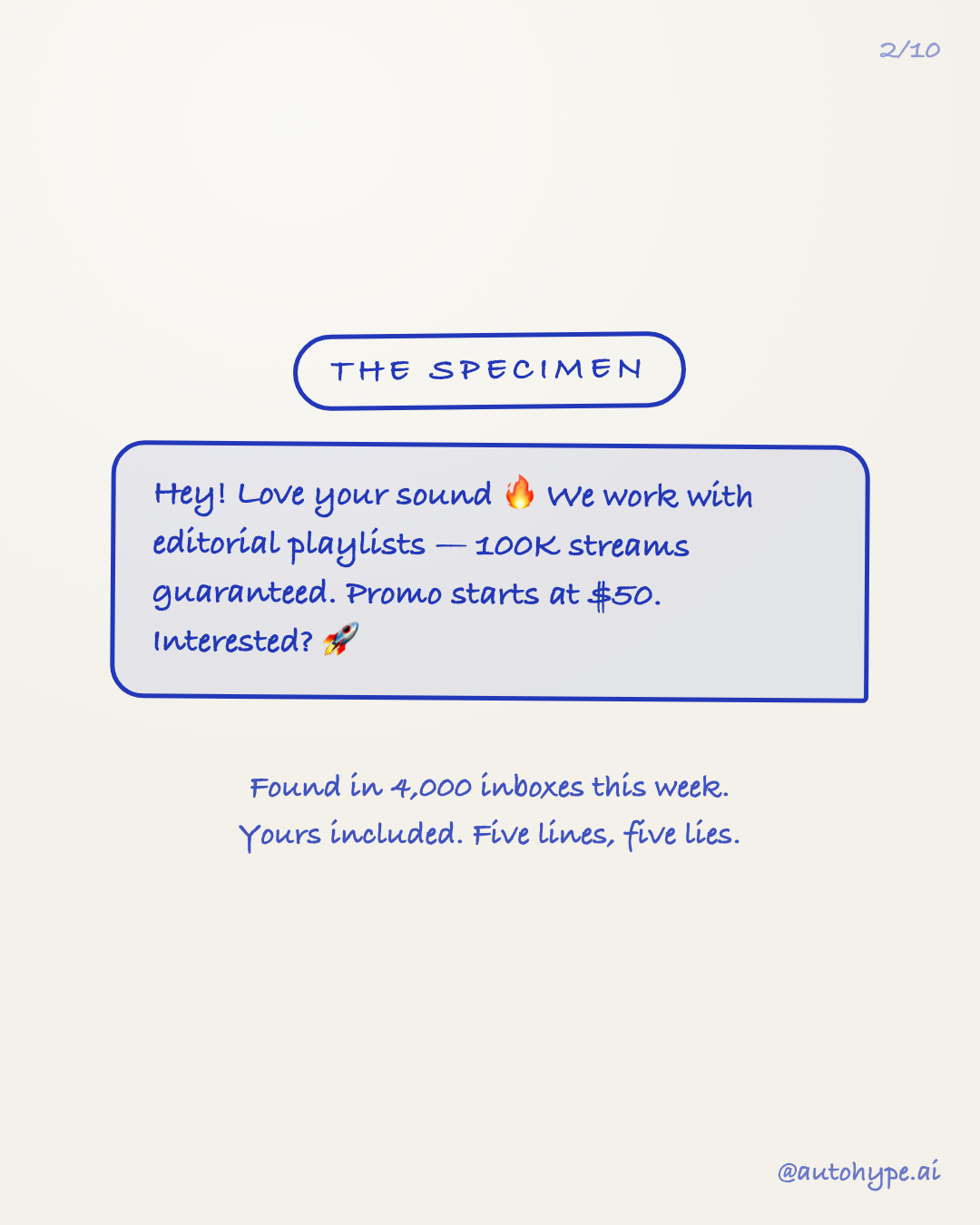
If you've released even one song, you've received it: "Hey! Love your sound 🔥 We work with editorial playlists — 100K streams guaranteed. Promo starts at $50. Interested? 🚀" The wording shifts a little from account to account, but the skeleton never changes. It's a template, blasted at thousands of artists a week, and it works often enough to keep coming. So let's put it on the table and open it up. The specimen below is a reconstructed archetype — not a screenshot of any real account — but you'll recognize every organ. Five lines, five lies, and each one exploits a specific weak spot in an artist's brain. By the end of this autopsy you'll be able to identify the species in under ten seconds, from the first sentence alone.
The specimen: five lines, five lies
Here it is in full: "Hey! Love your sound 🔥 We work with editorial playlists — 100K streams guaranteed. Promo starts at $50. Interested? 🚀" Twenty-two words. Every single one is doing a job, and none of those jobs is promoting your music.
Scam DMs are engineered like phishing emails: maximum emotional coverage, minimum verifiable detail. Notice what's missing before we look at what's there — no company name you can search, no portfolio, no reviews, no delivery date, no refund terms. The message is a vibe with a payment link attached.
The reason a line-by-line autopsy matters: once you understand the mechanism behind each sentence, the template stops working on you forever. Not just this DM — every future mutation of it. The species evolves its wording, never its skeleton.
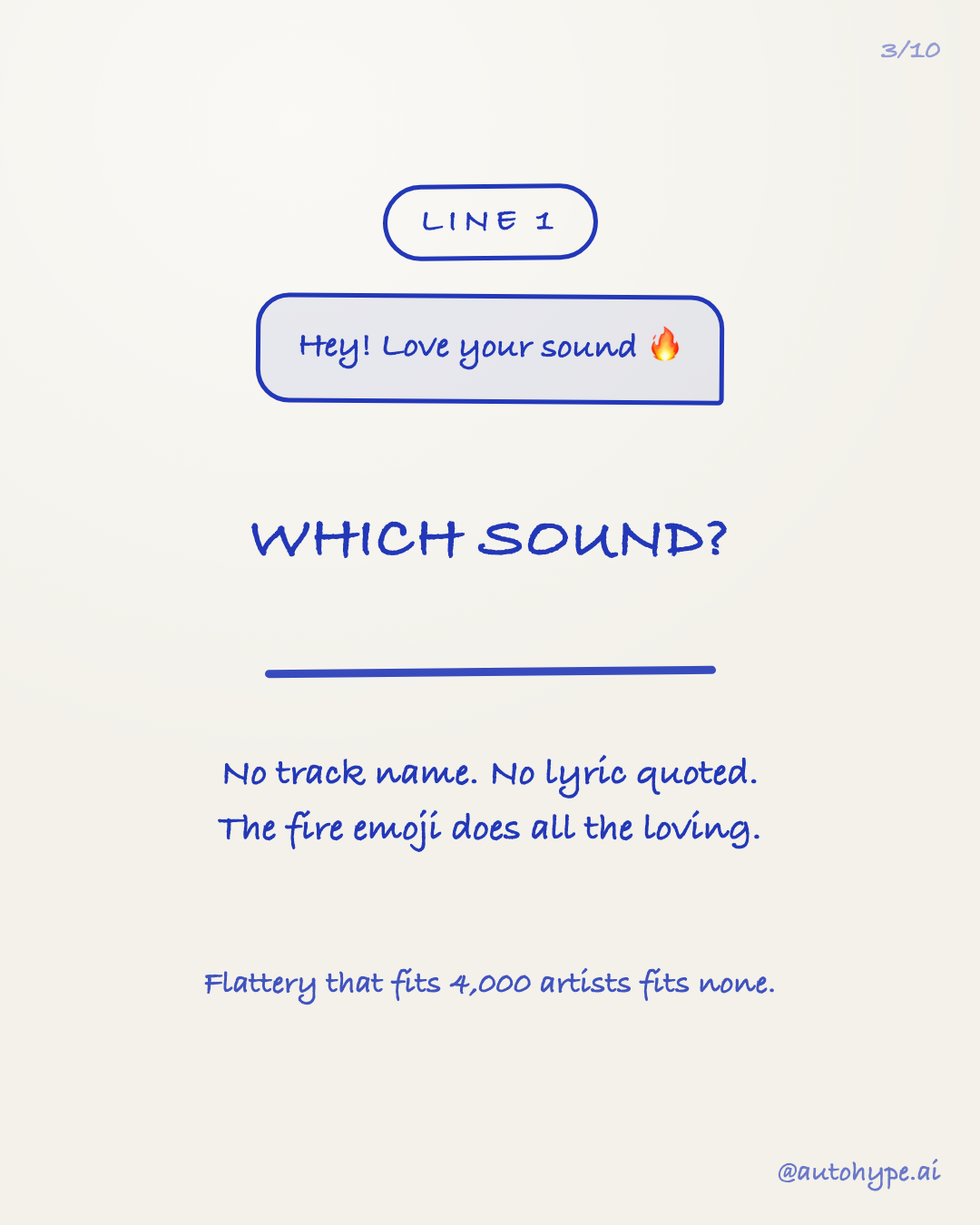
Line 1: "Hey! Love your sound 🔥" — flattery with no fingerprints
First question of the autopsy: which sound? No track name. No lyric quoted. No mention of your latest release, your genre, or anything a human who pressed play would know. The fire emoji is doing all of the loving.
The mechanism is cold-reading flattery — a compliment engineered to fit every artist on earth so it can be mass-sent to every artist on earth. It works because artists are starving for feedback. When you've released music into silence, "love your sound" lands like rain in a drought, and your critical brain takes a nap exactly when you need it.
The defense reflex: reply (mentally, not literally) with "which track?" Flattery that fits 4,000 artists fits none. A real fan quotes a lyric. A real curator names the song. A template names nothing, because the sender has heard nothing.
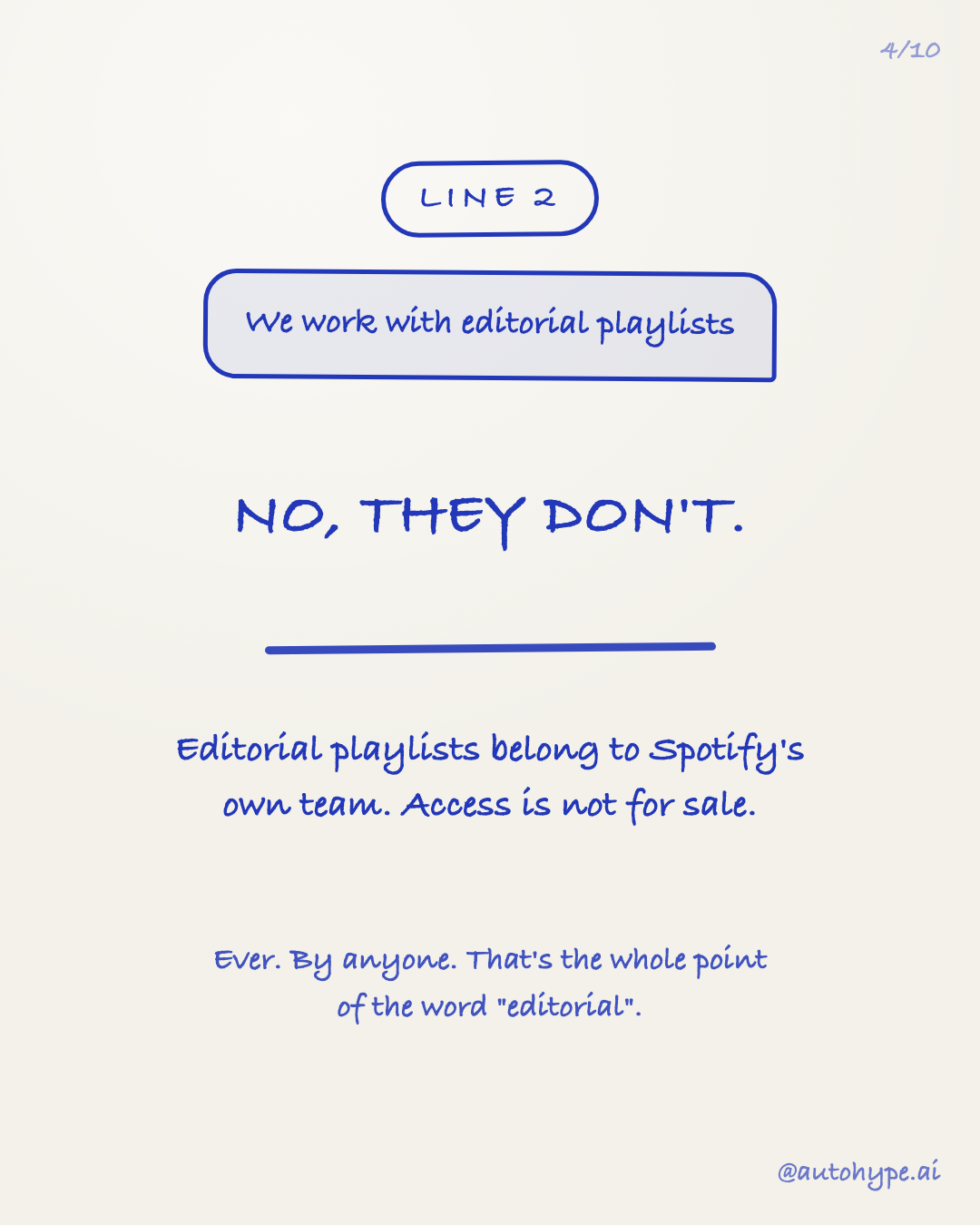
Line 2: "We work with editorial playlists" — the borrowed authority
No, they don't. This is the flat, boring, verifiable fact at the center of this entire scam economy: editorial playlists belong to the streaming platforms' own in-house teams. Access is not for sale. Ever. By anyone. That's the whole point of the word "editorial."
Anyone selling editorial placement is lying — not exaggerating, not overpromising, lying. There is no gray area here, no "well, some guys know a guy." The pitch works because it borrows the authority of a name you trust and sells you a fantasy of insider access, and because most artists have never been told, in plain words, that the door being sold does not exist.
The defense reflex: the moment anyone claims paid access to editorial playlists, the conversation is over. You don't need to check their reviews, their price, or their website. That one sentence is a full confession.
Line 3: "100K streams guaranteed" — the certainty machine
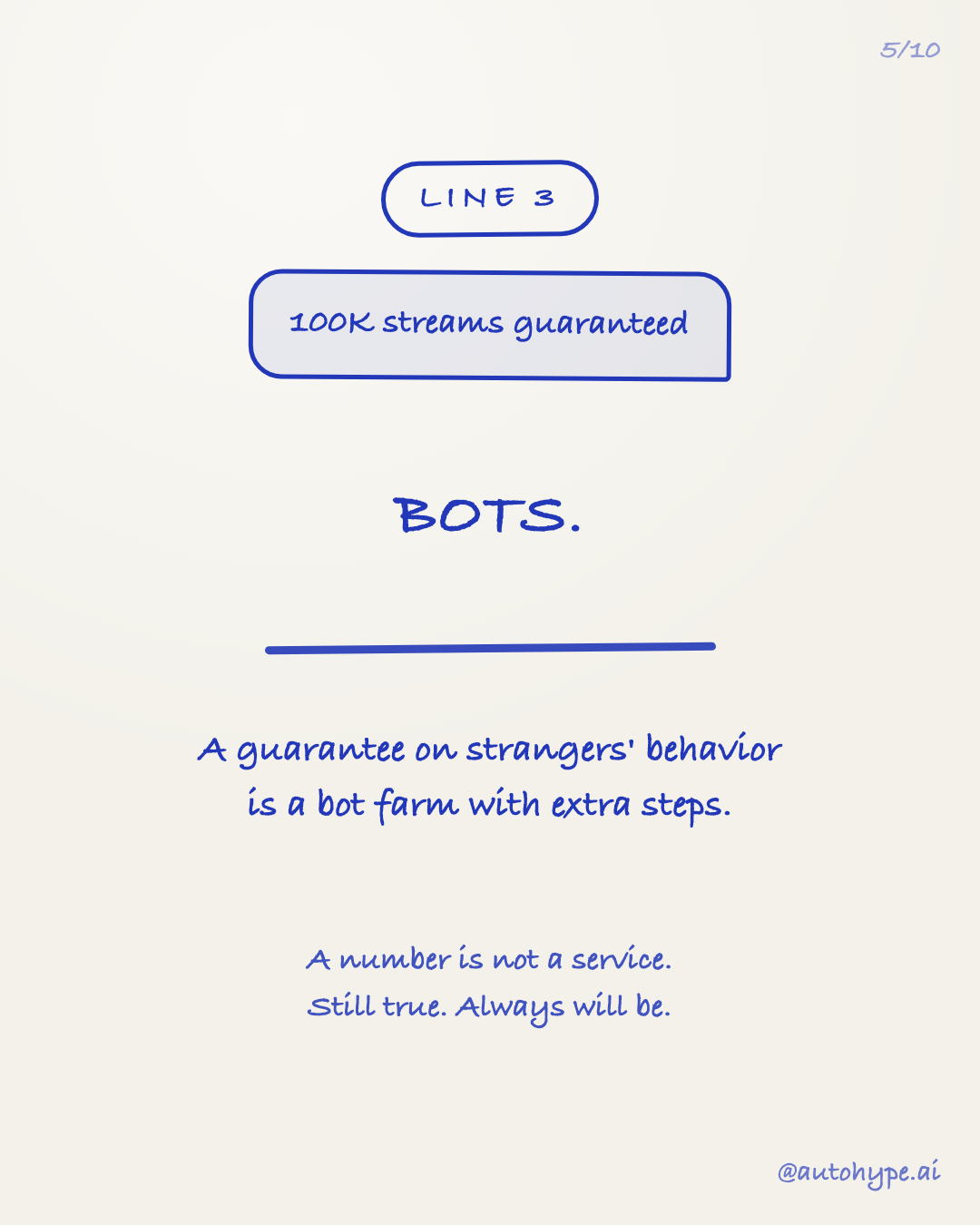
Nobody can guarantee what 100,000 strangers will do. Listeners are humans; humans don't take orders. The only "audience" that obeys a purchase order is a script running in a warehouse — which is why a guarantee on strangers' behavior is just a bot farm with extra steps.
This line works because certainty is the one product an exhausted artist wants most. You've done everything "right" and gotten silence, and here's someone selling you a number, in writing. But a number is not a service. Real promotion buys work — a video, a pitch, a post. What the audience does next was never for sale.
The defense reflex: guarantees attached to results (streams, followers, placements) mean bots, every time. The only thing an honest seller can guarantee is their own work. We guarantee delivery, not results — and anyone who guarantees more than that is describing a machine, not an audience.
Line 4: "Promo starts at $50" — the fishing rod
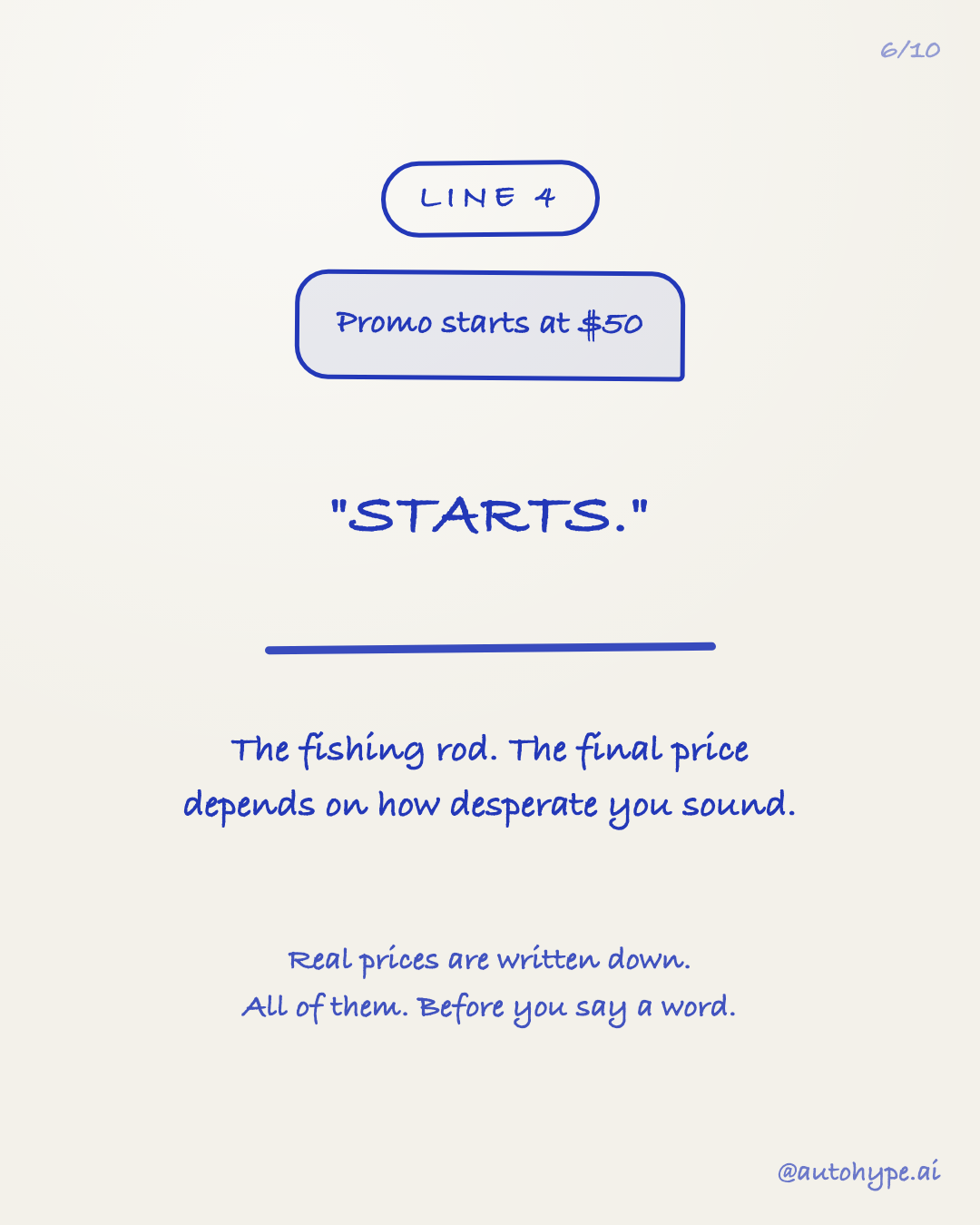
The load-bearing word is "starts." A starting price is a fishing rod: the hook is cheap, and the final price depends on how desperate you sound in the next five messages. Sound eager and the $50 package suddenly "isn't right for your goals" — but the $200 one is.
This is classic price anchoring plus a negotiation you don't know you've entered. The seller learns your budget from your replies and prices accordingly. That's why the rate isn't published anywhere: a written price would end the game before it starts.
The defense reflex: real prices are written down. All of them. Before you say a word. If you can't see the full price list without entering a conversation, the price list is you.
Line 5: "Interested? 🚀" — interested in what, exactly?
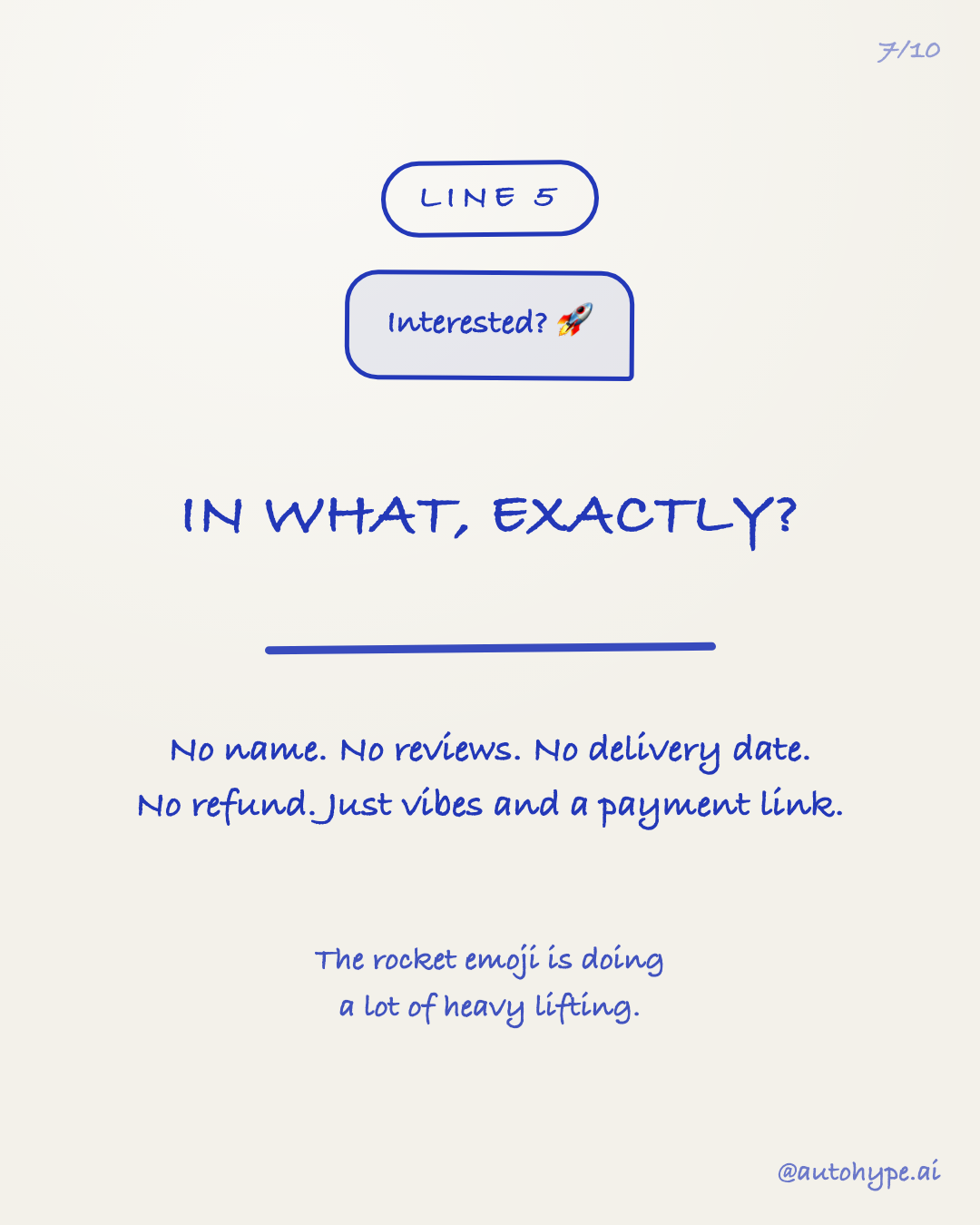
Read the close again and try to answer the question. Interested in... what? There's no named person behind the offer, no reviews, no delivery date, no refund policy. The rocket emoji is doing a lot of heavy lifting, and what it's lifting is the complete absence of a product.
The single-word close is a psychological trick borrowed from sales scripts: it asks for a tiny yes. Not "send $50" — just "interested?" Each small yes makes the next one easier, and by the time money comes up you feel like you've already agreed to something.
The defense reflex: never answer the question they asked; answer the questions they avoided. Who are you? Where are your reviews? What exactly ships, and when? What happens if it doesn't? Silence on any of those is your answer.
The 10-second autopsy you can run on any offer
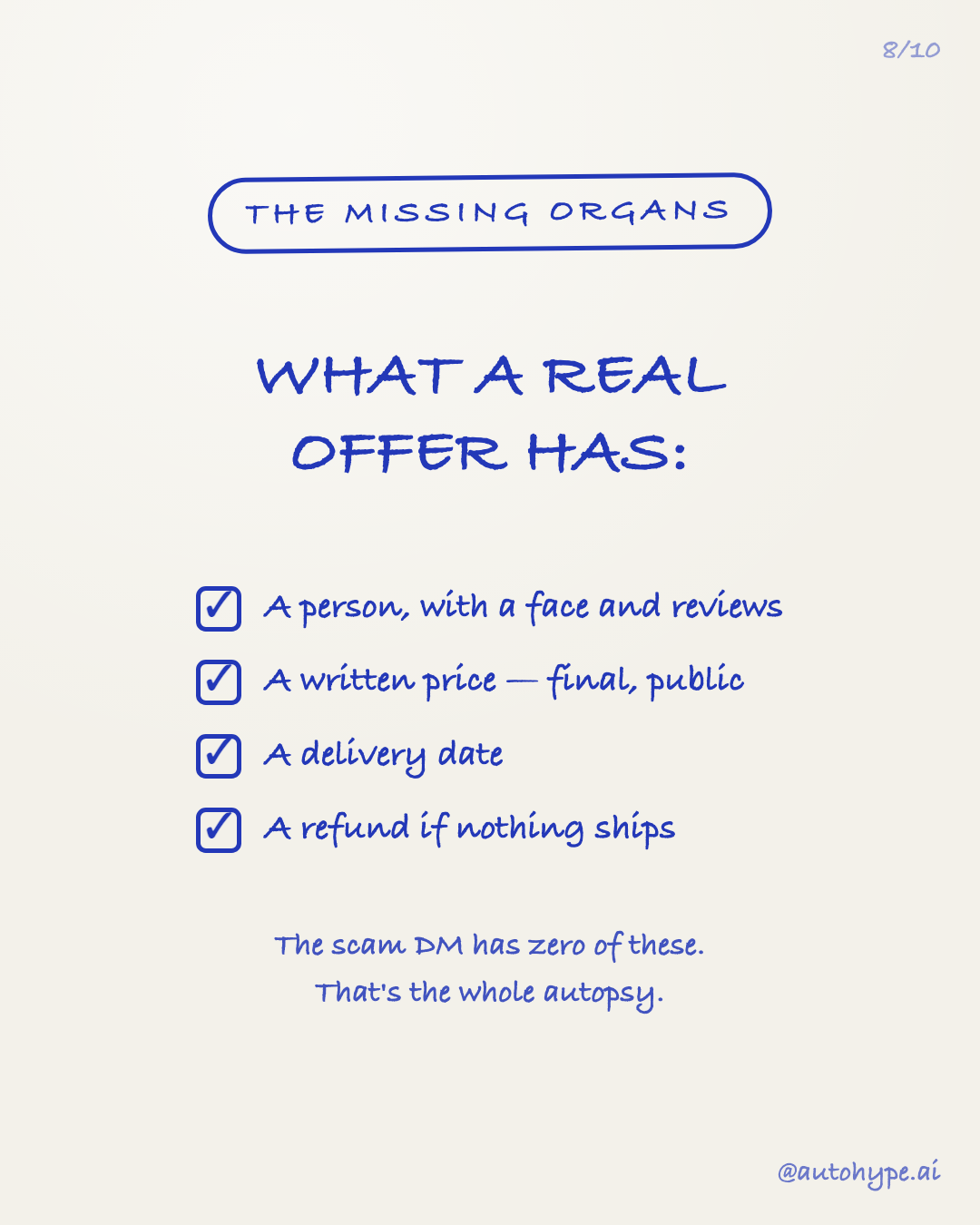
Every legitimate promotion offer, anywhere, has four organs: a person with a name, a face and public reviews; a written price that's final and visible before you talk; a delivery date; and a refund if nothing ships. The scam DM has zero of four. That's the whole autopsy. Count to four, and you'll never need this article again.
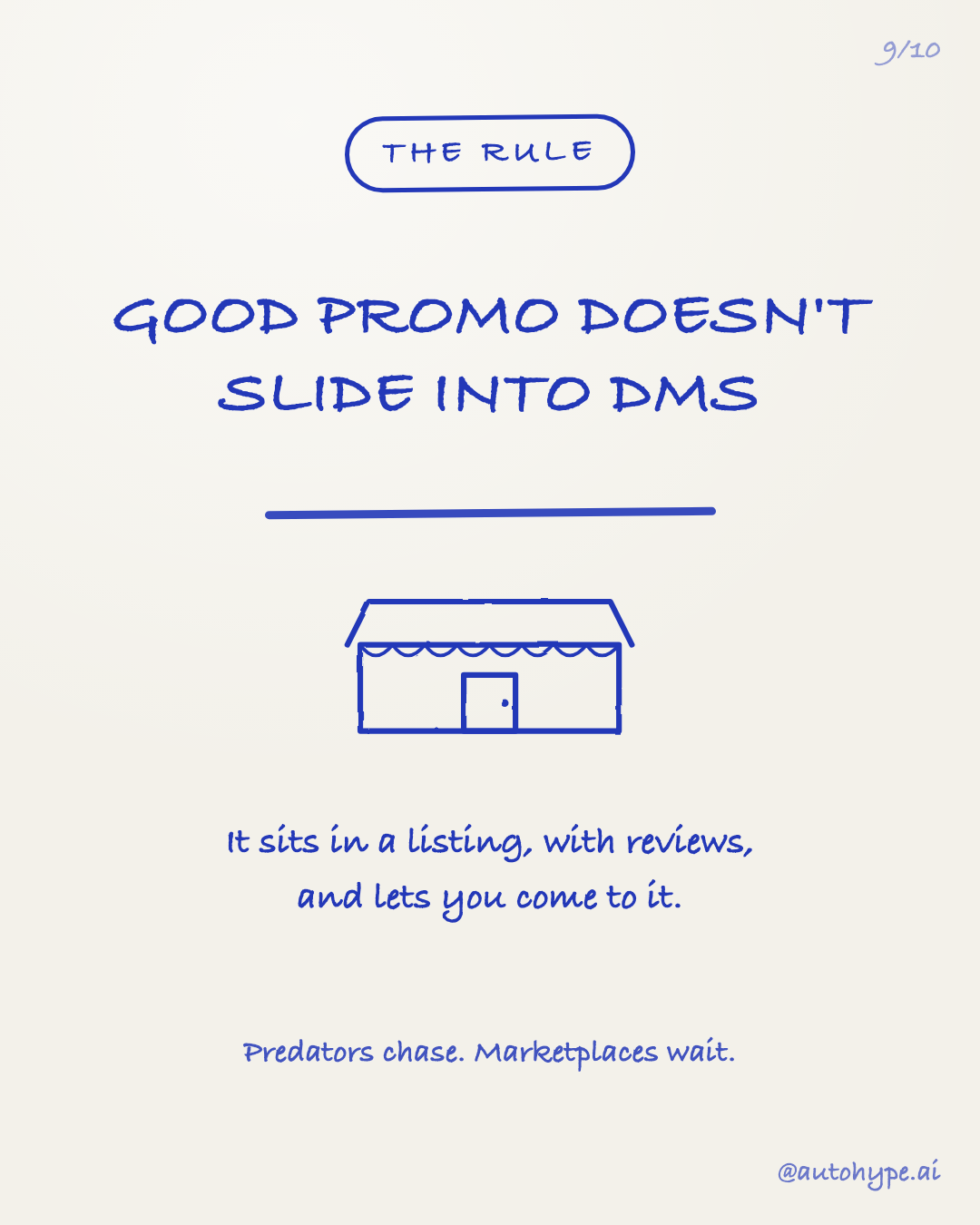
There's also a structural tell that requires zero counting: good promo doesn't slide into your DMs. It sits in a listing, with reviews attached, and lets you come to it. Predators chase; marketplaces wait. Unsolicited outreach isn't automatically a scam, but outreach plus hidden prices plus guaranteed numbers is the full uniform.
This is exactly why AutoHype exists as a pay-per-order marketplace instead of a DM thread: every seller — TikTok creators, playlist curators, DJs, bloggers — has a public profile, public reviews, and a written price (playlist pitches from $10, TikTok videos from $20, as listed by sellers in July 2026). Money sits in escrow and is released on delivery, with an automatic refund if nothing ships. Everything the DM hides, a marketplace publishes. That's not a feature. That's the entire difference between a store and a fishing rod.
Frequently asked questions
Are all music promotion DMs scams?
Not all, but the burden of proof is on the sender. Run the four-organ test: a named person with public reviews, a written final price, a delivery date, and a refund policy. A legitimate curator or creator can pass it in one reply. The template scam passes zero of four — and 'guaranteed streams' or 'editorial access' ends the conversation instantly, because neither is a thing anyone can sell.
Can you really not buy your way onto Spotify editorial playlists?
Correct — editorial playlists are curated by the platform's own internal team, and access cannot be purchased from anyone, at any price. Artists submit for editorial consideration for free through their artist tools. Anyone charging money for editorial placement is lying about a product that does not exist.
I already paid someone from a DM. What should I do?
Stop further payments, dispute the charge with your payment provider if possible, screenshot the conversation, and report the account. Don't pay anyone offering to 'recover' your money — that's the sequel scam. If they delivered bot streams, know that platforms detect and remove artificial streams, so treat those numbers as already gone.
Why do I keep getting these DMs? Did they actually listen to my music?
No — the targeting is hashtags and release announcements, not listening. Scam operations mass-message artists who post with tags like #indieartist or #newmusic. Getting the DM says nothing about your music, good or bad. It only says you're visible enough to be on a list.