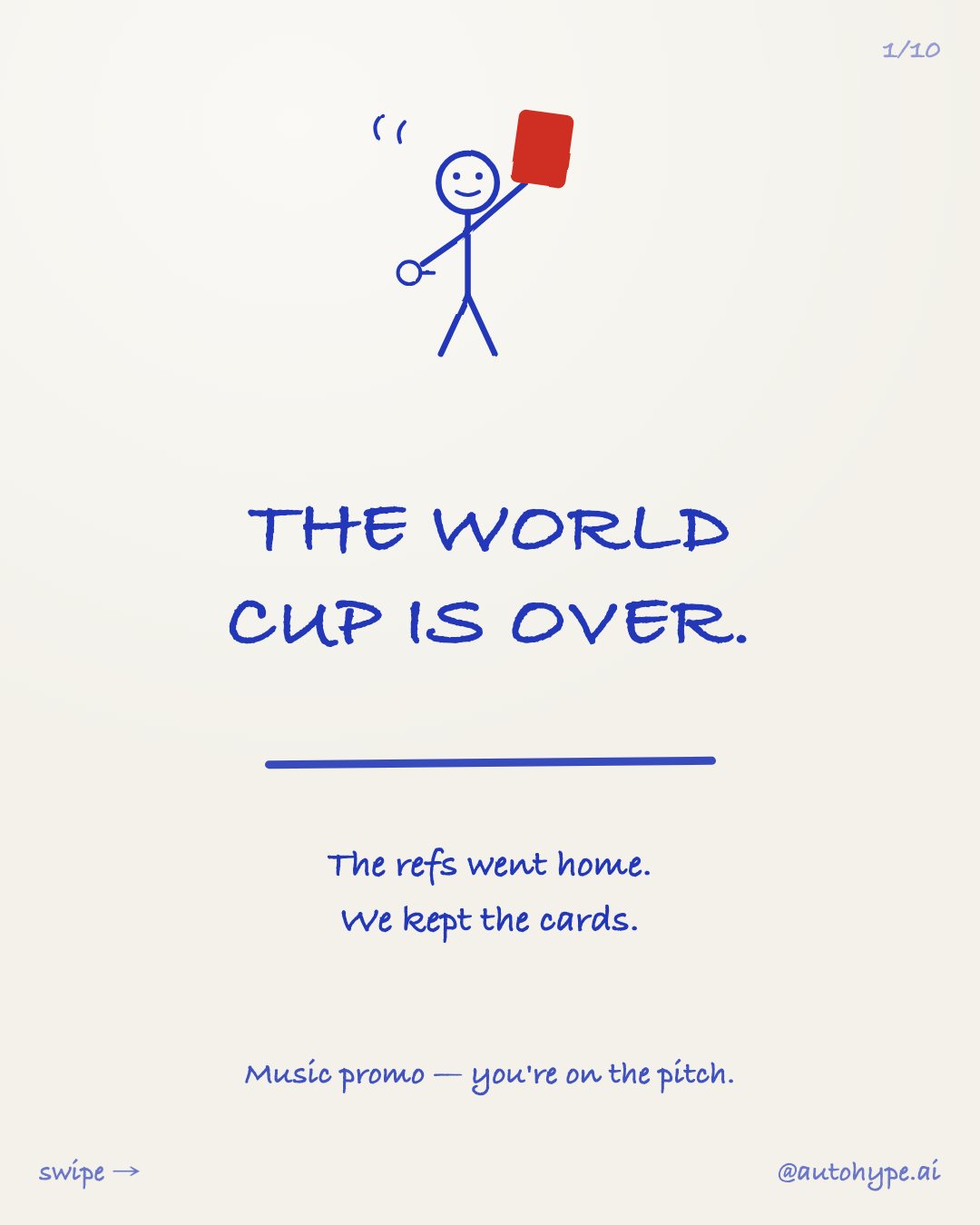
The World Cup is over. The refs went home. We kept the cards — because if any industry deserves a referee with a quick hand, it's music promotion. The same five fouls get committed on artists every single day, and most of them never even get called. So consider this the official disciplinary record. Five straight reds and one yellow: for each card, the lie itself, the reason it works on artists specifically (these fouls are well-designed — that's why they keep working), and the counter-reflex that gets you off the ground and back in the game. VAR has reviewed all of them. None are being overturned.
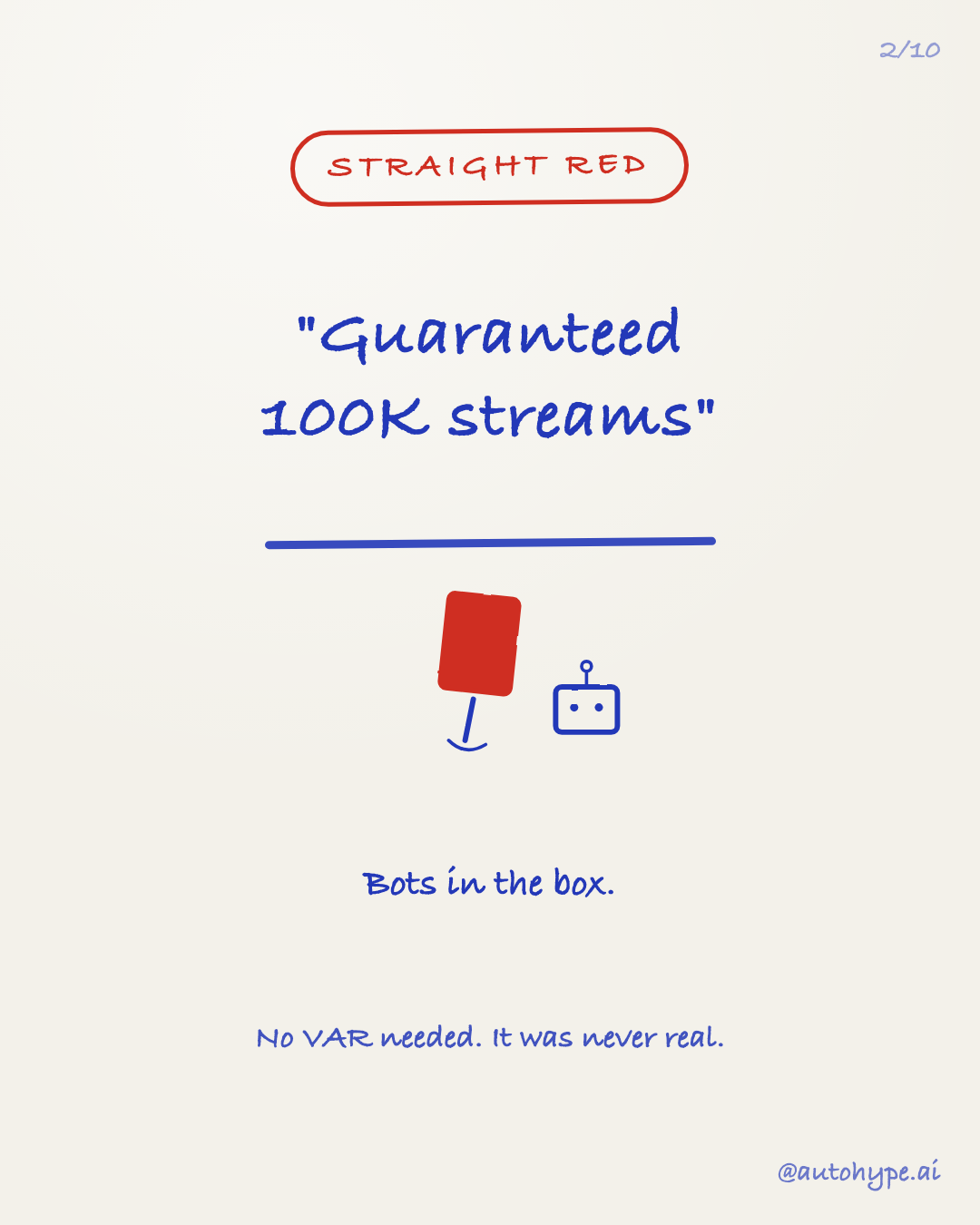
Straight red: "Guaranteed 100K streams"
The lie: that anyone, anywhere, can promise you a specific number of streams. They can't. Streams come from listeners, listeners are strangers, and strangers don't take orders. The only way to deliver a guaranteed number is to remove the humans entirely — bots in the box. No VAR needed; it was never real.
Why it works on artists: uncertainty is exhausting. You've released good music into silence, and silence has no numbers in it. Then someone offers a contract with a figure on it, and the tired part of your brain whispers "finally, something solid." The scam isn't selling streams — it's selling relief from not knowing.
The counter-reflex: flip the guarantee around. Honest sellers guarantee their own behavior — the work, the deadline, the refund — because that's all anyone controls. We guarantee delivery, not results, and that's the ceiling of honest promising. Anyone guaranteeing the behavior of 100,000 strangers is describing a server farm.
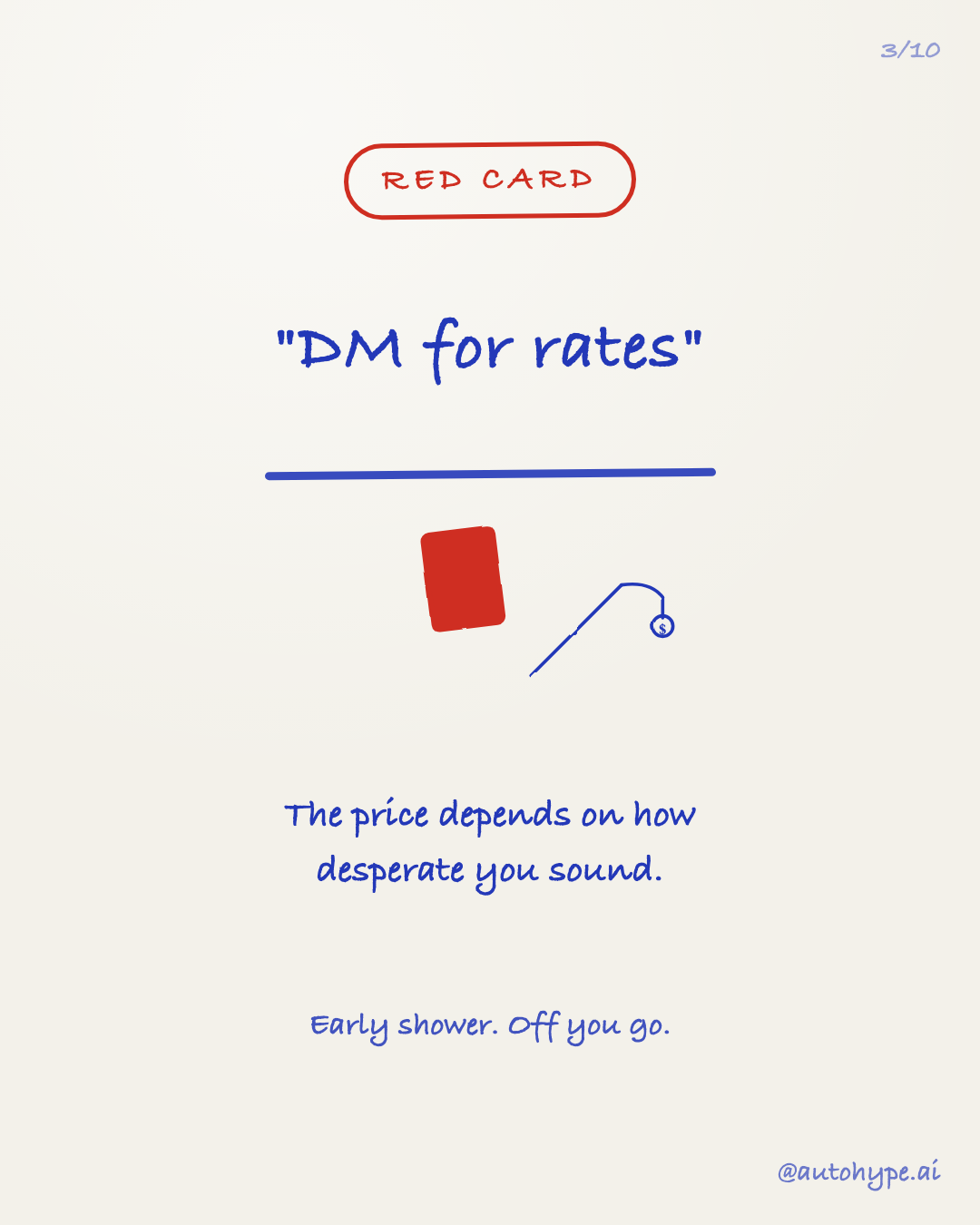
Straight red: "DM for rates"
The lie: that the price is a normal price which happens to live in a private conversation. It isn't. A hidden rate is a variable rate, and the variable is you — the final number depends on how desperate you sound by message five. The fishing rod finally gets its card. Early shower. Off you go.
Why it works on artists: the DM feels personal, even flattering — a bespoke quote for your special project. And once you're three messages deep, sunk-cost kicks in: you've invested the conversation, so you stay for the number. That's not customer service; that's the setup for the read.
The counter-reflex: real prices are written down before you say a word. Full stop. If a seller can publish their work but somehow can't publish their rates, the rates depend on the customer, and you don't want to be the customer they saw coming. Ask for the public price list once; treat silence as the answer it is.
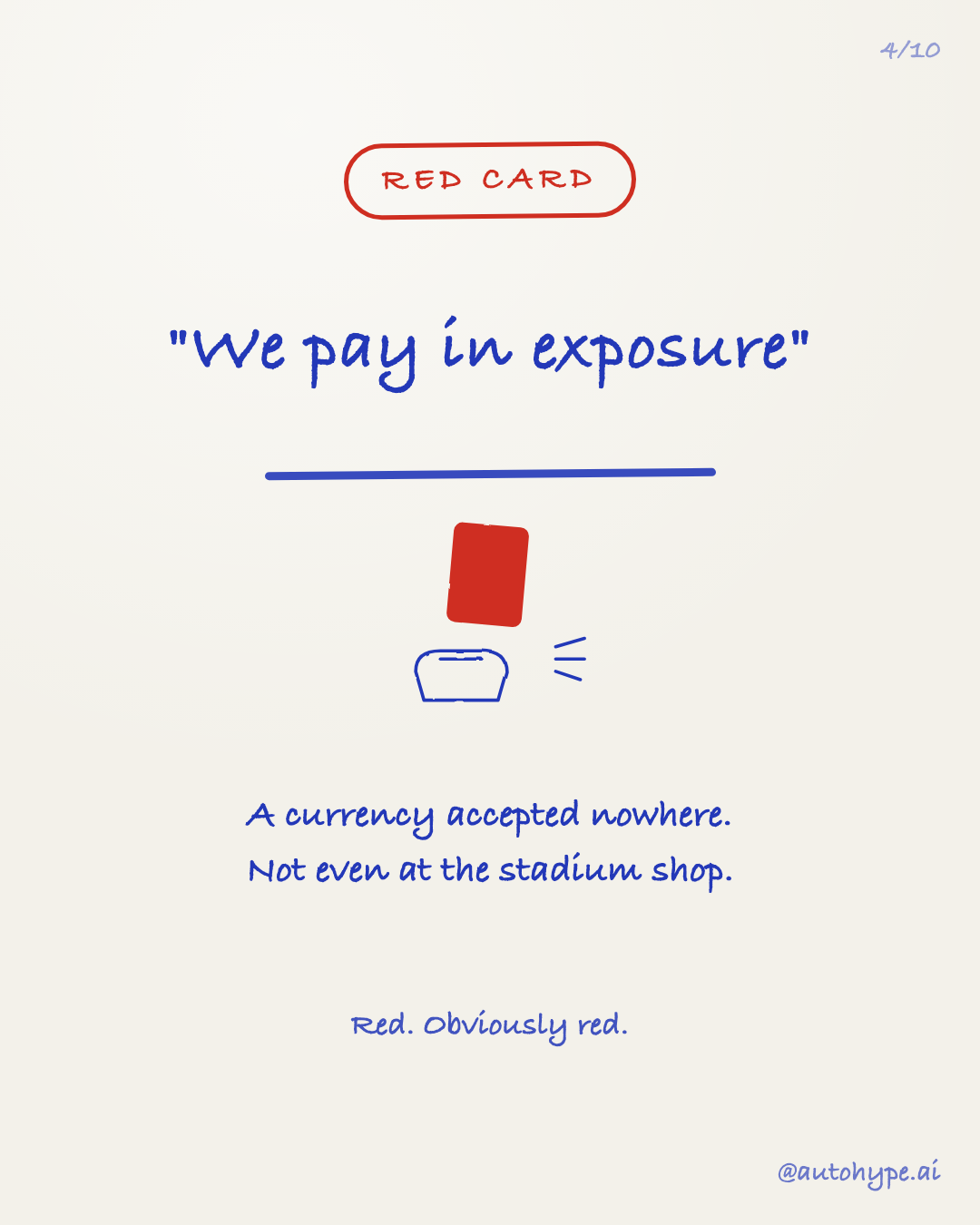
Straight red: "We pay in exposure"
The lie: that visibility is a form of payment. Exposure is a currency accepted nowhere — not by your landlord, not by your distributor, not even at the stadium shop. When someone profits from your music and pays you in the concept of being seen, that's not a collaboration; that's an unpaid invoice with confetti on it.
Why it works on artists: early-career musicians are trained to feel grateful for any attention, and "exposure" weaponizes that gratitude — plus the quiet fear that saying no means missing the one break. The pitch always implies the audience is enormous and the opportunity fleeting. Neither is ever verified.
The counter-reflex: make the trade explicit. "What are the money terms?" is a complete sentence. Genuine trades do exist — a genuinely large, relevant, verifiable audience can be worth more than a small fee — but that's a deal you evaluate and choose, with real numbers on the table. If the word "exposure" arrives before any number does, it's red. Obviously red.
Compare Instagram repost campaigns and independent Spotify curator submissions. See which format fits your release, the deliverables, service fees and terms before ordering. No guaranteed views, streams or playlist placement.
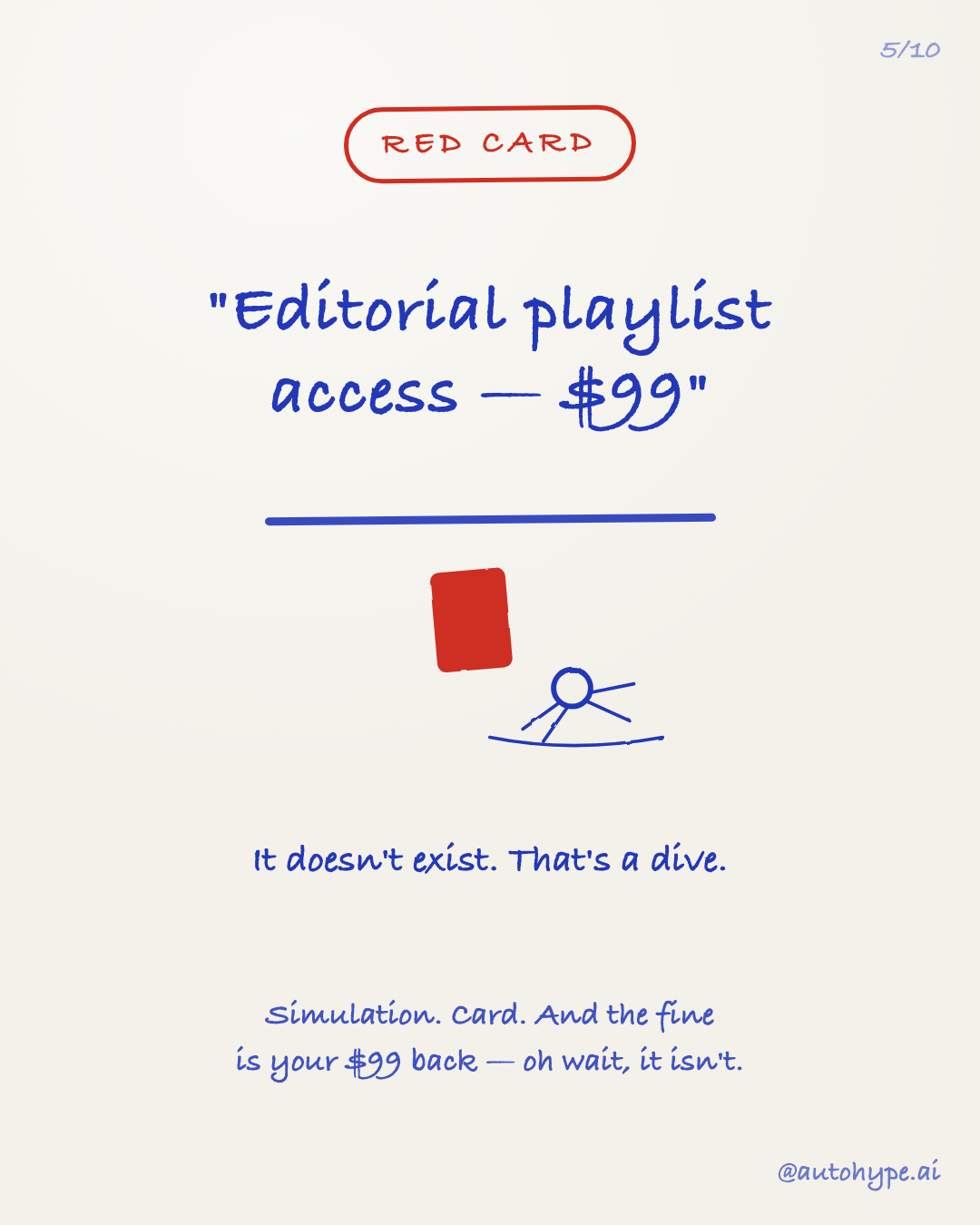
Straight red: "Editorial playlist access — $99"
The lie: that editorial playlist placement can be bought. It cannot. Editorial playlists are curated by the streaming platforms' own internal teams; access is not for sale, ever, by anyone, at any price. Submitting for editorial consideration is free through your artist tools. Selling that door for $99 is a theatrical dive — full simulation, card, and unlike football, the fine (your $99) never comes back.
Why it works on artists: it borrows real authority. Editorial playlists genuinely matter, artists genuinely want in, and the scam wraps itself in that legitimacy. It also exploits an information gap — nobody officially tells new artists, in plain language, that this door has no lock to sell. So let's be the plain language: it doesn't exist. That's a dive.
The counter-reflex: this one requires no judgment call, no context, no benefit of the doubt. The sentence "editorial access for sale" is a completed confession. Card, walk away, and warn the group chat.
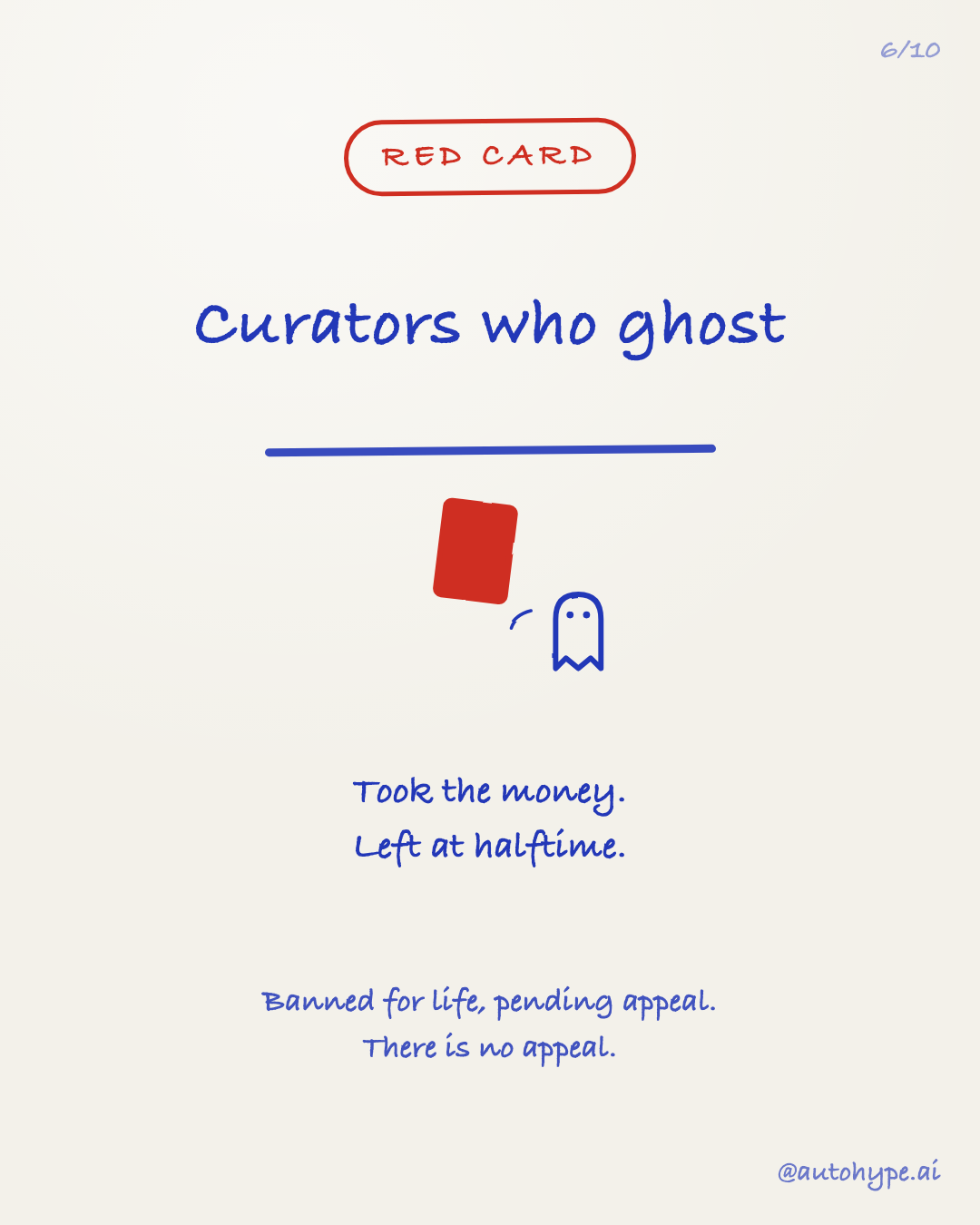
Straight red: curators who ghost
The lie: implied rather than spoken — "pay me and the work will happen." Then the money moves, and the curator leaves at halftime. No placement, no review, no reply. Banned for life, pending appeal. There is no appeal.
Why it works on artists: the entire transaction runs on trust with zero structure. You pay a stranger upfront, on their word, with no delivery date and no recourse. Most ghosted artists never even tell anyone, because the amounts are individually small — which is precisely the business model. Fifty artists ghosted for $30 each is a decent month for someone with no conscience.
The counter-reflex: never pay a stranger upfront with nothing holding them to the job. Structure beats trust: escrow that releases money on delivery, a written deadline, an automatic refund if the deadline passes. Ghosts can't survive in that arena — where money is released on delivery, ghosts work for free.
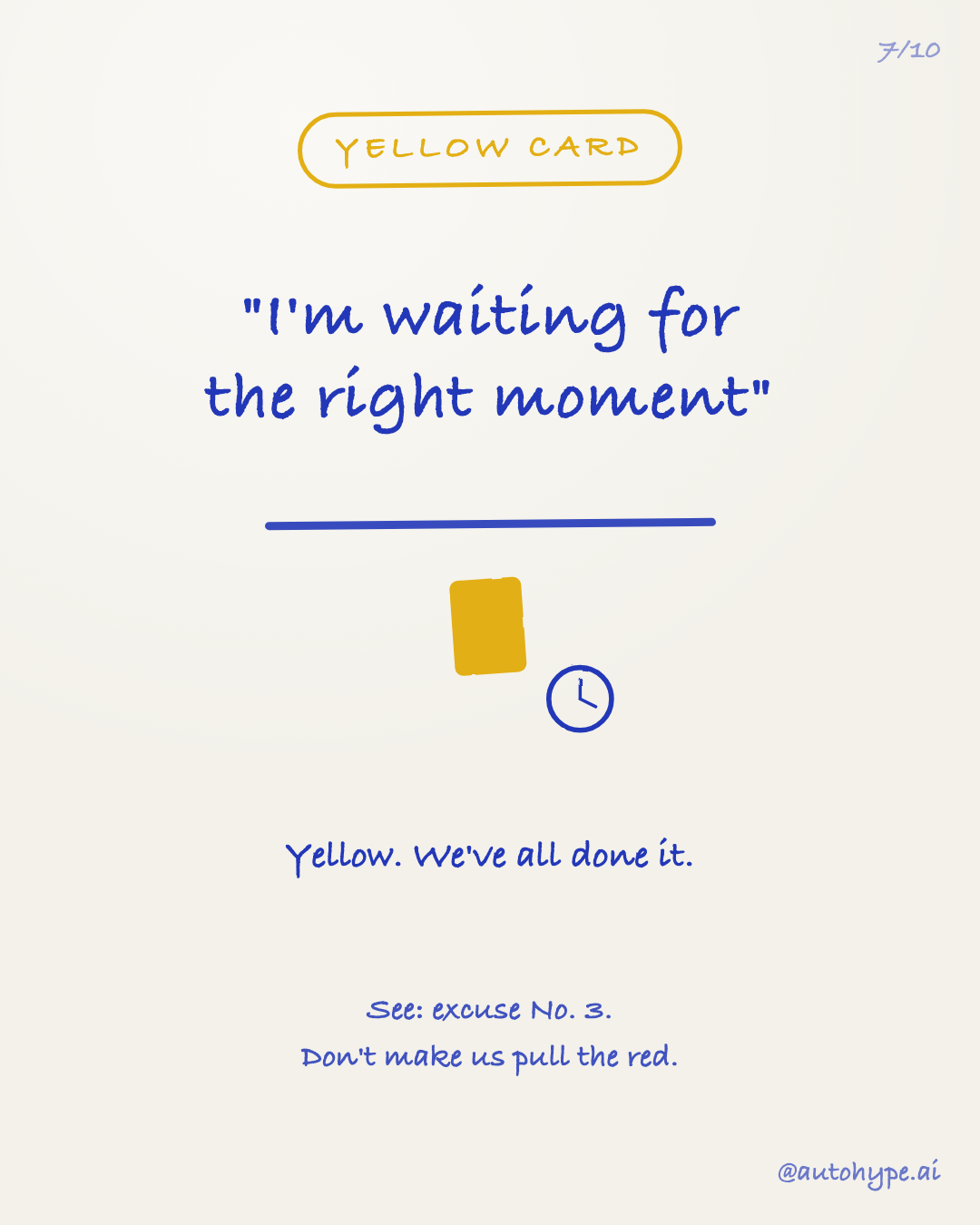
The one yellow: "I'm waiting for the right moment"
This card goes the other way — into the stands, at you. The foul: sitting on a finished song for months because the moment isn't "right." The mix could be 2% better. The rollout needs a plan. Mercury is in retrograde. Yellow, not red — we've all done it, and self-fouls get sympathy here.
But let's be honest about what the waiting usually is: fear wearing a strategy costume. A song in your drafts can't disappoint you, and that safety is comfortable and completely sterile. Meanwhile the actual "right moment" — listeners hearing it while you still love it — keeps sliding past.
The counter-reflex: pick a date within a month, book one small concrete promo action for release week, and let the song play. The perfect moment doesn't exist; the scheduled one does. Don't make us pull the red.
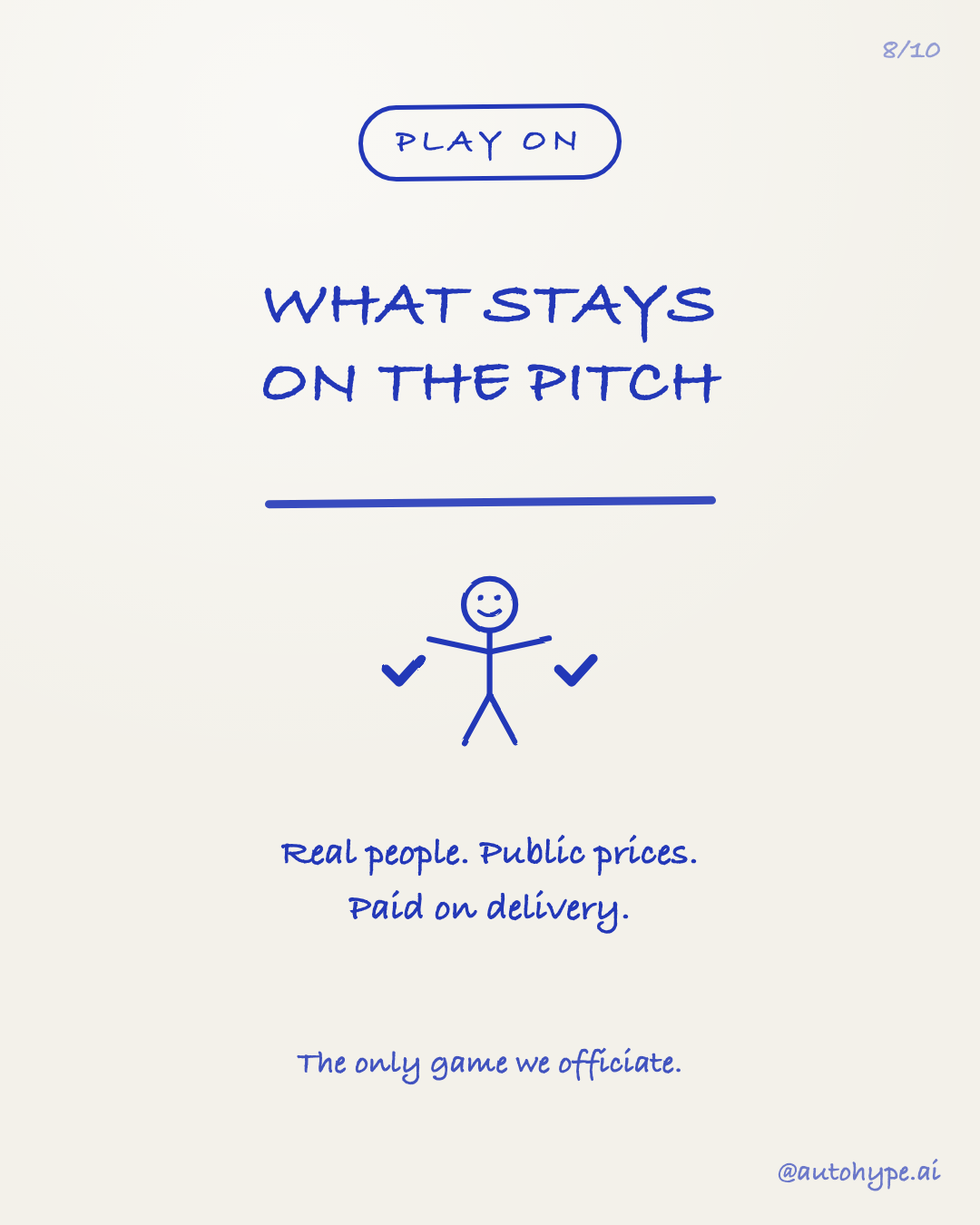
What stays on the pitch
Five reds and a yellow later, here's the whole clean game in three lines: real people, public prices, paid on delivery. A named human doing visible work, a rate written down before you say a word, and money that only moves when the work ships. That's the entire sport. Everything carded above is a deviation from one of those three lines.
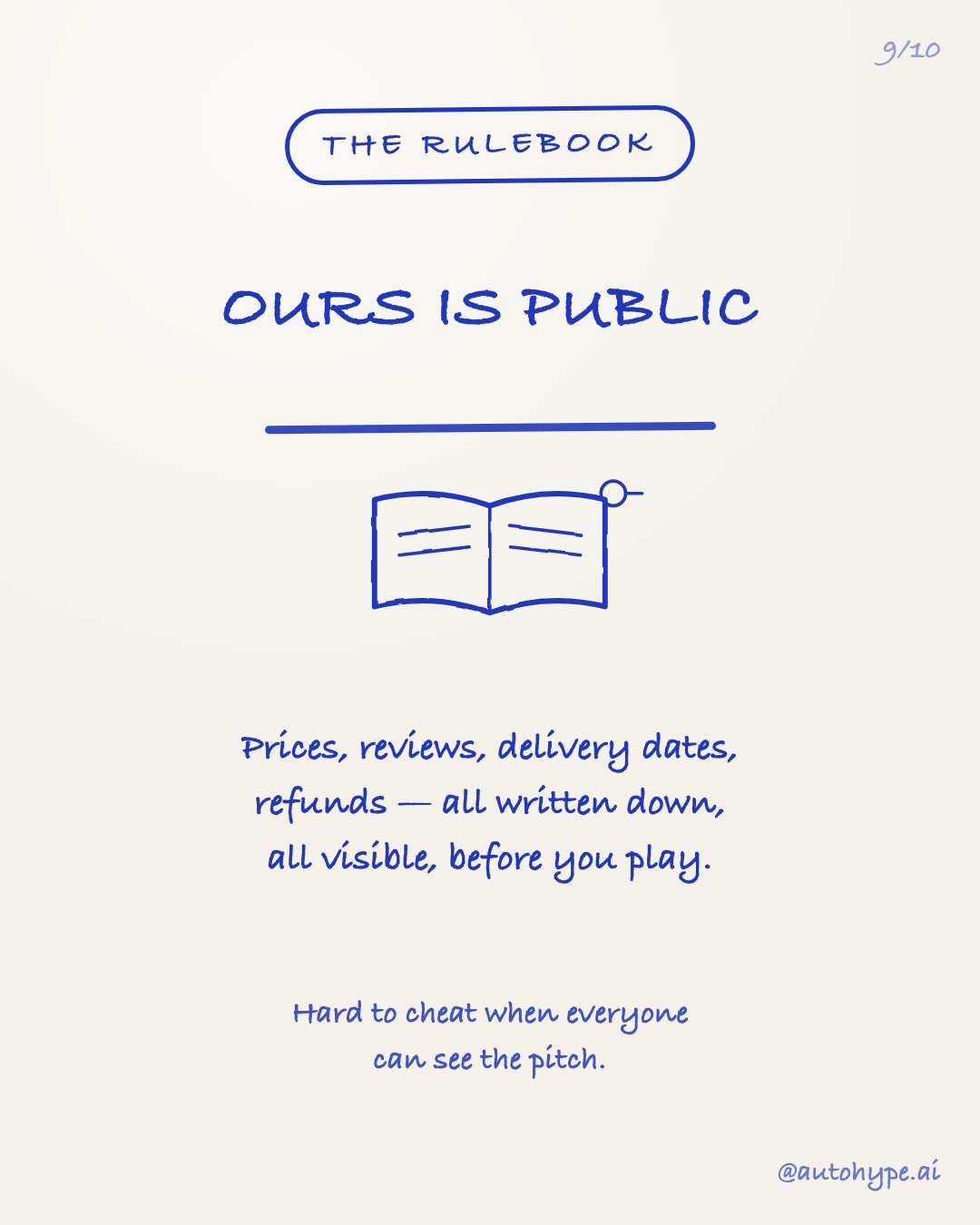
This is the game AutoHype was built to officiate: a pay-per-order marketplace where every seller — TikTok creators, playlist curators, DJs, bloggers — plays with their name, face and reviews visible, prices start from $10 (written, final, public, set by the sellers), and escrow releases payment on delivery with an automatic refund if nothing ships on time. Hard to cheat when everyone can see the pitch.
Keep the card handy. The next time an offer lands in your DMs, check it against the five reds — takes about ten seconds. If it survives, great, you might have found a real one. If it doesn't: you know the gesture. Straight red, no appeal, play on.
Choose the next step for your release.
Compare Instagram repost campaigns and independent Spotify curator submissions. See which format fits your release, the deliverables, service fees and terms before ordering. No guaranteed views, streams or playlist placement.
Compare artist campaigns →Frequently asked questions
What's the single biggest red flag in music promotion?
Guaranteed results — any specific number of streams, followers or placements promised in advance. Human listeners can't be pre-ordered, so a guaranteed number can only be delivered by bots. It's the one red flag with zero exceptions, and it usually travels with the others (hidden rates, no reviews, no refund terms).
Is an offer with just one red flag ever legitimate?
Depends on the flag. 'Guaranteed streams' and 'editorial access for sale' are disqualifying on their own — they describe things that don't exist honestly. A hidden price alone might just be amateurism, but it's still a bad sign: ask for the written rate and judge by the response. Two or more flags together: walk, every time.
What are the green flags — what does a trustworthy offer look like?
A named person you can verify, public reviews from other artists, a written final price visible before any conversation, a delivery deadline, and a refund mechanism if nothing ships. Structurally: the offer sits somewhere public (a listing, a marketplace) and lets you come to it, rather than chasing you into your DMs with urgency.
I already paid a curator who ghosted me. Is there anything I can do?
Dispute the payment with your provider if the window is still open, screenshot everything, and report the account on the platform where the deal happened. Then treat it as tuition: small unrecoverable amounts are exactly why the ghost model works. Next time, only pay where escrow holds the money until delivery — ghosts don't apply for jobs they can't get paid to abandon.