Every day, artists explain to us why they can't promote their music yet. Not won't — can't. There's always a reason, the reason always sounds reasonable, and after hearing them on a loop we noticed something uncomfortable: there are only six. Six excuses, endlessly remixed, like a bootleg of the same song. So here they are, each one getting the full treatment: the roast (you've earned it), the thing the excuse is actually protecting you from (this part stings more), and the smallest possible action that kills it (this part costs less than lunch). Count how many are yours. We'll wait.
Excuse No. 1: "The algorithm will find me"
The algorithm found a staggering pile of new songs today — the industry has cited figures on the order of a hundred thousand daily uploads to streaming services for years. Yours wasn't one of them. Not because it's bad. Because the algorithm doesn't go looking for songs. It goes looking for signals — saves, shares, playlist adds, repeat listens — and a song nobody has heard yet emits exactly none of them.
Here's what this excuse is really doing for you: it outsources the scary part. If discovery is the algorithm's job, then obscurity is the algorithm's fault, and you never have to find out what actual humans think of your track. Excuse No. 1 isn't a strategy. It's a shield against feedback.
The action that kills it: give the machine one signal to work with. Send a single playlist pitch — on our marketplace the floor is $10, a price set by the curators themselves. One pitch won't change your career, but it changes your position: your song goes from 'waiting to be found' to 'placed in front of a human who listens for a living'. Algorithms notice what humans do. Start with the humans.
Excuse No. 2: "Good music promotes itself"
So does bad music. With a budget. That's the entire roast, and it isn't even a joke — it's something you can verify from your own listening history. Songs reach you because someone, somewhere, did something: pitched a playlist, briefed a creator, emailed a blogger, booked a slot. The song you believe you 'just found' was placed in your path on purpose.
The merit myth is seductive because it makes promotion feel like cheating — as if truly good art shouldn't need help, and asking for attention is an admission of weakness. It's the opposite. Promotion isn't a confession that your music is weak. It's the delivery mechanism for music, full stop. Every artist you admire has one. The only songs with zero promotion are the ones you've never heard — which is precisely the point.
The action that kills it: write one sentence answering 'why should a stranger press play?' If you can't write it, that's your real blocker, and it's a solvable craft problem. If you can write it — congratulations, that sentence is a pitch. Send it to one curator or one creator this week.
Excuse No. 3: "I'm waiting for the right moment"
You've been waiting since 2023. The moment is bored. It left. It's promoting someone else's song now.
There is no algorithmic full moon. No secret Thursday when the industry opens its arms. What this excuse actually protects is the fantasy: an unpromoted song can still 'blow up someday', while a promoted song produces a number — and a number can disappoint you. Waiting isn't timing. It's anesthesia.
To be fair, some timing is real: pitching playlists a couple of weeks before release beats pitching the day of, and having your artwork and links ready helps. But that's a checklist, not a horoscope — and a checklist can be finished this weekend.
The action that kills it: pick a date, write it down, and tell one person who will ask you about it. A moment you chose beats a perfect moment that never introduces itself.
Compare Instagram repost campaigns and independent Spotify curator submissions. See which format fits your release, the deliverables, service fees and terms before ordering. No guaranteed views, streams or playlist placement.
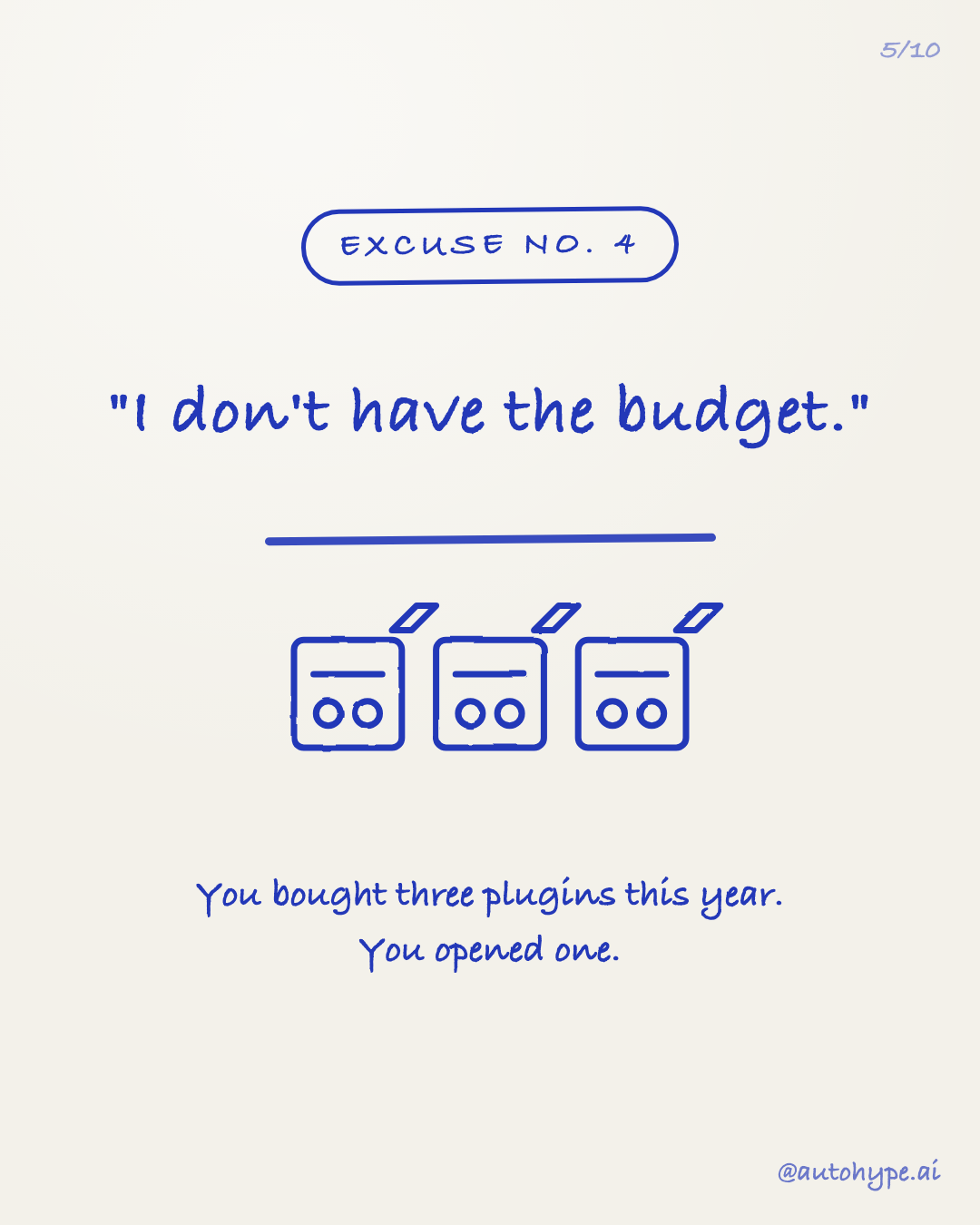
Excuse No. 4: "I don't have the budget"
You bought three plugins this year. You opened one. We're not judging — fine, we're judging a little — but let's be precise about what happened: you had a budget. You spent it on the part of music-making that feels safe.
Plugins are purchases that flatter you: 'tomorrow I'll sound better.' Promo is a purchase that tests you: 'today we find out.' That's why the wallet opens for one and slams shut for the other. The budget excuse is rarely about money — it's about which purchase risks your feelings.
Here's what the actual money looks like. On autohype.ai, prices are public and set by the sellers themselves: playlist pitching starts at $10, a TikTok or Instagram video at $20, press and blog features at $20, YouTube and X promotion at $10 — and 17 different services sit under $20 (floors we last verified in July 2026). That's sandwich money, not label money.
The action that kills it: match one plugin. Skip one $15 impulse buy this month and place one order instead. One of those two purchases has a chance of being heard by strangers.
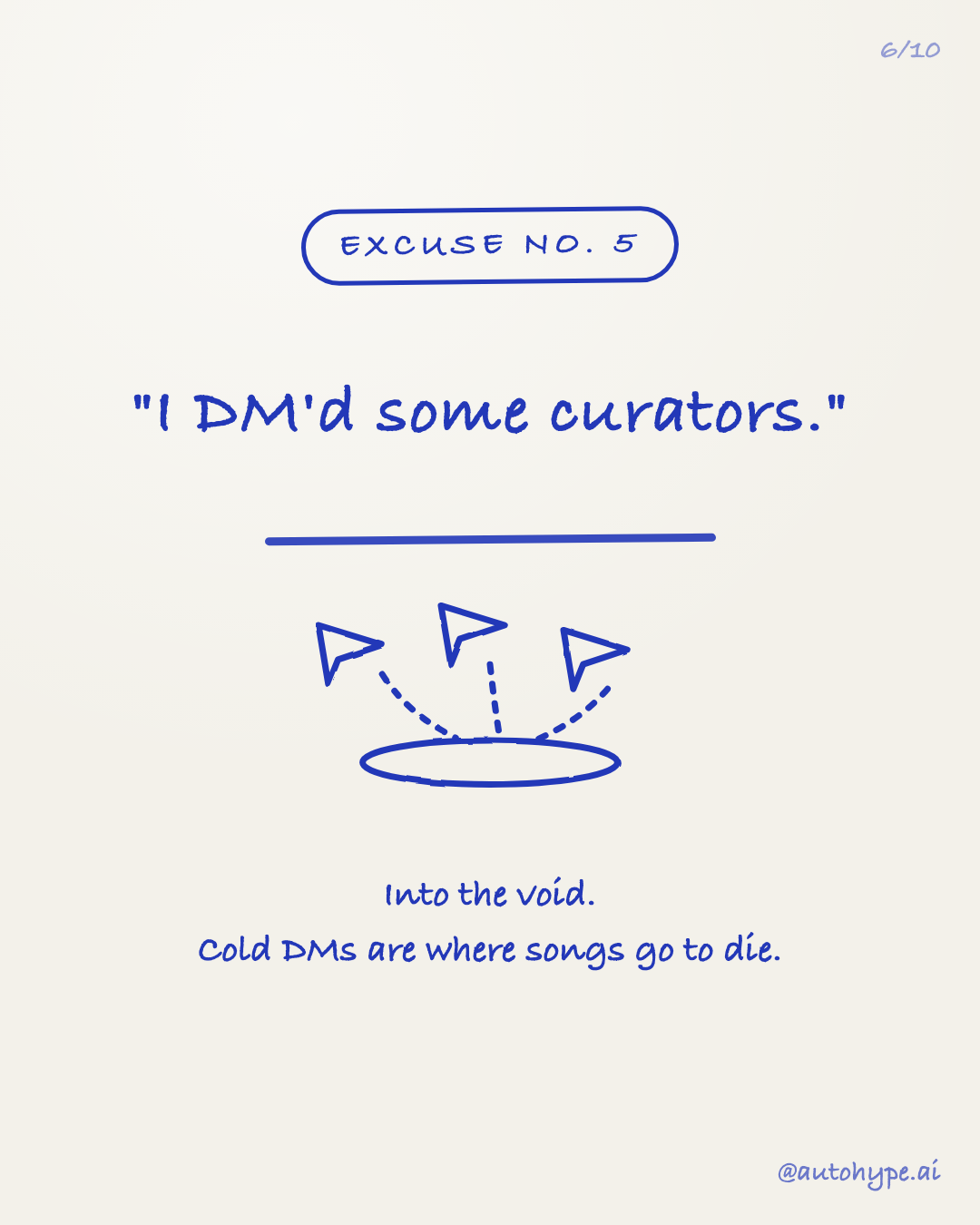
Excuse No. 5: "I DM'd some curators"
Into the void. Cold DMs are where songs go to die — not because curators are cruel, but because an unsolicited message carries no price, no deadline, and no obligation. It can be ignored for free. So it is.
This excuse is the sneakiest of the six because it looks like action. You did promo-shaped activity! You have the screenshots! But activity without accountability is theater. What those DMs actually bought you was the feeling of having tried — which is exactly enough to justify not trying properly.
The action that kills it: replace volume with structure. One pitch where the terms exist in writing beats twenty that vanish. On a marketplace listing, the curator has a public price, a stated delivery window, and reviews they have to live with — and your money is held in escrow until they deliver. Same effort as a DM. Entirely different physics.
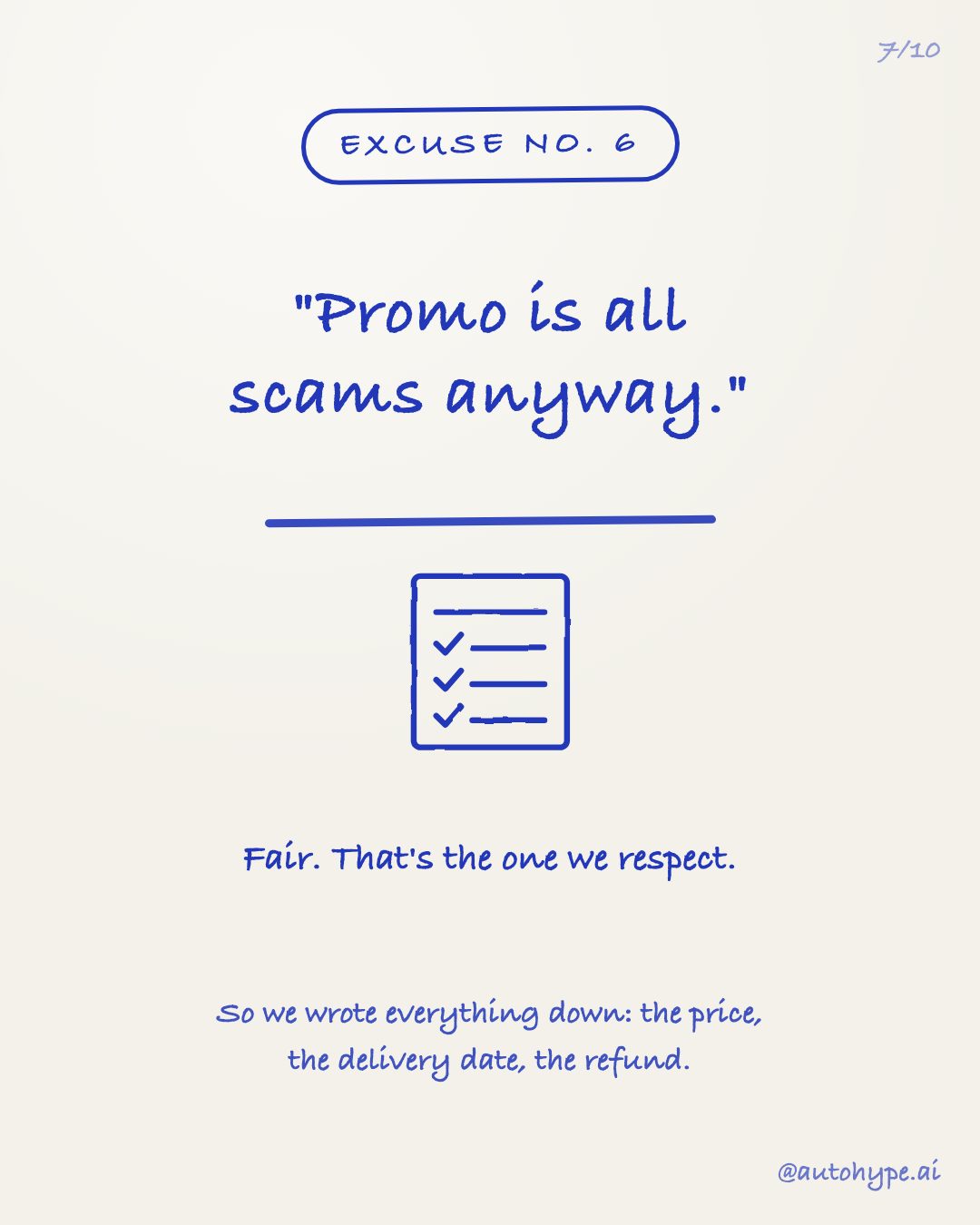
Excuse No. 6: "Promo is all scams anyway"
Fair. That's the one we respect. It's the only excuse on this list built from actual evidence: the DMs promising '100K streams guaranteed', the bot farms, the mystery 'viral packages'. And one fact deserves repeating until everyone knows it: editorial playlist placement on Spotify cannot be bought. Anyone selling it is lying to you.
But notice the move this excuse makes: it converts 'some sellers are scammers' into 'all promotion is a scam', then uses that to justify doing nothing forever. That's not caution. That's the most sophisticated procrastination on this list — cynicism as a sleeping pill.
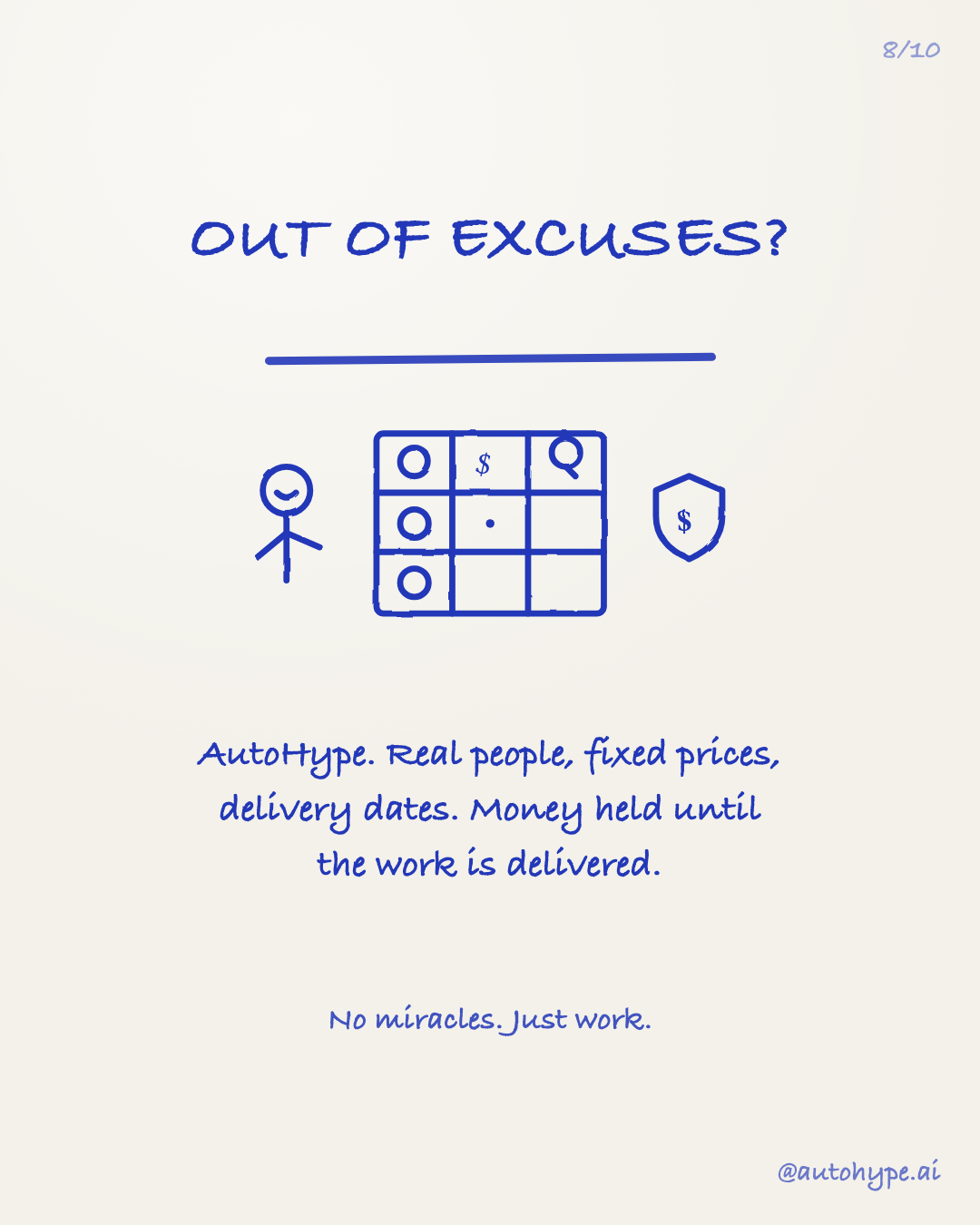
The fix for a market full of scams isn't abstinence. It's terms in writing. Three questions expose almost every scam before it costs you a cent: Is the price written down? Is the deliverable written down? What happens, in writing, if it isn't delivered? A legitimate seller answers all three before taking your money. That's the entire design of AutoHype: public prices, stated delivery dates, money held until the work is delivered, refund if it isn't. We guarantee delivery, not results — anyone promising you results is reading from the scammer's script.
Out of excuses? Good. Here's your move
Six excuses, one pattern: every single one postpones the moment you find out how the world responds to your song. That's the job of an excuse — it keeps the dream safe. The problem is that a protected dream doesn't compound. Songs do, listeners do, skills do — but only after contact with reality.
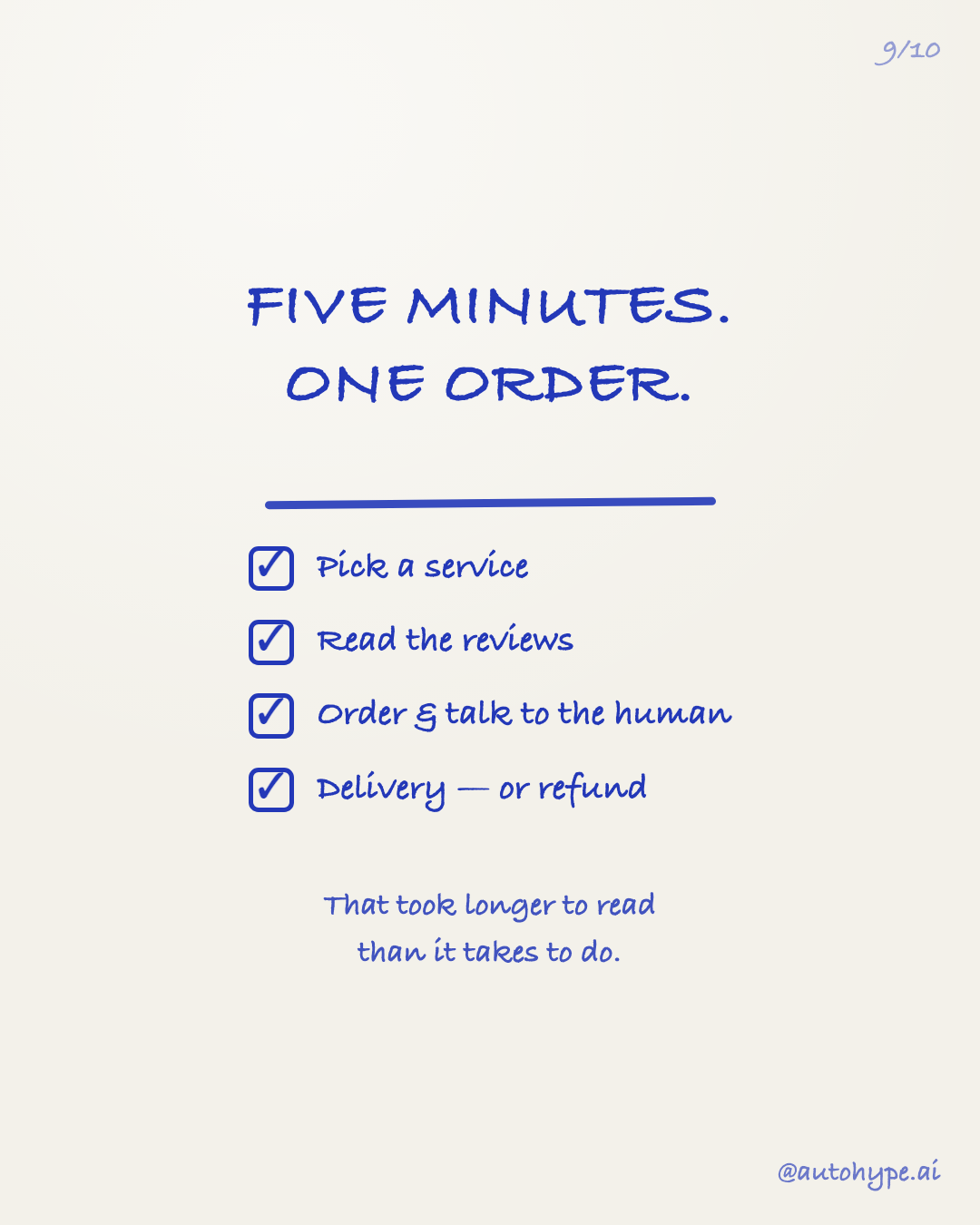
So the counter-move is deliberately small. Five minutes, one order: pick a service, read the reviews, talk to the human behind it, get delivery — or your money back. Not a campaign, not a rebrand, not a life overhaul. One order.
One small order beats another year of excuses, mostly because it replaces a story with a fact. And facts, unlike excuses, are something you can build on.
Choose the next step for your release.
Compare Instagram repost campaigns and independent Spotify curator submissions. See which format fits your release, the deliverables, service fees and terms before ordering. No guaranteed views, streams or playlist placement.
Compare artist campaigns →Frequently asked questions
Why do I keep making excuses not to promote my music?
Because promotion produces feedback, and feedback can hurt. Every classic excuse — waiting for the right moment, trusting the algorithm, blaming the budget — postpones the moment you find out how strangers respond to your song. Naming the fear is the first step; a tiny, low-stakes first action (one pitch, one order) is the second.
What's the cheapest way to start promoting a song?
Pitching playlist curators is usually the lowest-cost entry point — on marketplaces like AutoHype the floor is $10, with 17 services under $20 (seller-set prices, verified July 2026). The point of starting cheap isn't the size of the result; it's breaking the zero-promotion habit with terms that are written down.
Isn't music promotion full of scams?
Parts of it, yes — bot streams and 'guaranteed placement' sellers are real, and editorial Spotify playlist placement can never be bought. The filter is simple: written price, written deliverable, written refund policy. A seller who provides all three before payment has nothing to hide; a seller who dodges any of them is the scam.
Can promotion guarantee my song will take off?
No, and nobody honest will tell you otherwise. What a legitimate service can guarantee is the work: a real person with a real audience delivering what was ordered, on time, or your money back. We guarantee delivery, not results — the results depend on the song, and that part has always been yours.