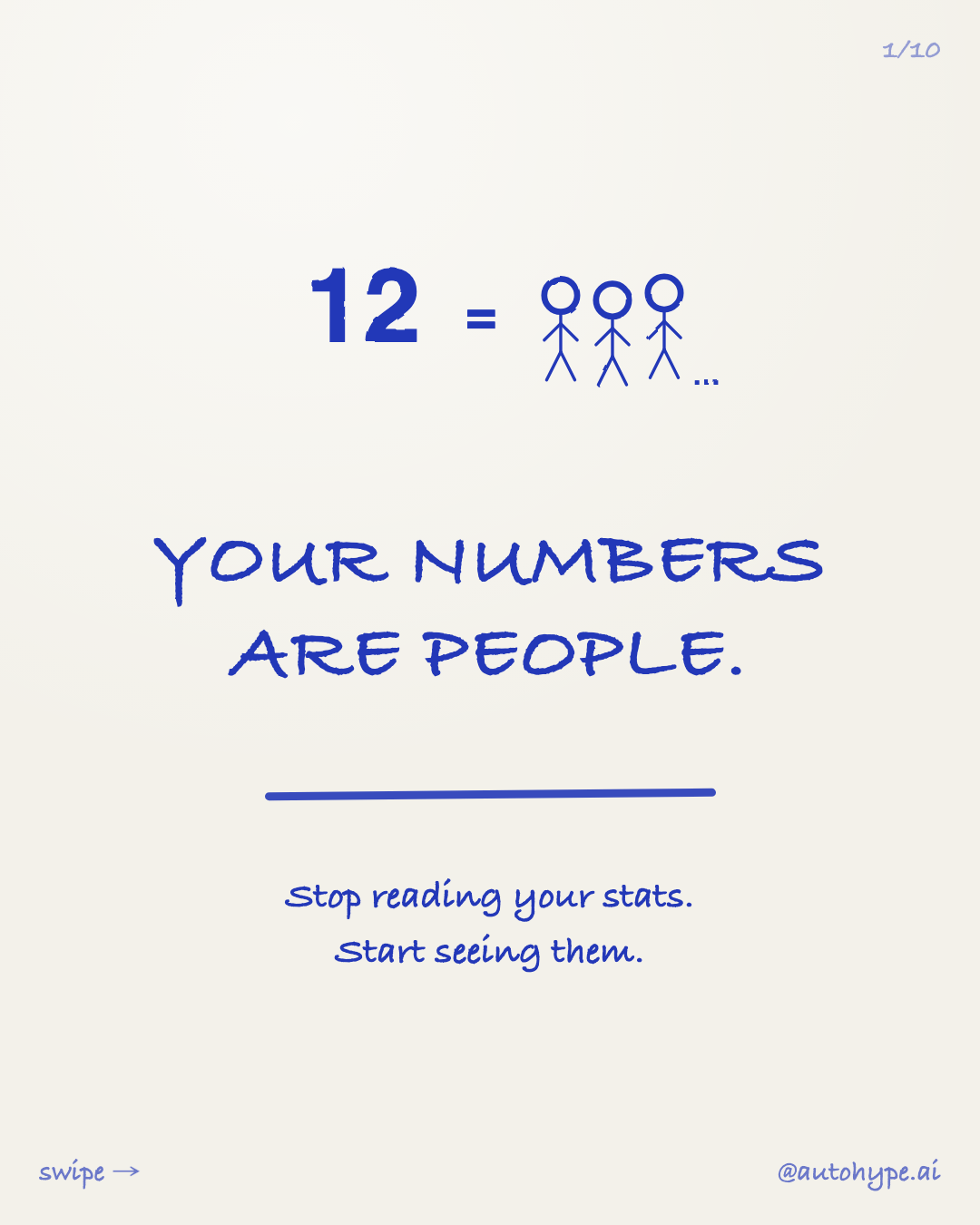
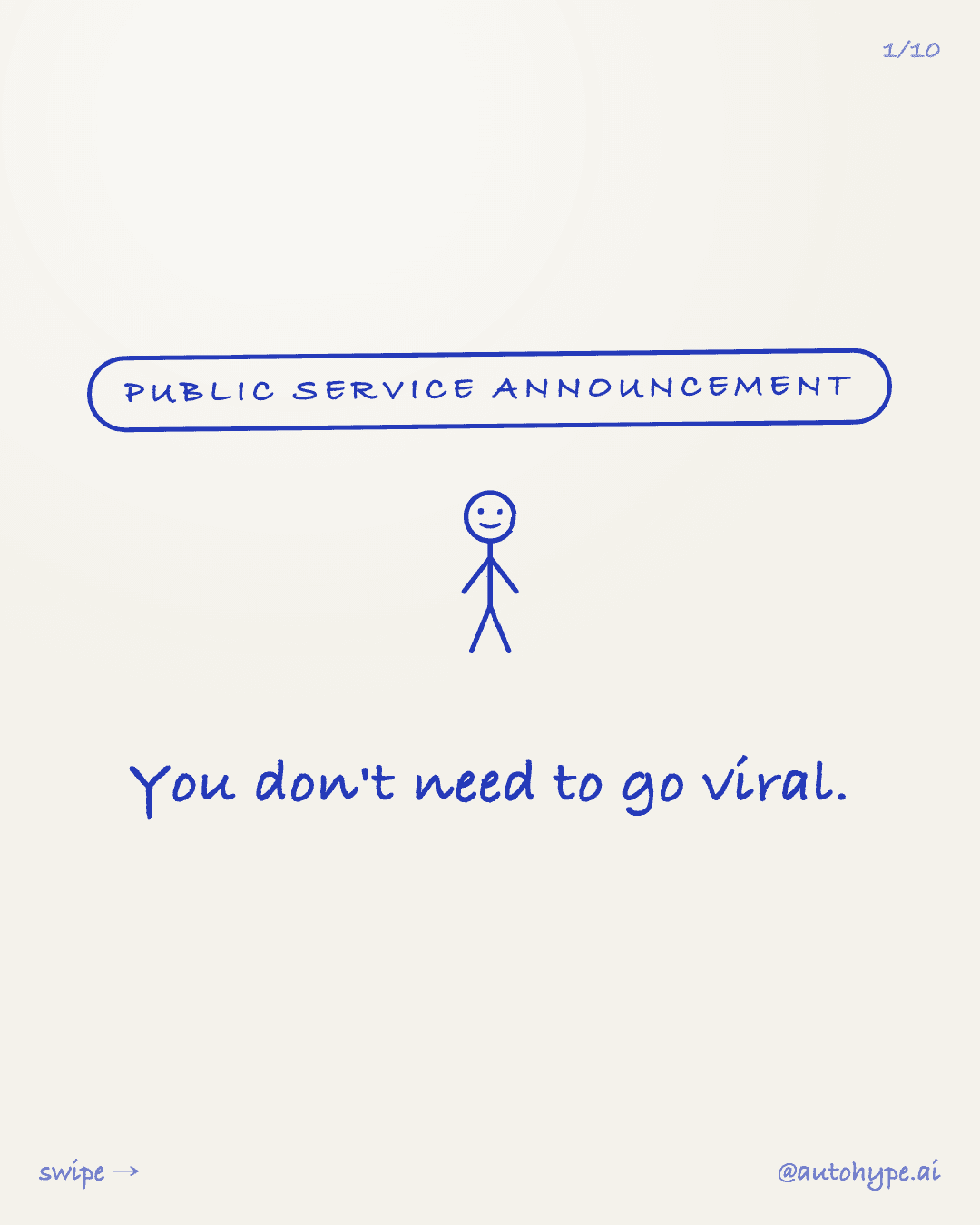
There's a carousel on our Instagram where our stick-man mascot repeats one sentence, louder and louder, until he flips a table. Then he sits down with a coffee and apologizes. The sentence is: you don't need to go viral. We get emotional about this one. This is the argued version — why chasing virality is the worst growth plan in music, what the overnight-success stories are hiding, and the boring, repeatable math that actually builds audiences. Fair warning: by the end of this article, 'boring' is going to sound like a compliment.

Why we keep yelling this
Ask an independent artist what their promotion plan is and the honest answer is often some version of 'post and pray'. Upload the song, share the link, refresh the stats, hope the platform picks it up. When it doesn't — and statistically, it doesn't — the conclusion is never 'the plan was hope'. It's 'the song failed', or worse, 'I failed'.
That's the damage the viral dream does. It's not that virality is bad — enjoy it if lightning finds you. It's that chasing it is a plan whose rules you don't know, can't see, and can't influence, run by systems that owe you nothing. Building a career on that is building on weather.
So consider this article our table-flip, in writing, with footnotes.
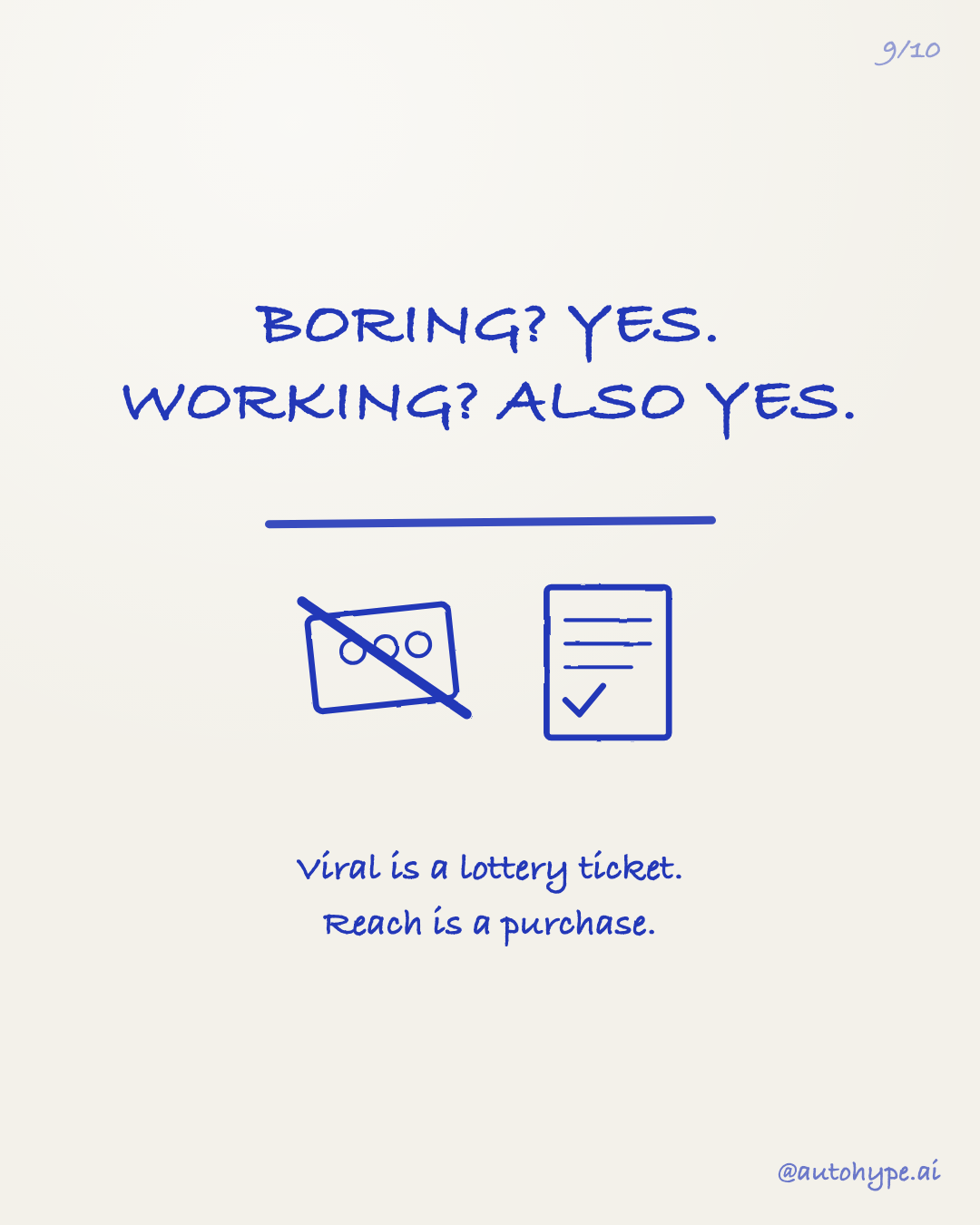
Viral is a lottery ticket. Reach is a purchase.
This is the thesis, so let's define terms. A lottery ticket has unknown odds, no refund, and a house that profits whether or not you win. Sound familiar? Every 'this could be the one' upload is a scratch card. Most tickets pay nothing, the occasional jackpot keeps everyone buying, and the platforms — the house — do fine either way.
A purchase is a different object entirely: known price, known deliverable, receipt. A $10 playlist pitch is a purchase. A $20 TikTok video from a real creator is a purchase. You know what you bought, when it arrives, and what happens if it doesn't (on our marketplace: your money back — funds sit in escrow until delivery).
One honesty clause, because it matters: nobody can sell you an outcome. We guarantee delivery, not results. What can be sold honestly is the work — a real person with a real audience doing a real thing for your song at a written price. Anyone selling the jackpot itself is selling you a lottery ticket with extra steps.
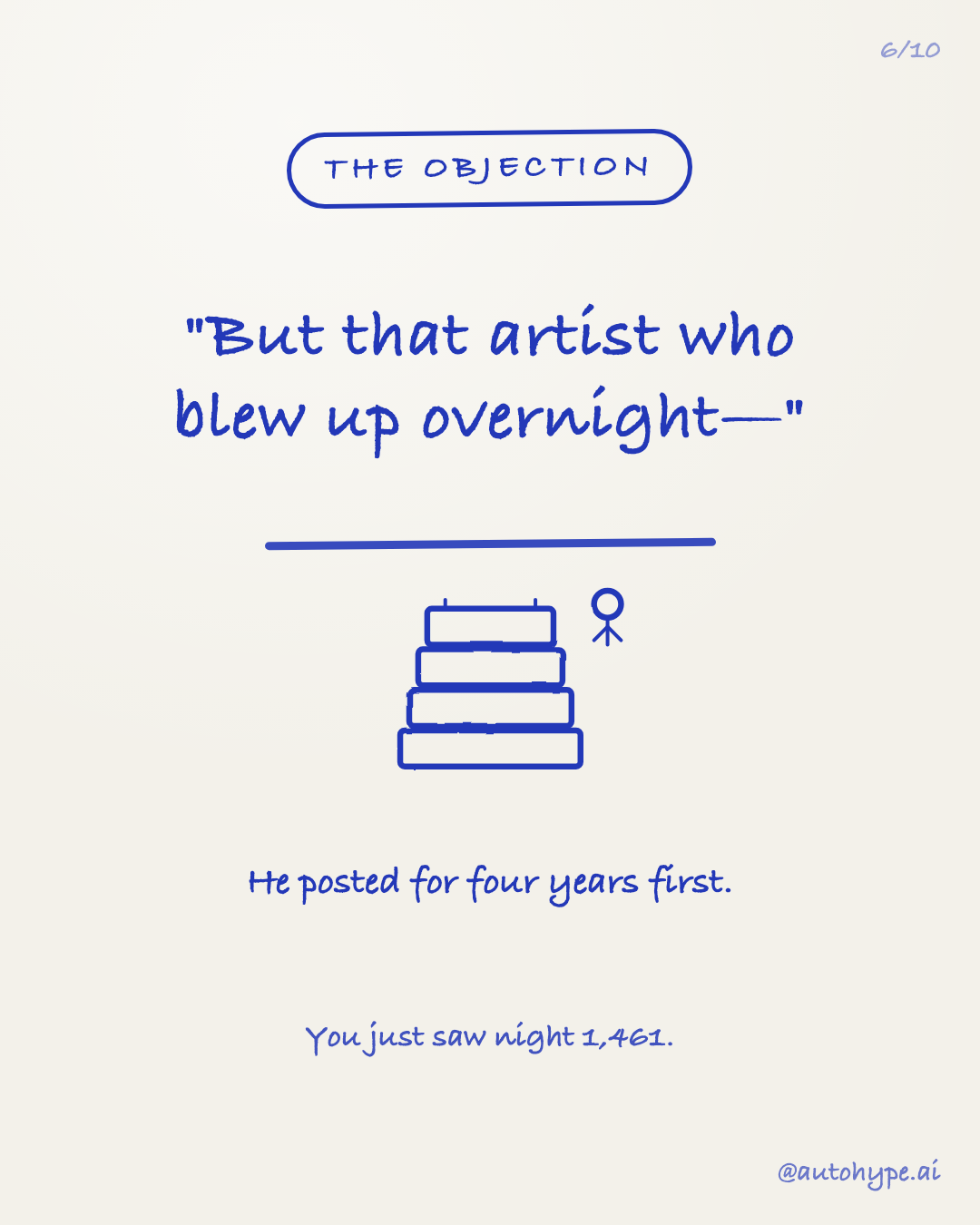
"But that artist who blew up overnight—" He posted for four years first.
You just saw night 1,461. That's what four years of showing up looks like from the outside: invisible, right up until the one night it isn't.
This is survivorship bias doing its favorite trick. The feed shows you the moment the rocket left the pad, never the years of assembly. For every overnight success you can name, the back catalog tells the real story — dozens of releases, hundreds of posts, rooms played to nobody. The lightning strike was real. So was the four-year-tall lightning rod.
And here's the part nobody puts in the highlight reel: artists who do catch a viral moment without a foundation usually can't hold it. A spike with no catalog behind it, no listener base, nowhere for the curious to land — it evaporates in a week. Virality rewards the prepared and merely teases everyone else.
Compare Instagram repost campaigns and independent Spotify curator submissions. See which format fits your release, the deliverables, service fees and terms before ordering. No guaranteed views, streams or playlist placement.
The math of 1,000 real listeners
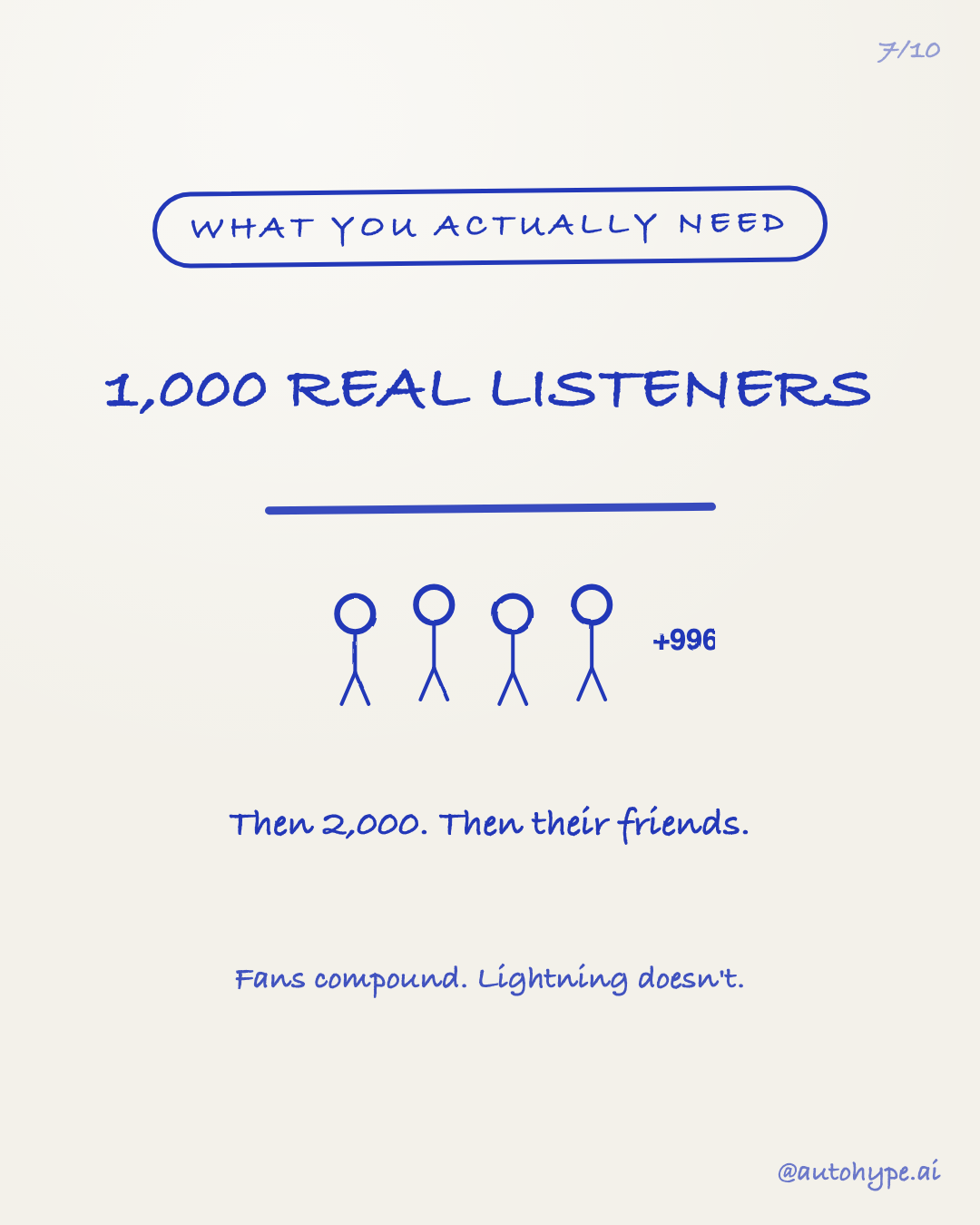
In 2008, Kevin Kelly wrote an essay called '1,000 True Fans' that quietly became the founding document of the independent creator economy. The argument: you don't need millions. You need roughly a thousand people who genuinely care — who save the song, show up, and buy the thing — because a thousand true fans is a career's worth of foundation.
The reason this works is that real listeners compound and impressions don't. A viral view scrolls past and forgets you existed. A real listener plays the next song, saves it, adds it to the gym playlist, sends it to a friend with 'you need this'. Each real fan is a node that recruits more nodes. A viral spike is a crowd walking past your window; a thousand real listeners is a room that fills every time you play.
The other thing about 1,000: it decomposes. You can't schedule a jackpot, but you can absolutely go get the next ten listeners, then the next hundred. Which brings us to the how.
Bricks, not lottery tickets: what stacking looks like
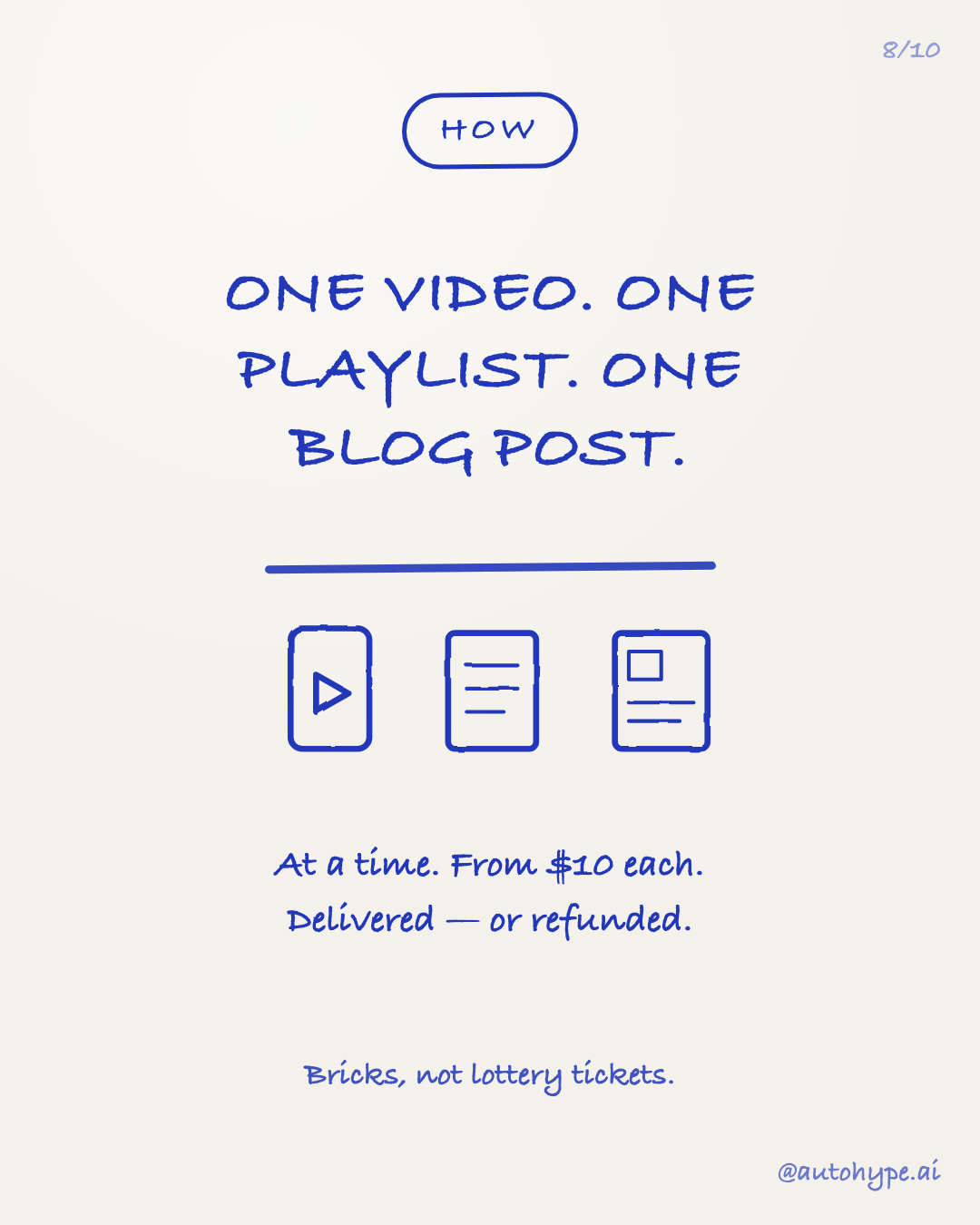
One video. One playlist pitch. One blog post. At a time. That's the whole method — unglamorous on any single day, unrecognizable after a year.
The prices make it a plan rather than a dream. On autohype.ai, sellers publish their own rates: playlist pitching from $10, TikTok or Instagram videos from $20, press and blog features from $20, YouTube and X promotion from $10 — with 17 services under $20 (floors verified in July 2026). Each order is a brick: small, priced, delivered — or refunded.
A realistic stacking rhythm for one release: a playlist pitch or two in the weeks before it drops, one creator video the week it's out, one blog feature after. Total damage: less than a mid-tier plugin. Then the next release gets the same treatment, and the one after that. No single brick is impressive. The wall is.
Boring? Yes. Working? Also yes.
We'll own it: this is a boring plan. It has no jackpot moment, no screenshot that makes your group chat gasp. What it has is the thing lottery tickets never give you — accumulation.
Repetition pays in three currencies. Skill: your tenth pitch is sharper than your first, because rejection is information. Data: you learn which kind of creator fits your sound, which playlists actually convert, what a fair price looks like. Relationships: curators and creators remember artists who show up professionally, release after release. A year of chasing virality teaches you nothing except that the slot machine is rigged. A year of stacking teaches you your own playbook.
Boring is what compounding looks like from up close. Zoom out and it looks like a career.
Stop chasing lightning. Start stacking listeners.
You don't need to go viral. You need the next hundred real listeners. Then the hundred after that. Fans compound; lightning doesn't — and unlike lightning, listeners can be introduced to you, one video, one playlist, one blog post at a time, by real people with written prices.
If the lightning finds you anyway, wonderful — you'll finally have somewhere for the crowd to land. That's the quiet punchline of the boring plan: it's also the best preparation for the exciting one.
Choose the next step for your release.
Compare Instagram repost campaigns and independent Spotify curator submissions. See which format fits your release, the deliverables, service fees and terms before ordering. No guaranteed views, streams or playlist placement.
Compare artist campaigns →Frequently asked questions
Do I need to go viral to have a music career?
No. Careers are overwhelmingly built on accumulation — a growing base of real listeners who save, share, and return — not on a single spike. Virality is welcome luck, but it's not a plan: the odds are unknowable and the moment rarely converts without a catalog and audience already in place to catch it.
What should I do instead of chasing virality?
Buy known reach in small, verifiable units and repeat: a playlist pitch here, a creator video there, a blog feature after release. On marketplaces with public prices this starts around $10–$20 per order, with escrow and refunds if delivery doesn't happen. Each order adds real listeners; the repetition is what compounds.
How many listeners do I actually need?
The most durable benchmark is Kevin Kelly's '1,000 true fans' idea: roughly a thousand people who genuinely care is a career foundation. The useful property of that number is that it decomposes — you can't schedule a viral hit, but you can go earn the next ten real listeners this month.
Can a promotion service make my song go viral?
No honest one will claim that. What a legitimate service delivers is the work — a real creator posting a real video, a real curator reviewing your pitch — at a written price, on a written date. We guarantee delivery, not results. Anyone promising virality is selling you a lottery ticket with a service fee.