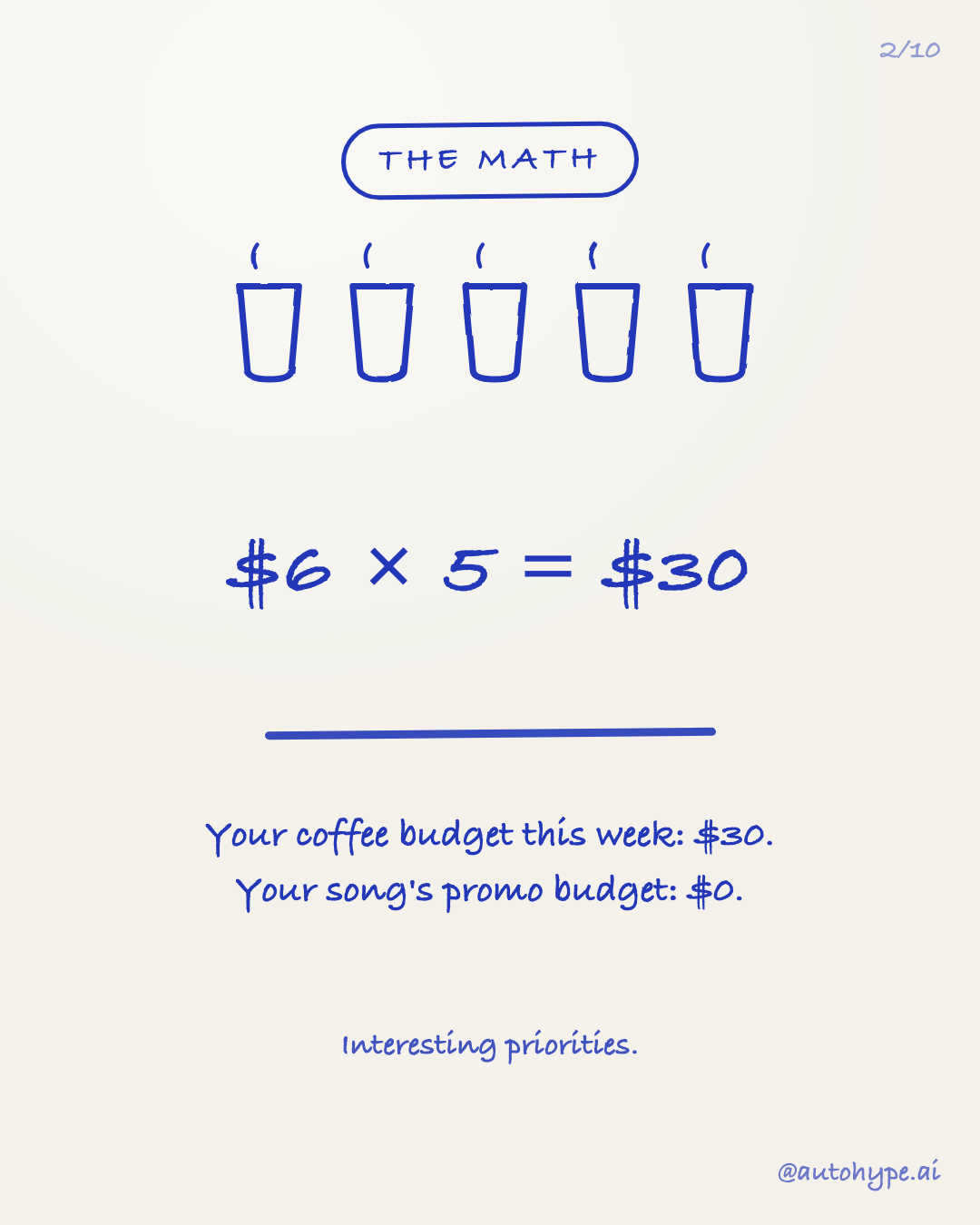
Yes, this is one of those "skip your coffee" posts. We're not proud of it either. The skip-your-latte genre is the most eye-rolled advice format on the internet, usually deployed by people selling courses, and we promise we know how it sounds. We wrote it anyway, for one irritating reason: the math checks out. A $6 coffee, five days a week, is $30. That's a real number leaving your account every week while "I have no promo budget" does the talking. This article is about what that same $30 buys in actual, delivered, refund-protected music promotion — with prices verified live on autohype.ai on July 17, 2026. And then, at the end, we'll tell you to keep the coffee anyway. Stay with us.
The math is annoying, and that's the point
Nobody's coffee is the problem. The problem is the sentence "I can't afford promotion" coming from a person who spends $30 a week on things that last eleven minutes. It's not a moral failing — it's an accounting blind spot. Small recurring pleasures feel free; one-off investments in your own music feel expensive. That asymmetry quietly decides your song's future.
So run the honest ledger once. Coffee budget this week: $30. Your song's promo budget this week: $0. If the song matters to you, those two numbers in that order should sting a little. Not enough to give up caffeine — enough to question which of the two purchases you'll remember in a year.
The rest of this article prices the alternative in coffee units, because apparently that's the only currency this industry conversation respects.
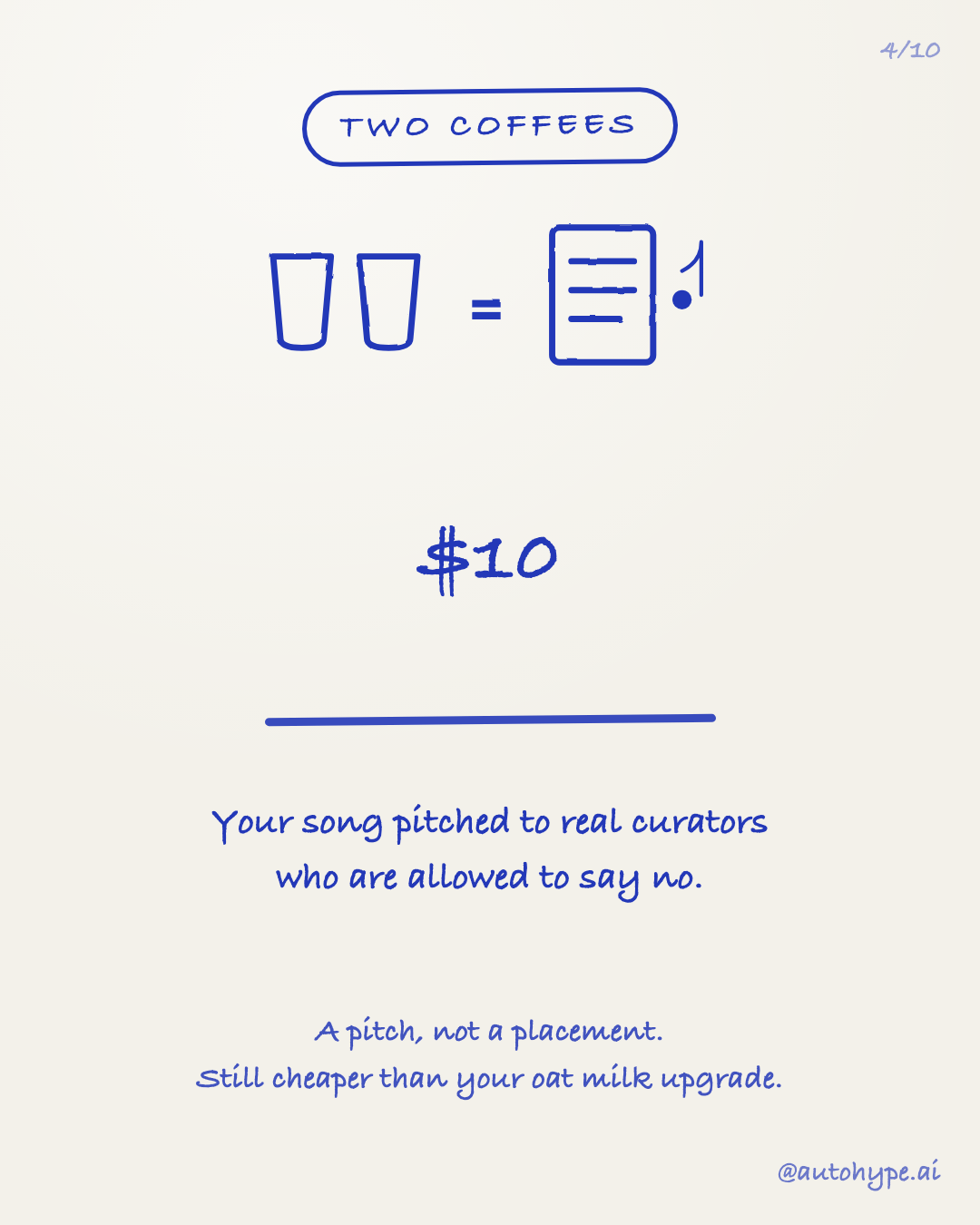
Two coffees ($10): a real push or a real pitch
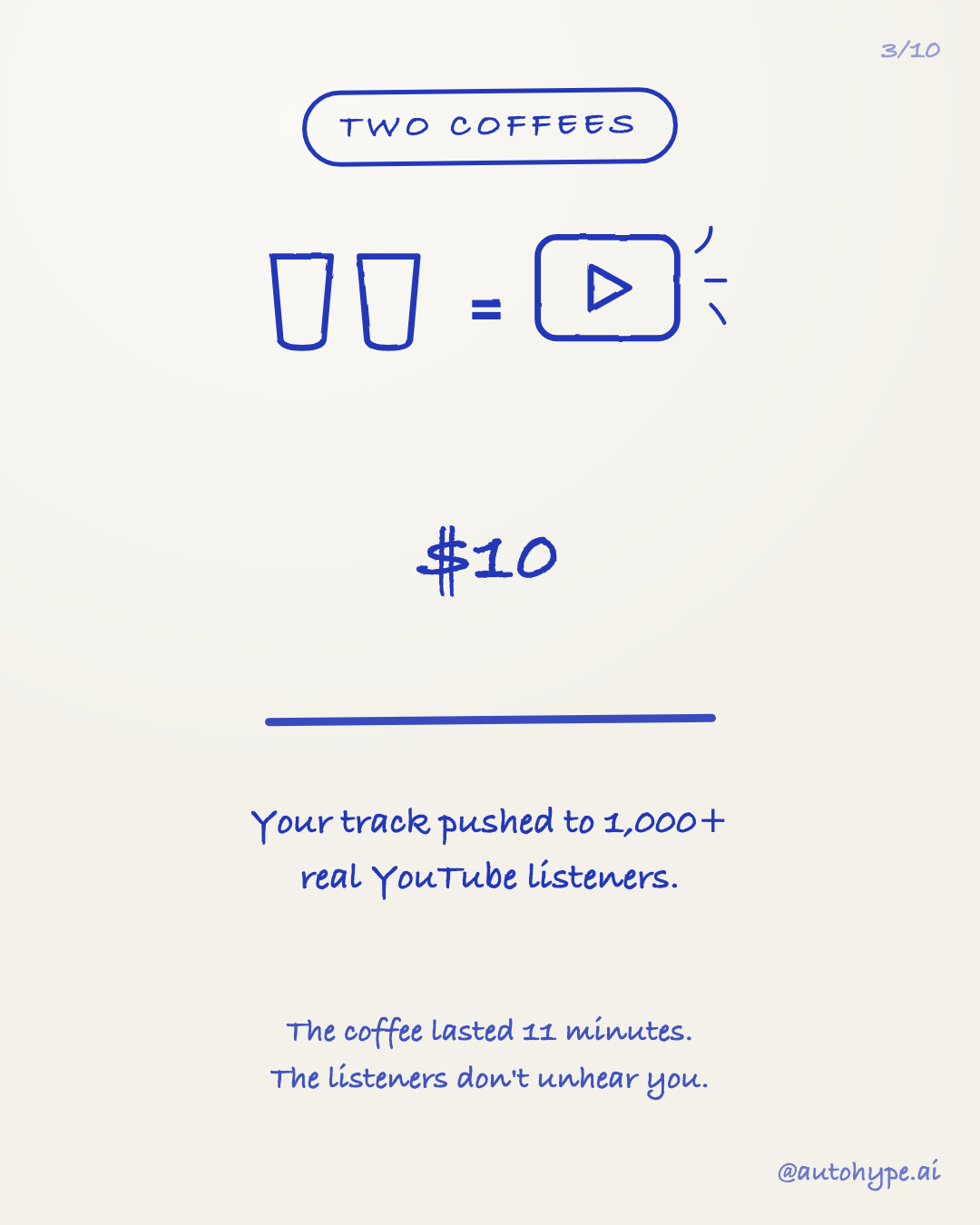
Ten dollars — two coffees — was the floor price on July 17, 2026 for a YouTube or X push: your track shared to an audience of over 1,000 real listeners by the person who built that audience. The coffee lasted eleven minutes. A listener who hears your song can't unhear it.
The same $10 alternatively buys a playlist pitch: your song submitted to real curators who are allowed to say no. Read that clause again, because it's the quality filter — a curator who can decline is a curator whose playlist means something. You're buying a pitch, not a placement, and anyone who sells you a guaranteed placement on a playlist worth being on is selling fiction.
Either way, the transaction is written down: price, deliverable, deadline, and escrow holding the money until the work ships. Still cheaper than your oat milk upgrade.
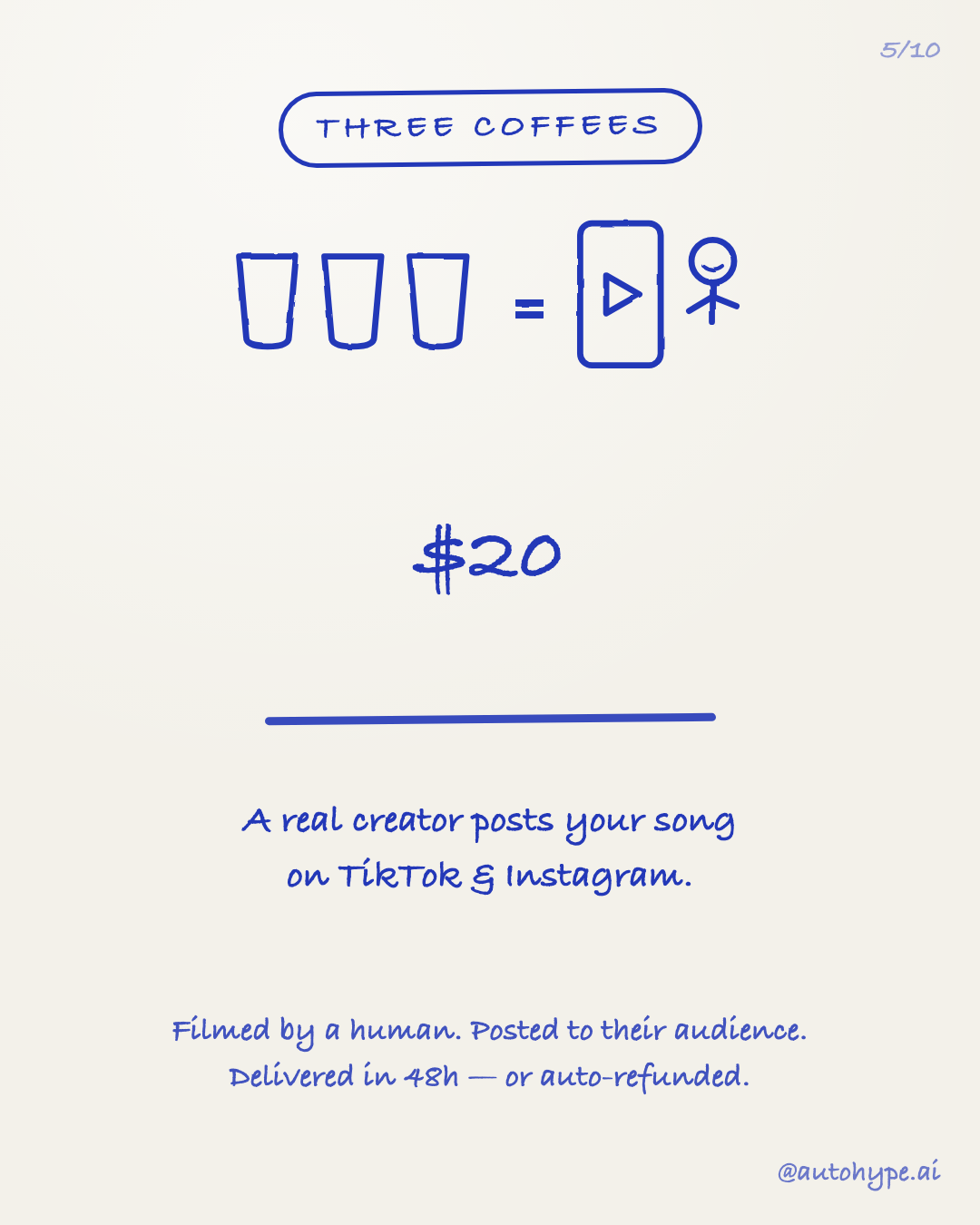
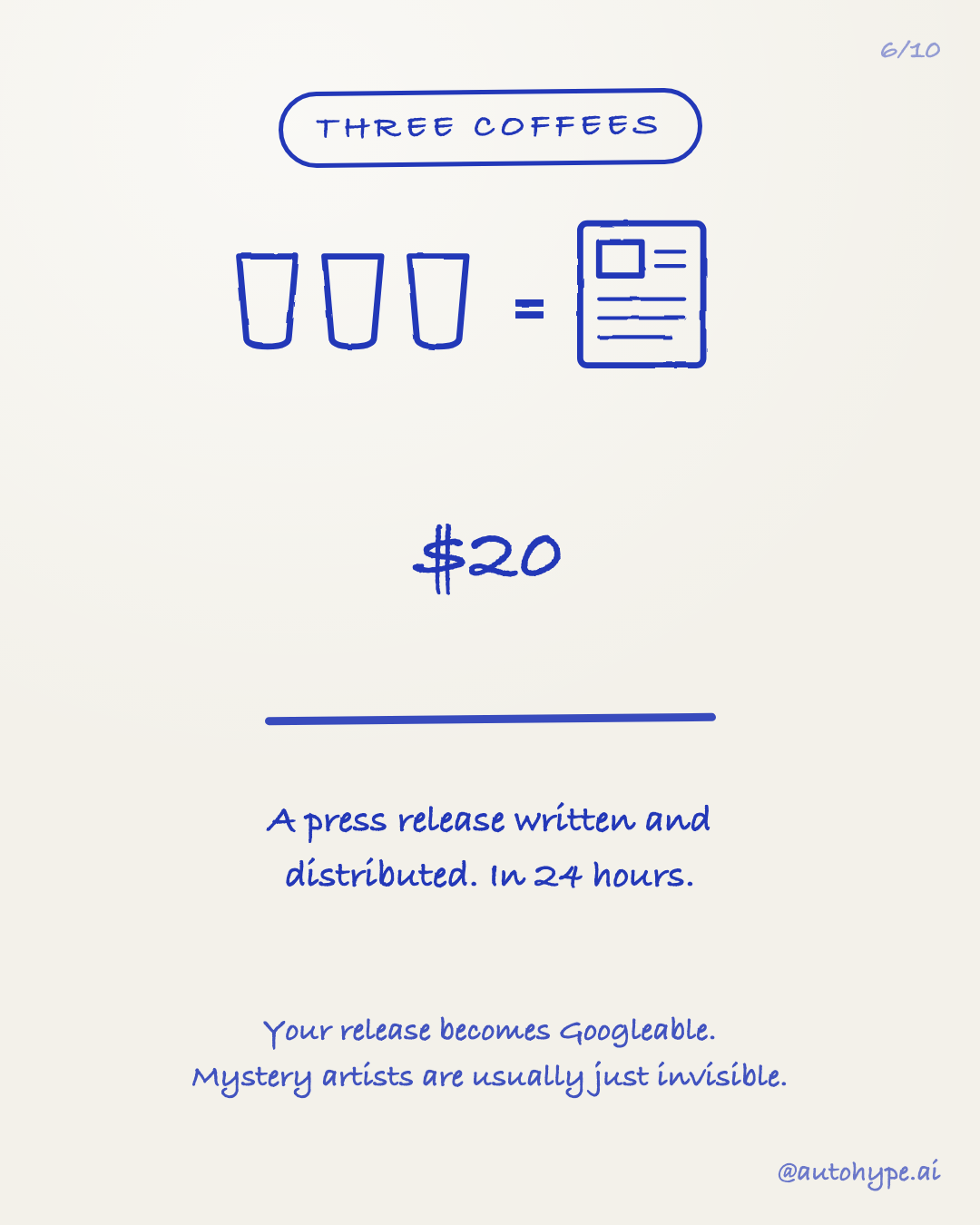
Three coffees ($20): a human with a camera, or a Googleable release
At $20 — three coffees — the floor bought a real creator posting your song on TikTok and Instagram. Filmed by a human, posted to their actual audience, delivered within 48 hours or automatically refunded. That's a real person deciding how to present your music to people who follow them for their taste. No bot farm produces that sentence.
The same $20 alternatively bought a press release written and distributed within 24 hours. Unglamorous? Completely. But here's what it fixes: when a curator, a blogger or a booker searches your artist name and finds nothing, the conversation usually ends there. "Mystery artist" sounds romantic; in practice it just reads as invisible. Twenty dollars makes your release Googleable.
Two very different purchases, same three-coffee price. Which one your song needs first depends on whether your problem is attention or credibility — most artists need a little of both, which is where the next number comes in.
Compare Instagram repost campaigns and independent Spotify curator submissions. See which format fits your release, the deliverables, service fees and terms before ordering. No guaranteed views, streams or playlist placement.
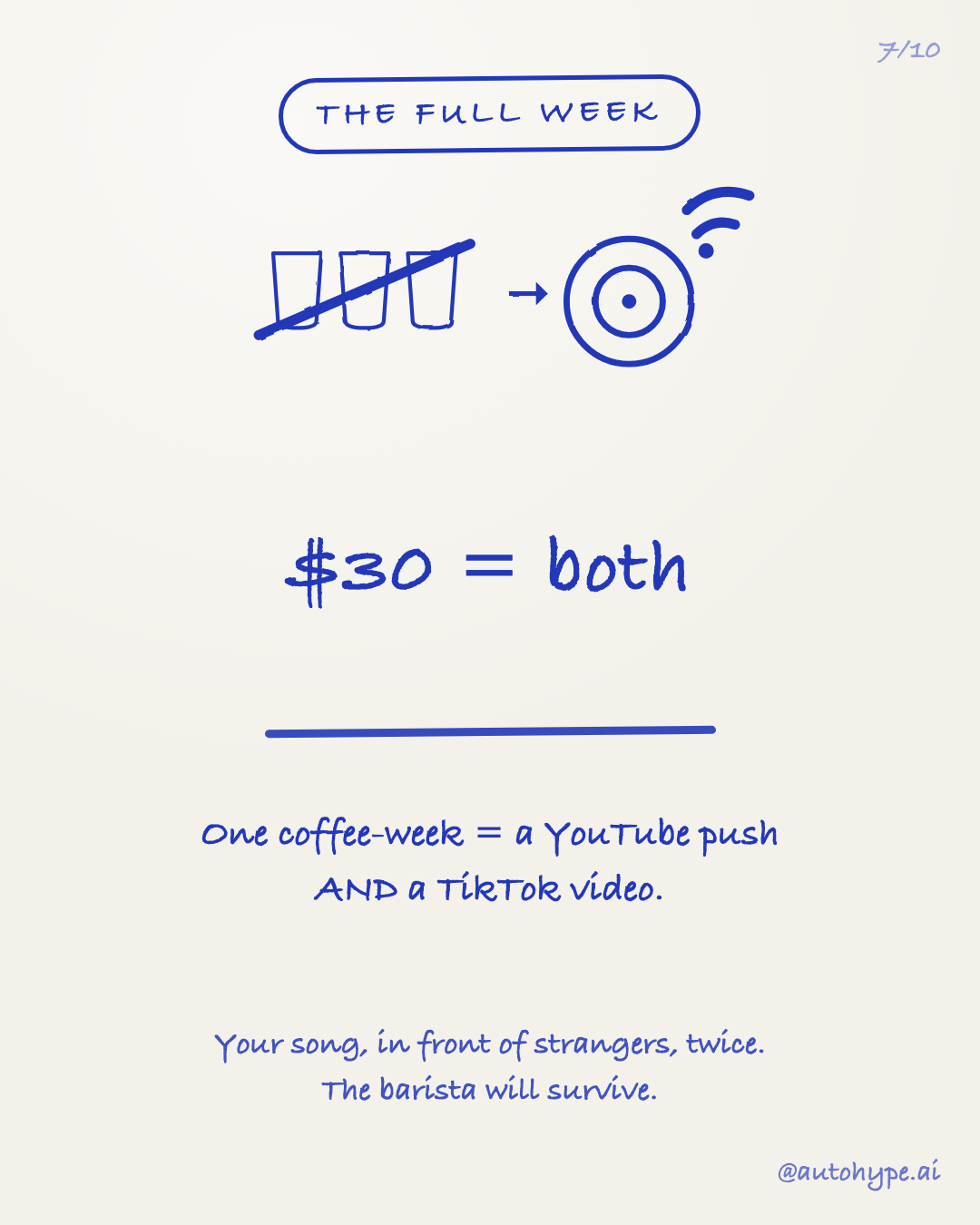
The full week ($30): your song in front of strangers, twice
One coffee-week — $30 — covered both: a YouTube push and a TikTok creator video. Your song, in front of strangers, twice, on two different platforms, through two different real humans. The barista will survive the loss.
Why does "twice" matter more than "bigger once"? Because at this budget you're not buying fame, you're buying information. Two small orders on two channels tell you where your song actually connects — which format got saves, which audience replayed the hook — for the price of one week of lattes. That information is what makes your next $30 smarter than your first.
This is the honest case for cheap music promotion that works: not that small money buys big outcomes, but that small real orders compound into knowledge, contacts and content, while big vague promises compound into nothing.
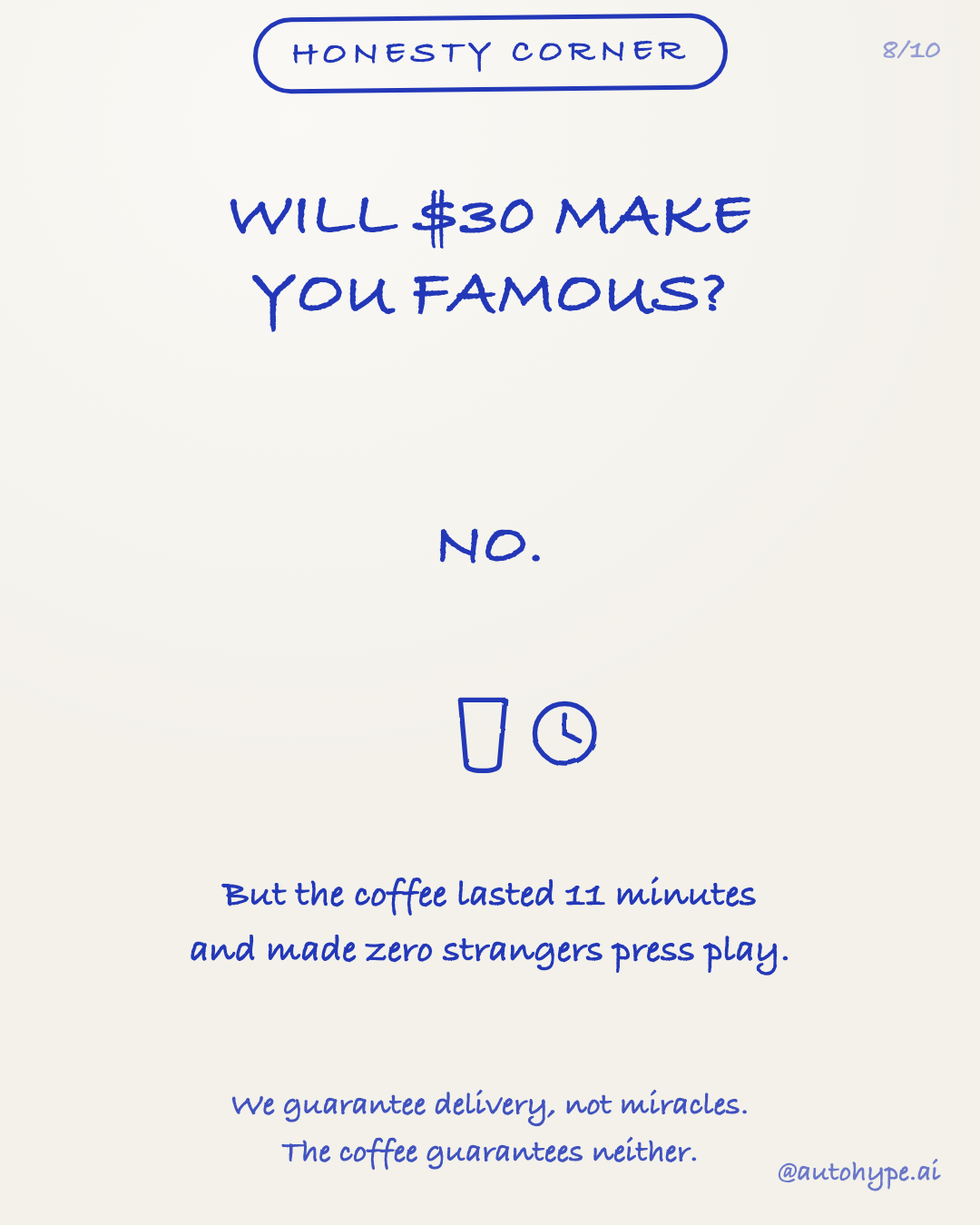
Honesty corner: will $30 make you famous? No.
Let's kill the fantasy before someone sells it to you. Thirty dollars will not make you famous. It won't make the algorithm anoint you, and anyone who says otherwise for any price is lying — fame was never on any legitimate menu. What $30 buys is defined work, actually delivered: a post that exists, a pitch that was sent, listeners who pressed play because a human they follow shared your song.
We guarantee delivery, not results. The distinction is the entire business model: every order either ships on time or refunds without you chasing anyone. The results — saves, follows, the curator's yes — belong to your song, as they should. For comparison, the coffee guarantees neither delivery nor results. It's just gone by 9:11 a.m.
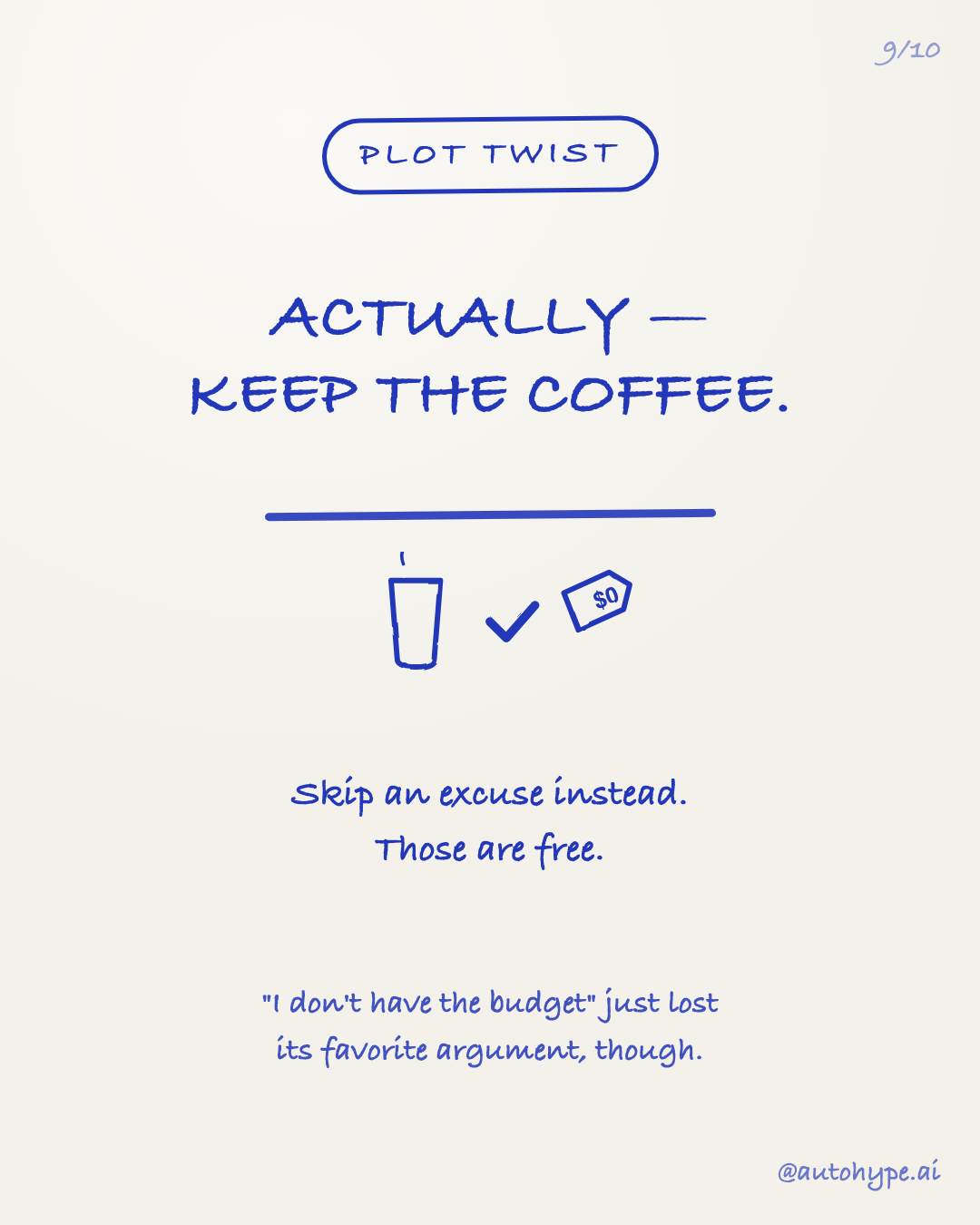
Plot twist: keep the coffee
Here's the part the skip-your-latte genre never says: keep the coffee. We don't actually want you under-caffeinated and miserable, and $6 of daily joy is a fine purchase. The latte was never the enemy. It was just the most convenient measuring stick for a budget you claimed not to have.
Skip an excuse instead — those are free and you have several. "I don't have the budget" just lost its favorite argument to a paragraph of arithmetic. "I'll promote it when it's perfect" and "the right people will find it eventually" are next in line, and neither survives contact with a $10 order form.
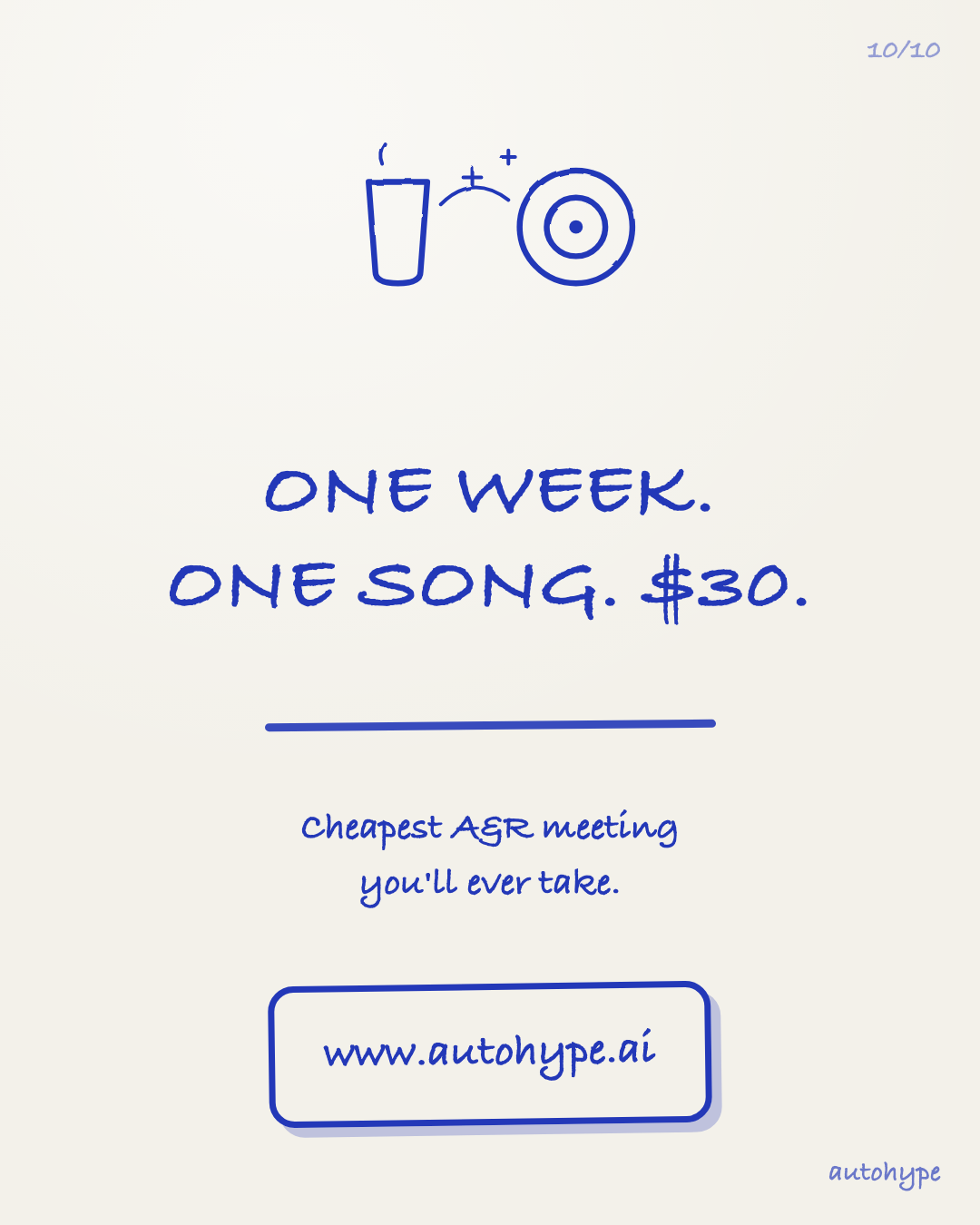
One week. One song. $30. It's the cheapest A&R meeting you'll ever take — and unlike the coffee, it's still working for you tomorrow.
Choose the next step for your release.
Compare Instagram repost campaigns and independent Spotify curator submissions. See which format fits your release, the deliverables, service fees and terms before ordering. No guaranteed views, streams or playlist placement.
Compare artist campaigns →Frequently asked questions
Is cheap music promotion always bots and fake streams?
No — but cheap promises of huge numbers always are. The difference is what's being sold: 10,000 streams for $20 is a bot farm, while one creator video for $20 is a real person's real work at an entry-level price. Judge cheap promotion by whether the deliverable is a defined human action with a written price, not by the price tag alone.
What's the smallest music promotion budget that's actually useful?
As of July 17, 2026, floors on Autohype started at $10 for a playlist pitch or a YouTube/X push, and 17 services were listed under $20. One $10–$20 order is genuinely useful — not because it transforms your career, but because it gets your song in front of real strangers and teaches you which format works before you spend more.
Will a $20 or $30 order get me a specific number of streams?
No, and nobody honest will promise you one. A real order guarantees the work — a video posted, a pitch sent, a release distributed — with an automatic refund if it isn't delivered on time. We guarantee delivery, not results. Listener reactions can't be pre-purchased; services that promise exact stream counts are describing bots.
Why are several small orders better than one big campaign?
Because small orders buy information as well as promotion. Two $15 orders on different channels show you where your song connects — which audience saved it, which format flopped — so your next dollars go where the evidence points. One big upfront campaign spends your whole budget before you've learned anything.