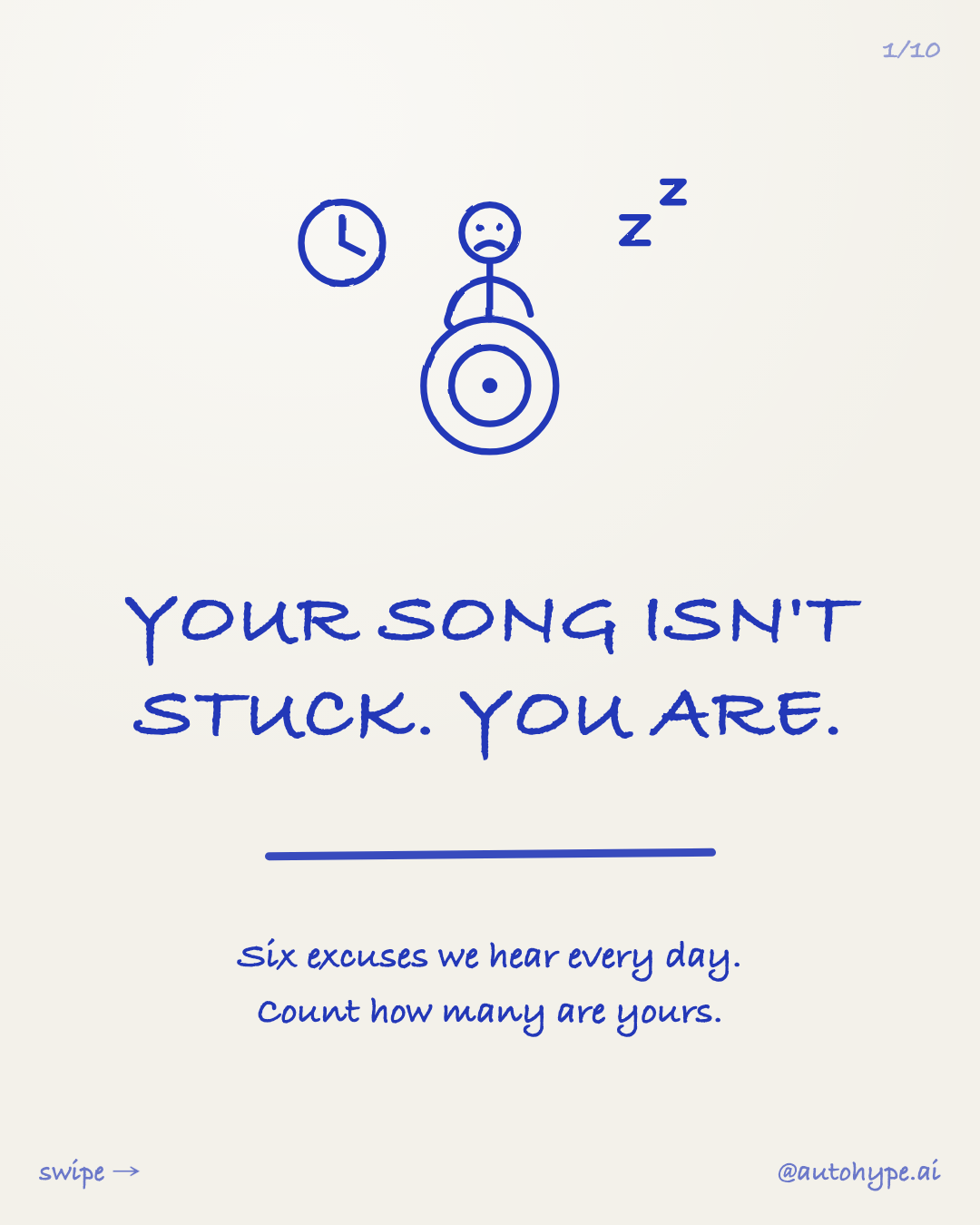
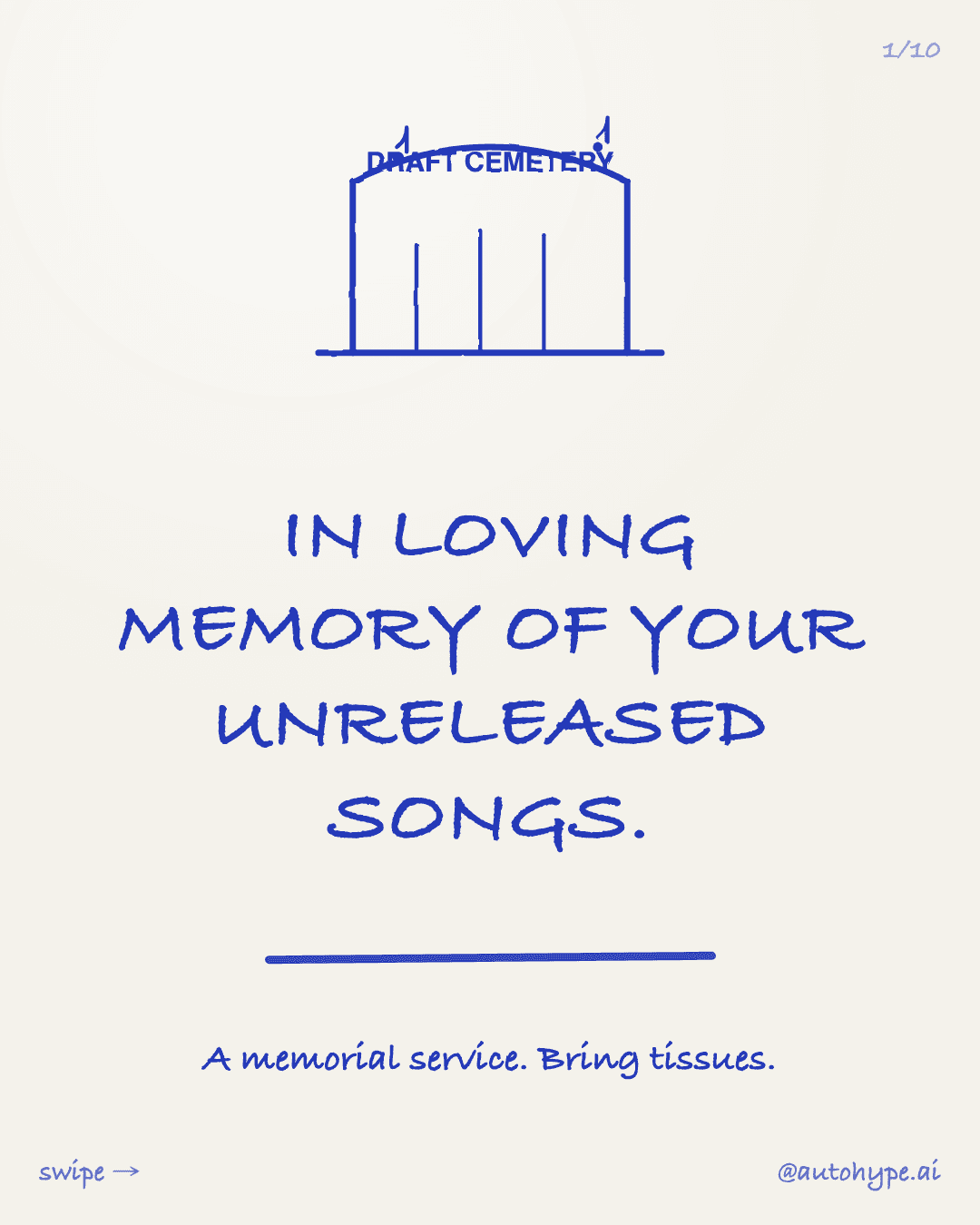
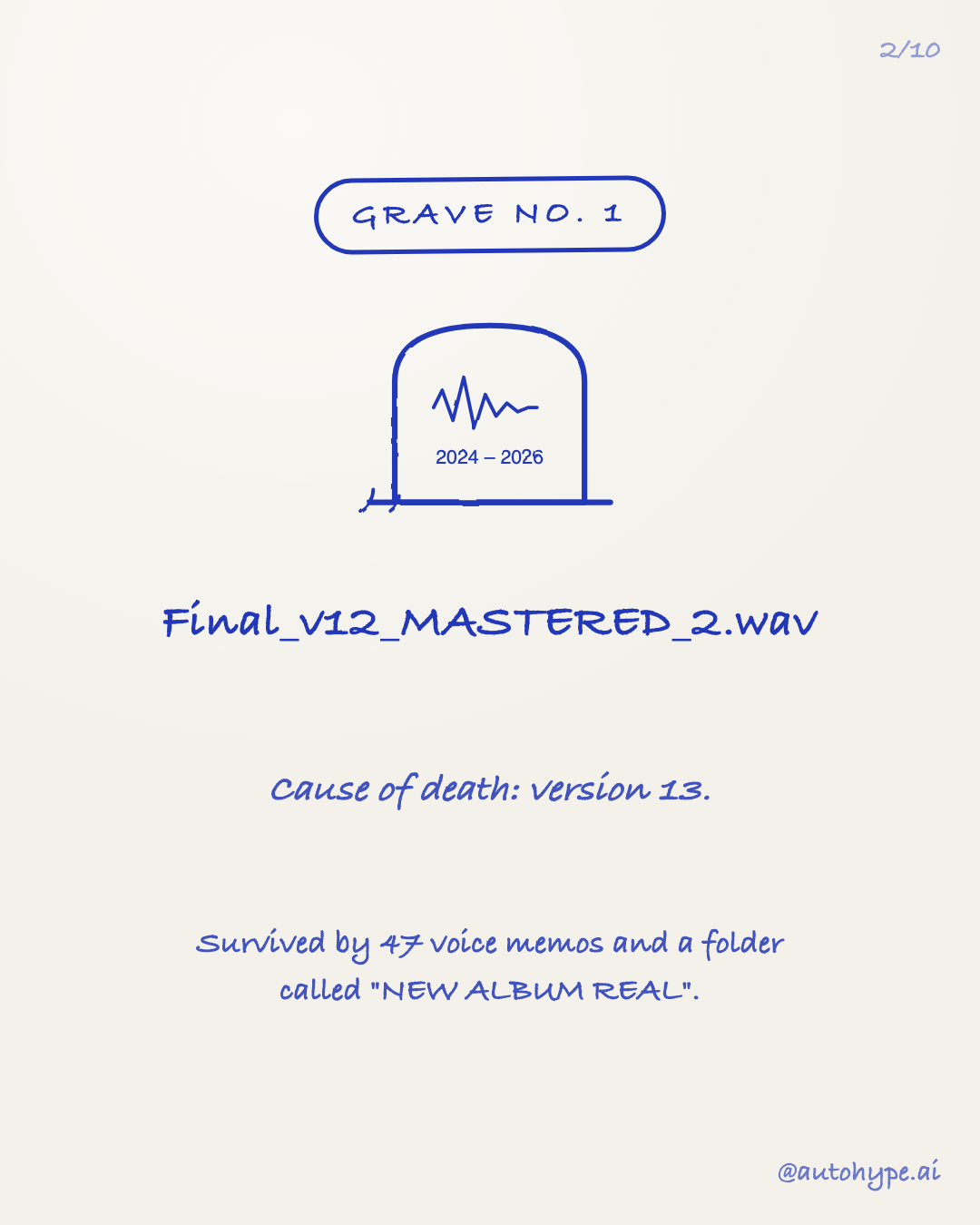
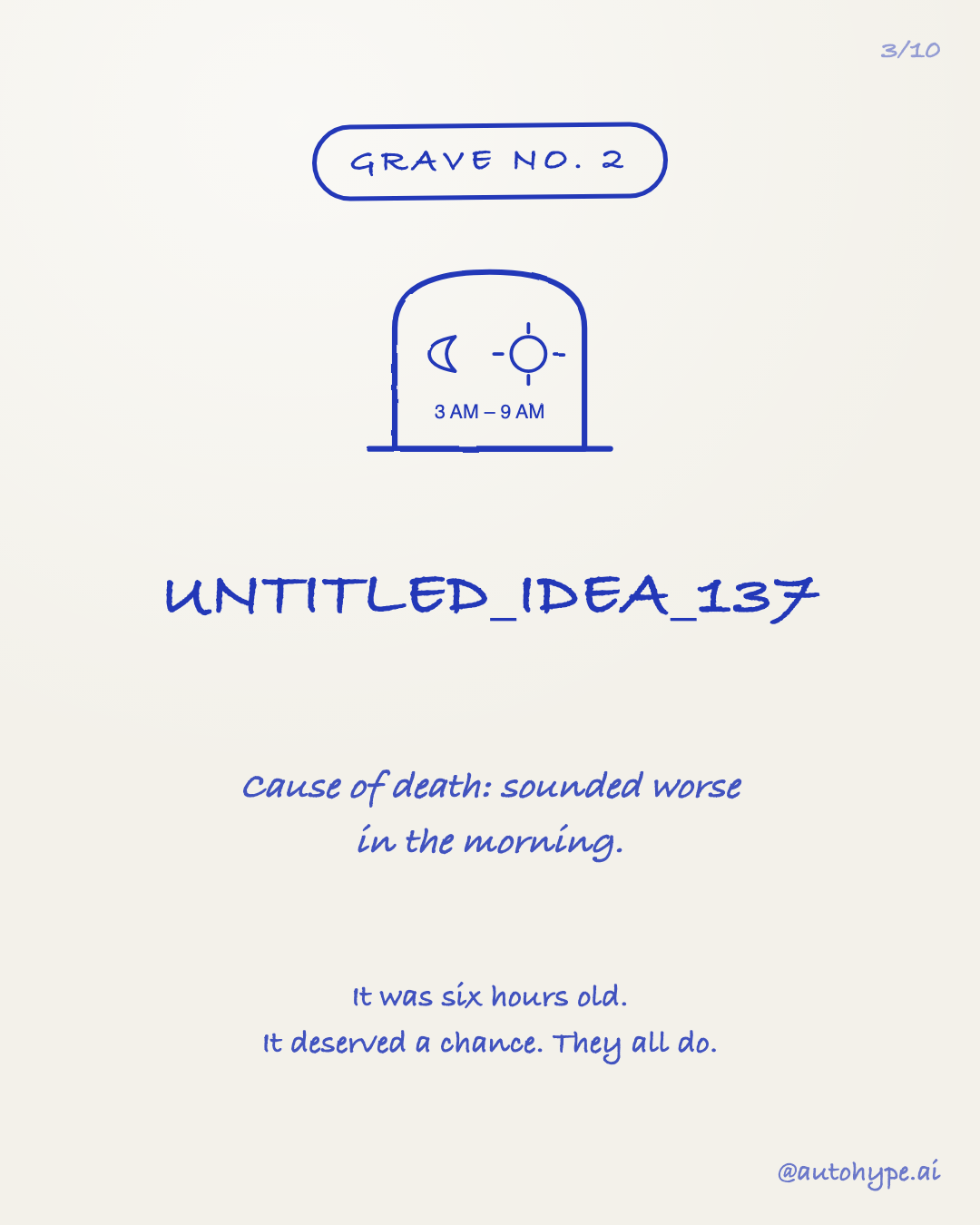
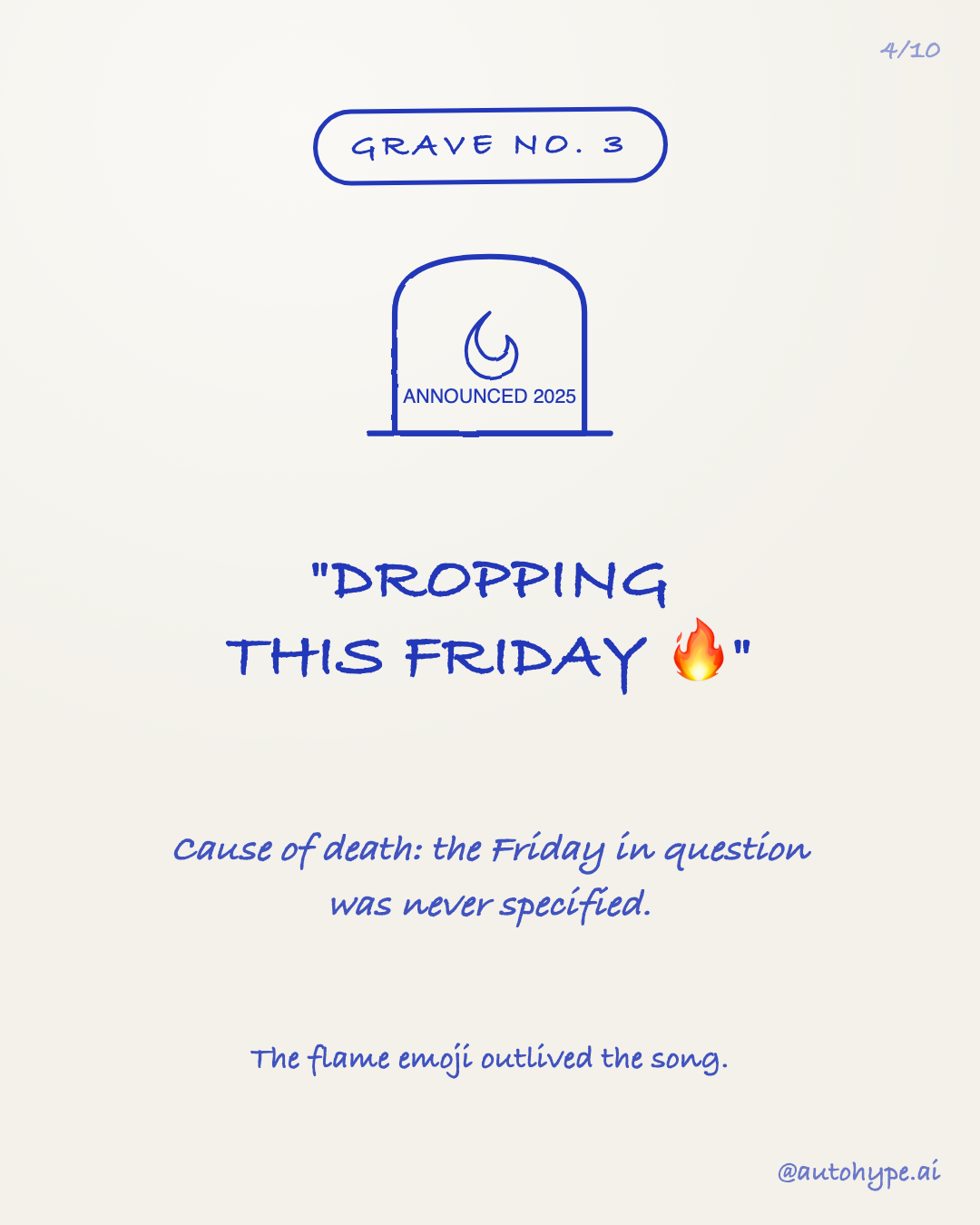
Somewhere on your hard drive there's a folder. You know the one. Final_v12_MASTERED_2.wav lives there. So does Untitled_Idea_137, born at 3am and dead by 9. So does the track you announced with 'Dropping this Friday 🔥' — the Friday in question was never specified. This article is their memorial service. Bring tissues. It's also a resurrection manual. Because here's the thing about those songs: they didn't die of bad quality. They died of waiting. And waiting is curable — with a protocol simple enough to fit on a sticky note, and honest enough to admit up front what nobody can promise you.
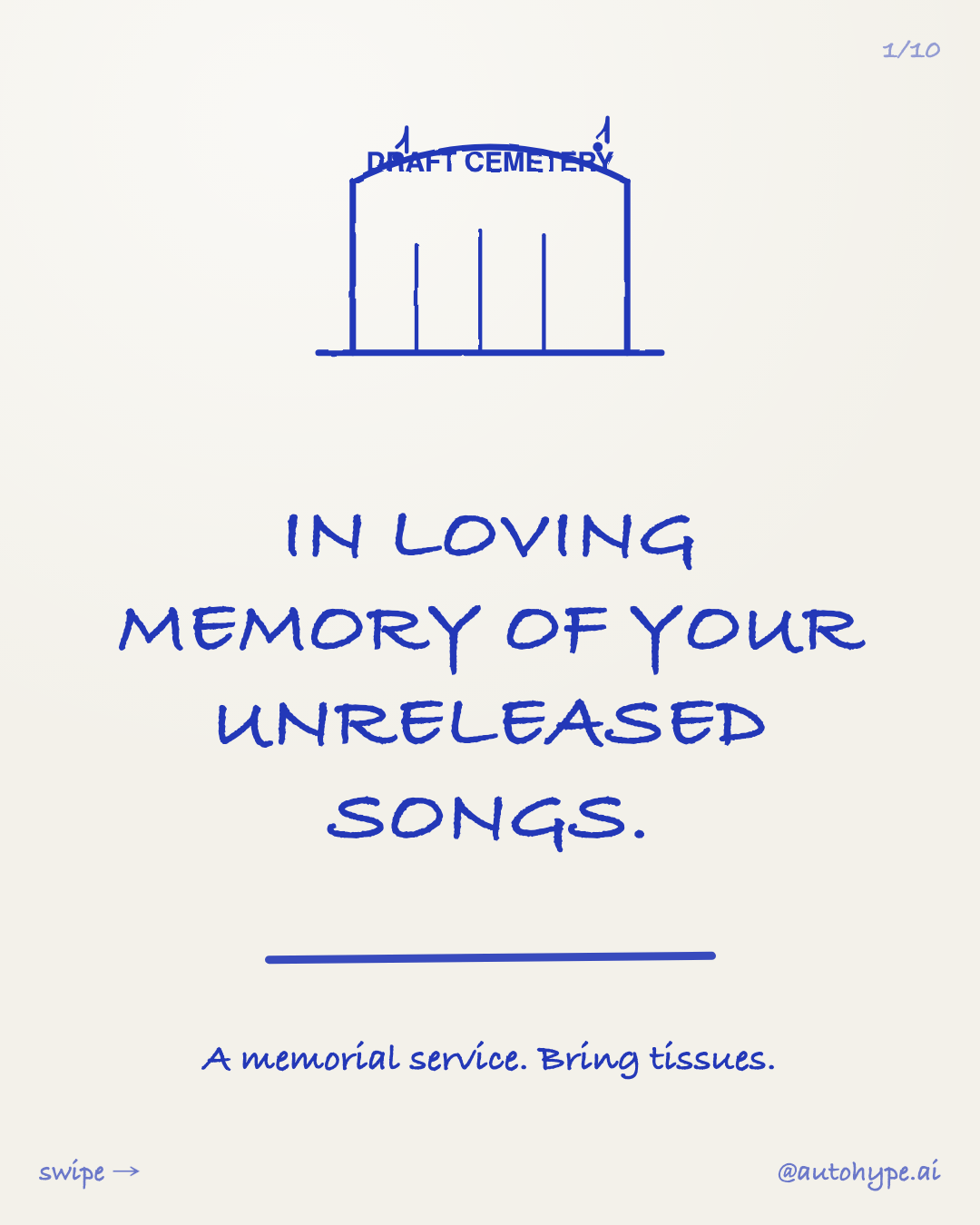
Welcome to the draft cemetery
Take the tour. Grave No. 1: Final_v12_MASTERED_2.wav, 2024–2026, cause of death: version 13. Survived by 47 voice memos and a folder called 'NEW ALBUM REAL'. Grave No. 2: Untitled_Idea_137, lived from 3am to 9am, cause of death: sounded worse in the morning. It was six hours old. It deserved a chance — they all do. Grave No. 3: 'Dropping this Friday 🔥', announced sometime in 2025. The flame emoji outlived the song.
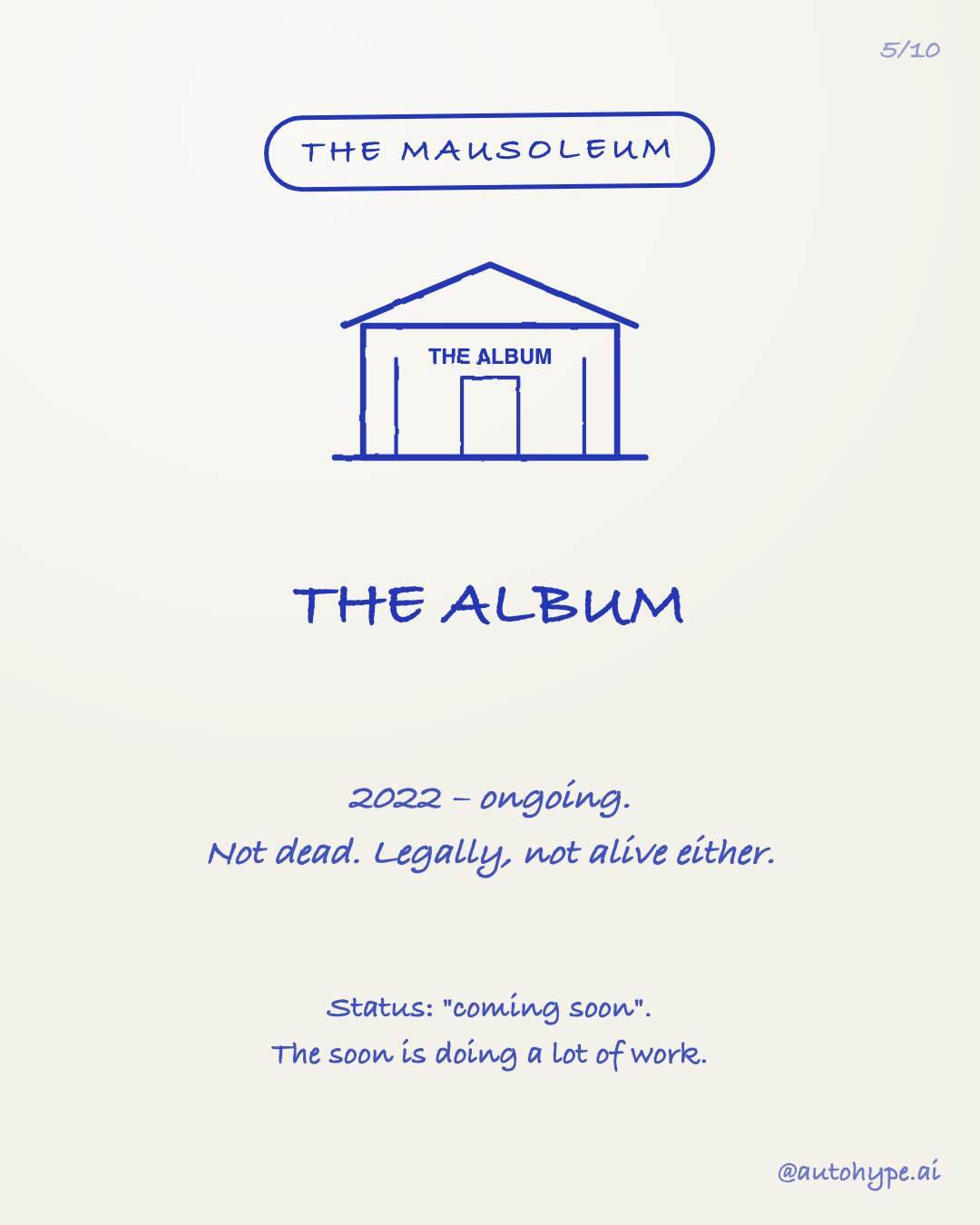
And at the center of the grounds, the mausoleum: The Album. 2022–ongoing. Not dead — legally, not alive either. Status: 'coming soon'. The soon is doing a lot of work.
If none of these files exist on your drive, congratulations: close this tab and go promote something. Everyone else, keep reading — we're about to dig.
Cause of death: never the music
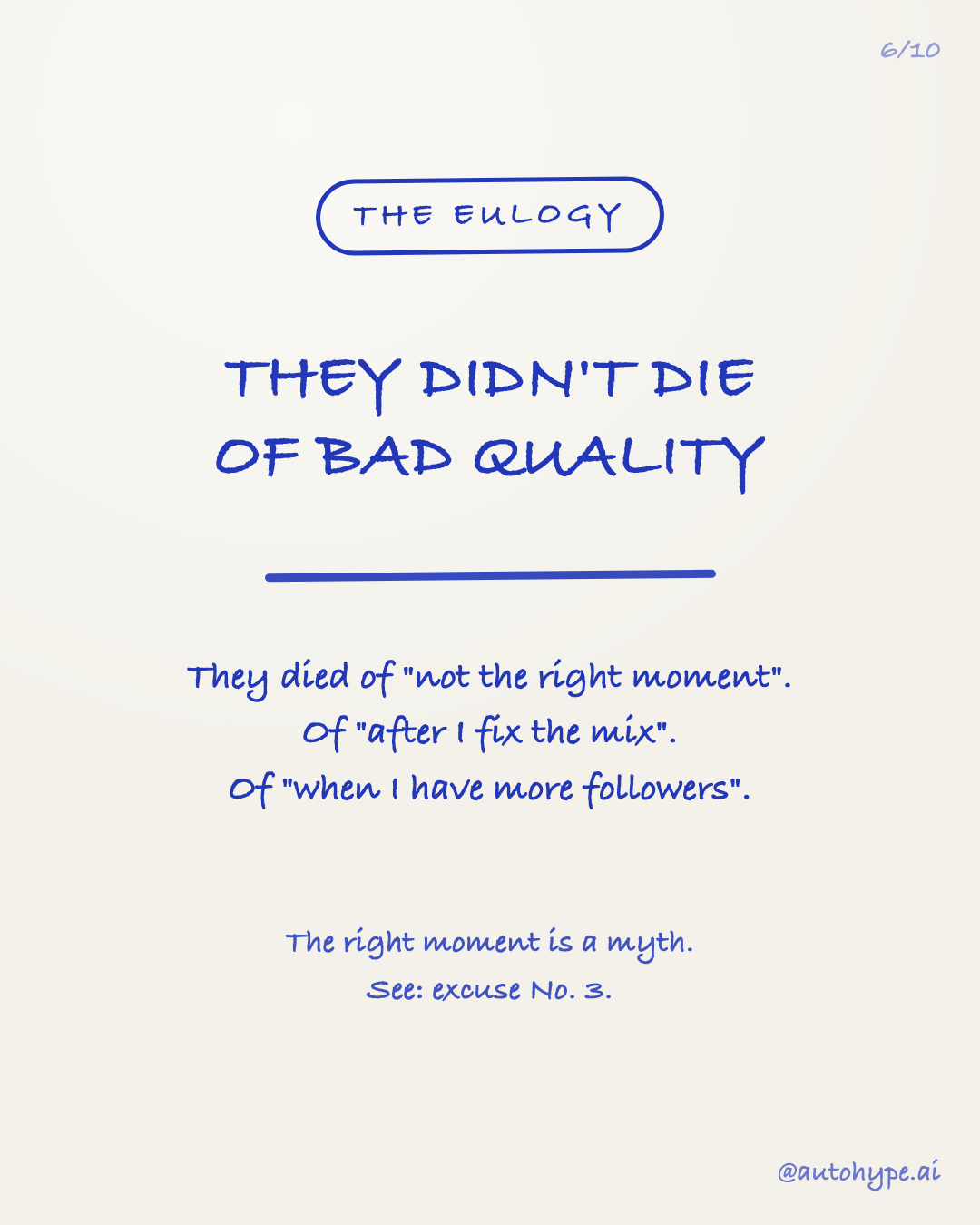
Read the tombstones again. Not one says 'died of being a bad song'. They say version 13. Sounded worse in the morning. The Friday was never specified. Every cause of death in this cemetery is a variation of the same thing: waiting, dressed up as a reason.
'Not the right moment.' 'After I fix the mix.' 'When I have more followers.' Each sounds responsible. Each has the same expiry date: never. The right moment is a myth (see our excuses article, grave — sorry, excuse — No. 3), the mix fix that matters was four versions ago, and the followers you're waiting for are waiting for you to release something.
Here's the uncomfortable technical truth: past a certain version, your changes are inaudible to every human who isn't you. The difference between v8 and v12 is real to you because you've heard the song four hundred times. To a first-time listener, both are simply the song. Version 13 was never going to save it, because it was never in danger — it was finished.
Perfectionism is fear wearing studio headphones
Why do we do this? Because a draft is pure potential. Unreleased, your song can still be a masterpiece — nobody has proven otherwise. Released, it becomes data: a number that can underwhelm, comments that may not come. Perfectionism isn't a quality standard. It's a strategy for keeping the dream unfalsifiable.
That's why 'one more pass' feels so virtuous. It looks like craftsmanship, but functionally it postpones the verdict. Version 13 isn't improving the song; it's buying another week where the song can't disappoint you.
There's an identity layer too: 'producer with 200 drafts' is a safe thing to be. Prolific, mysterious, permanently promising. Releasing converts you into something riskier — an artist with a catalog people can actually judge. The cemetery is comfortable. That's exactly what's wrong with it.
Compare Instagram repost campaigns and independent Spotify curator submissions. See which format fits your release, the deliverables, service fees and terms before ordering. No guaranteed views, streams or playlist placement.
What the graveyard actually costs you
Cost one: the feedback loop. A draft teaches you nothing — it has no listeners, no skips, no saves, no 'this part hits'. A release teaches you everything, including the uncomfortable lessons, which happen to be the valuable ones. Producers who release twelve imperfect songs a year improve faster than producers who polish one, for the same reason you can't learn to swim from the diving board.
Cost two: the catalog. Every released song is a permanent discovery surface — a door a stranger can walk through years later. Drafts have no doors. When something eventually goes right for you, the curious will look for more and find either a body of work or a single lonely track.
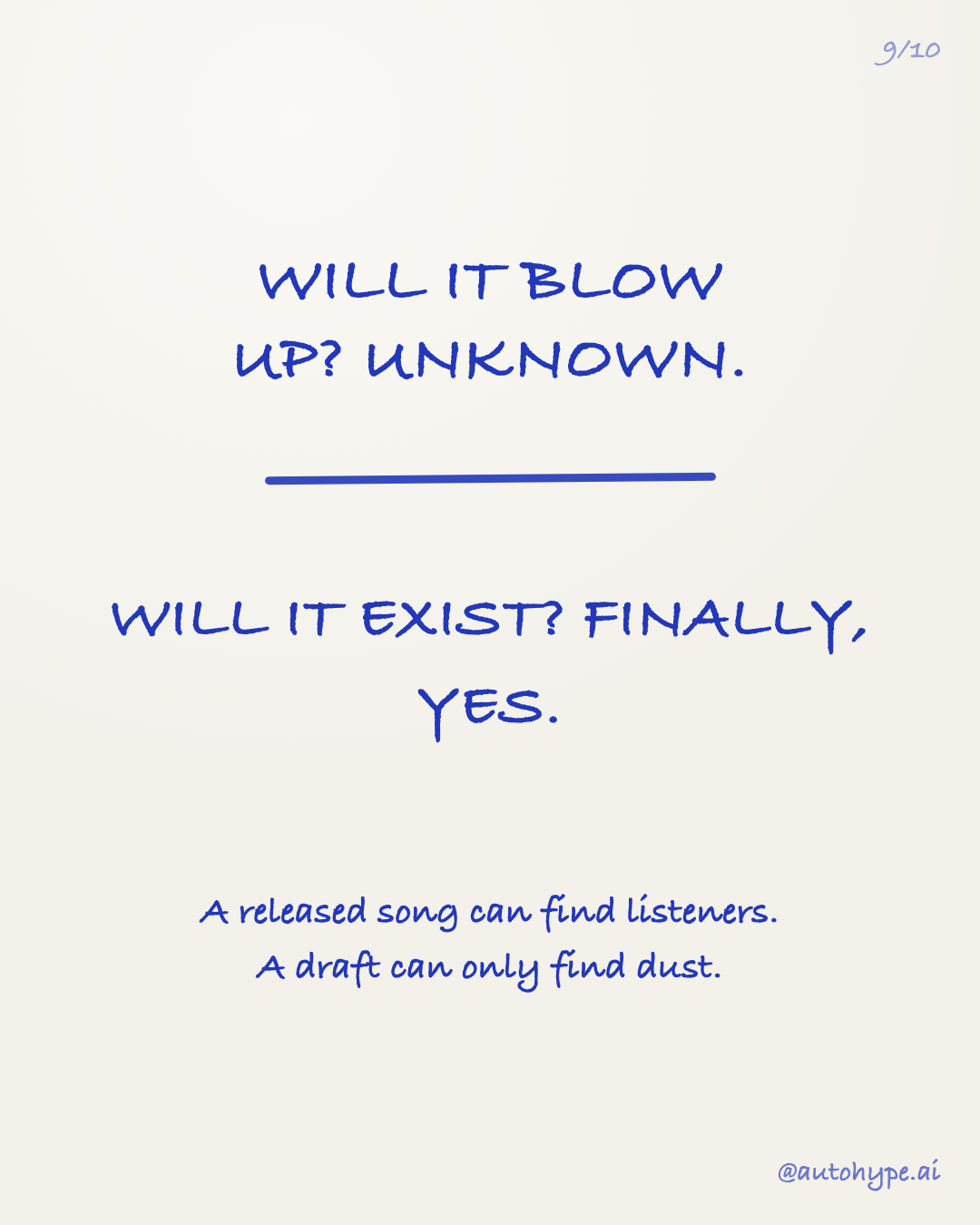
Cost three: the compounding you'll never see. Listeners can only accumulate on songs that exist. As the slide says: a released song can find listeners. A draft can only find dust.
The 5-step release protocol
Step 1 — Pick ONE. Not your best song; your most finished one. The bar is 'ready', not 'perfect', and you only get to pick a single hostage to free. Choosing one is the point: the protocol dies the moment it becomes a plan to release everything, someday.
Step 2 — Declare it mastered. One final pass, then the version counter is frozen. If you can't trust your own ears anymore (fair — you've heard it four hundred times), hand it to a studio engineer with a written price and a delivery date, or bounce the best version you have. Either way: version 13 is cancelled.
Step 3 — Set a date, in writing. Two to four weeks out. Long enough to prepare artwork, distribution, and playlist pitches before release; short enough that cold feet can't organize a comeback.
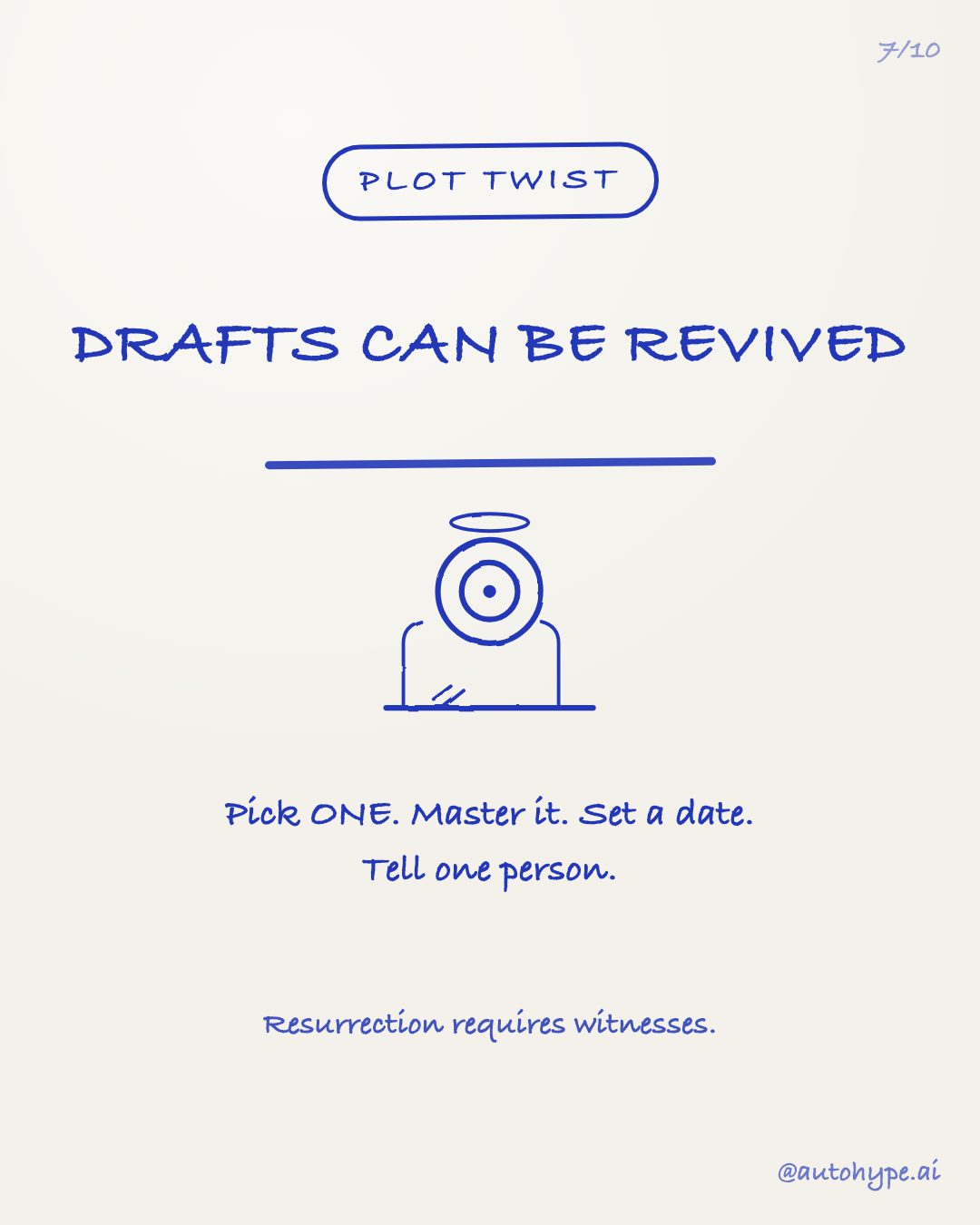
Step 4 — Tell one person. Resurrection requires witnesses. A date only you know is a suggestion; a date one friend will ask about is a deadline. Choose the friend who follows up.
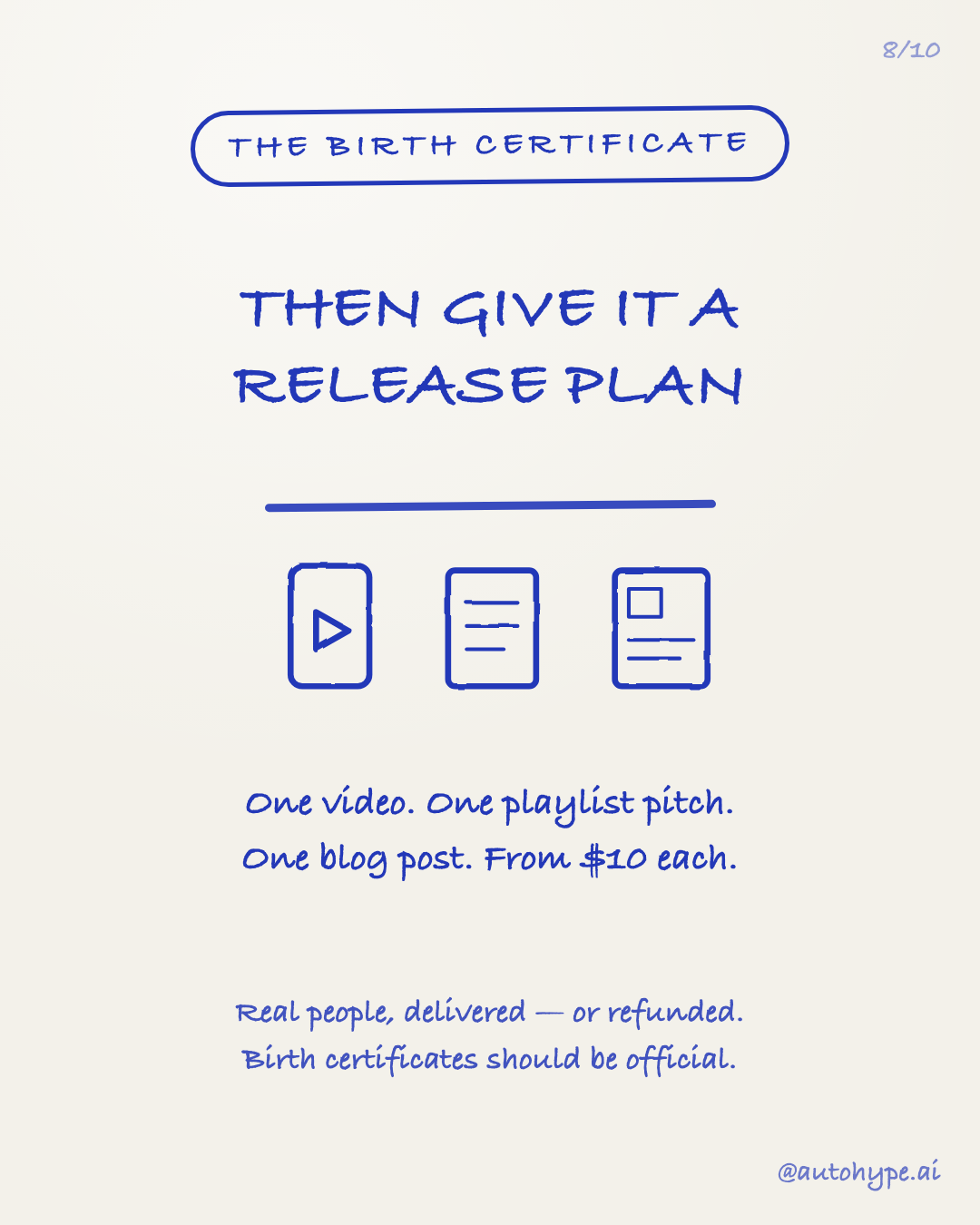
Step 5 — Give it a birth certificate. After the death certificate, paperwork of the happier kind: a small promo plan. One video, one playlist pitch, one blog post. On autohype.ai those start at $10, $20 and $20 respectively — prices set by the sellers, verified July 2026 — from real people, with your money held until the work is delivered, or refunded.
Will it blow up? Unknown. Will it exist? Finally, yes.
Time for the honest part of the eulogy. Nobody can promise you that the song you free this month does numbers. Not us, not anyone — we guarantee delivery, not results. The promoters you hire will do the work they were paid for; what the world does with your song was always between the song and the world.
But notice what changes the moment you release: the question upgrades. 'Could it have been something?' is a question that haunts. 'What did it do, and what do I make next?' is a question that builds. Existence beats potential, every time, because existence compounds and potential just accrues dust.
So: free one hostage this month. Pick the file. Follow the five steps. Release the damn song — we'll handle the 'heard' part.
Choose the next step for your release.
Compare Instagram repost campaigns and independent Spotify curator submissions. See which format fits your release, the deliverables, service fees and terms before ordering. No guaranteed views, streams or playlist placement.
Compare artist campaigns →Frequently asked questions
How do I know when a song is finished?
A practical test: if your last two versions would be indistinguishable to someone hearing the song for the first time, it's finished. Past that point, revisions aren't improving the track — they're postponing the release. Freeze the version counter, do one final master pass (yours or a hired engineer's), and set the date.
What if I release it and it flops?
Then you've earned something a draft can never give you: information. A quiet release tells you about pitching, artwork, timing, and which sounds connect — lessons that compound into the next release. A draft teaches nothing and expires worthless. Also, a 'flop' is permanent discovery surface: songs get found years after release.
How far in advance should I plan a release?
Two to four weeks covers the essentials without leaving room for cold feet: distribution upload, artwork, and playlist pitching ahead of the date, then a creator video and press outreach around release week. The plan can be three orders and a checklist — small and executed beats elaborate and abandoned.
Do I need a big budget to release music properly?
No. Distribution is cheap or free depending on the service, and entry-level promotion is priced like lunch: playlist pitches from $10, TikTok videos from $20, blog features from $20 on marketplaces with public, seller-set prices (verified July 2026). Escrow and refund-on-non-delivery mean small budgets aren't gambling money.