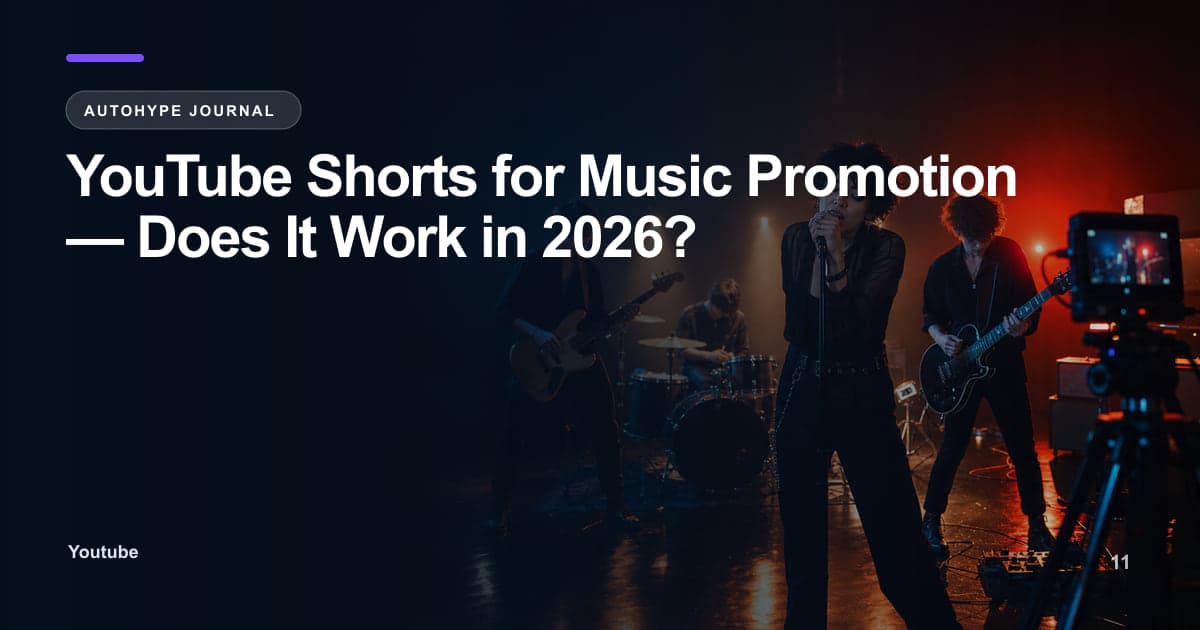
YouTube Shorts launched as a TikTok competitor and has grown to 70 billion daily views globally. For musicians, it represents a third short-form video distribution channel alongside TikTok and Instagram Reels — and it reaches a meaningfully different demographic. Here's the honest assessment of whether YouTube Shorts is worth adding to your music promotion strategy, and how it compares to TikTok.
YouTube Shorts vs TikTok for music: the key differences
TikTok is a discovery-first platform: 75% of TikTok music discoveries come from the FYP, not from following an artist. YouTube Shorts leans more toward existing subscribers: Shorts are served to your existing YouTube subscribers first, then to non-subscribers via the Shorts feed.
This means YouTube Shorts rewards artists who already have a YouTube presence. If you have 0 YouTube subscribers, your Shorts start with no initial audience — making growth slower than TikTok where every video gets a genuine test regardless of subscriber count.
Where YouTube Shorts genuinely outperforms TikTok
YouTube's music ecosystem is unique: if someone discovers you through a Short, your full YouTube music videos, albums, and playlists are one click away. YouTube's watch time per session is far higher than TikTok's — a Short that converts leads to 10-minute YouTube sessions, not 15-second TikTok loops.
YouTube Shorts also drives Spotify saves through YouTube Music integration. If your track is on YouTube Music (via your distributor), YouTube Shorts viewers can tap to add your song to their library — a Spotify-equivalent save behavior on a different platform.
Compare Instagram repost campaigns and independent Spotify curator submissions. See which format fits your release, the deliverables, service fees and terms before ordering. No guaranteed views, streams or playlist placement.
The cross-posting workflow
The most time-efficient approach: use your TikTok clips as YouTube Shorts. Export the original file (before TikTok watermark), upload directly to YouTube Shorts with the same or adapted caption.
YouTube Shorts doesn't penalize TikTok watermarks as aggressively as Instagram does, but clean files always look more professional. The content itself works identically on both platforms — the same hook, the same visual approach, the same 15–21 second length.
Should you prioritize YouTube Shorts?
Priority order for independent artists with limited time: TikTok first, Instagram Reels second, YouTube Shorts third. TikTok has the strongest music discovery algorithm. Reels has the strongest community-building. YouTube Shorts has the strongest long-form ecosystem but lowest standalone discovery.
If you're already posting daily on TikTok, adding YouTube Shorts takes 2 minutes per clip — upload the clean file, write a caption, done. At that marginal cost, it's worth doing. But don't let YouTube Shorts replace TikTok if you have to choose.
Choose the next step for your release.
Compare Instagram repost campaigns and independent Spotify curator submissions. See which format fits your release, the deliverables, service fees and terms before ordering. No guaranteed views, streams or playlist placement.
Compare artist campaigns →Frequently asked questions
Does YouTube Shorts pay musicians?
YouTube Shorts has a Shorts ad revenue program (YouTube Partner Program). To qualify, you need 1,000 subscribers and 10 million Shorts views in the last 90 days. The per-view rate is very low — Shorts monetization is about audience building, not direct income.
Can YouTube Shorts go viral the same way TikTok can?
Yes, but it's rarer for unknown artists. YouTube's algorithm is more conservative with viral distribution for new channels. That said, music-related Shorts from unknown artists do occasionally break through — the potential exists, it's just less reliable than TikTok's discovery system.
Should I link to Spotify or YouTube Music in my Shorts bio?
Both if possible via a Linktree. If you have to choose, Spotify — most of your streaming income and algorithmic momentum is on Spotify, and the listener base is larger in most markets.