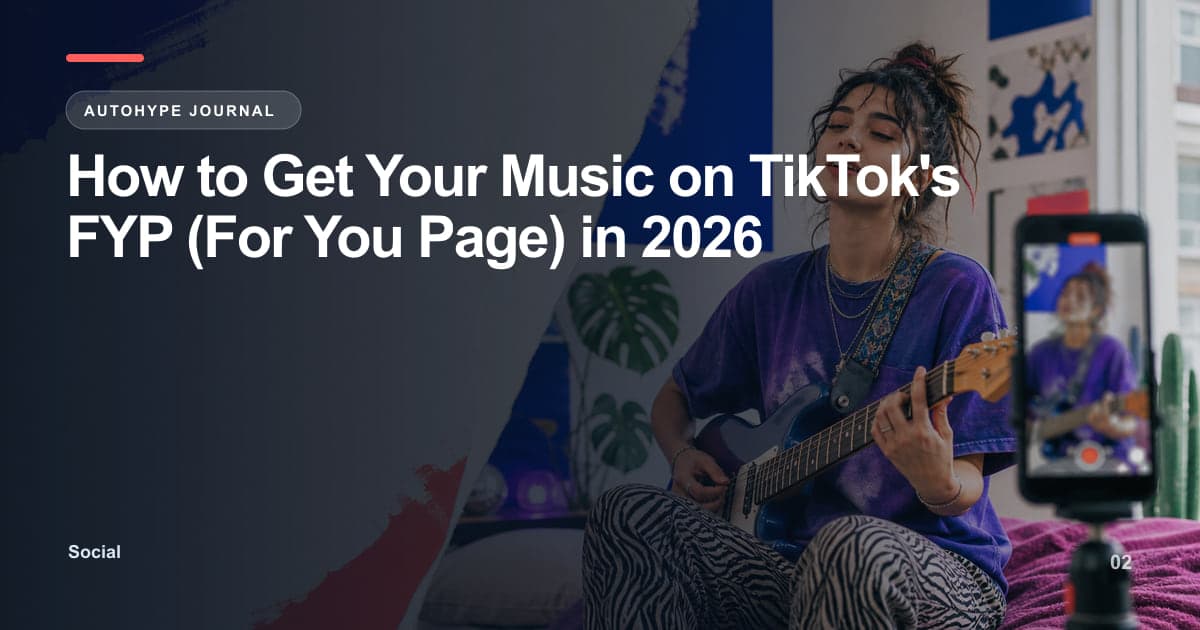
Every musician wants their song on the TikTok For You Page. Most don't know how it actually works. The FYP isn't a lottery — it's a signal-processing machine that promotes content when it gets the right signals in the first 200–500 views. Once you understand that, you can engineer for it. This guide breaks down exactly what TikTok's algorithm weights in 2026 for music content, and what actions you can take to maximize your chance of a FYP breakthrough.
How TikTok's FYP algorithm actually works
TikTok shows your video to a small test group — typically 200 to 500 accounts — when you first post. It measures how they react. If the reaction is strong (high completion rate, saves, shares, follows), it expands to a larger group. If it's weak, it stops distributing the video.
This means every video starts with a fresh test. An account with 50 followers and an account with 500K followers start from the same point with each post. The difference is that larger accounts have trained the algorithm on who their audience is, so the initial test group is better-targeted.
For music specifically, the signals TikTok weights most are: completion rate (did people watch to the end?), save rate (did they save the sound?), and share rate (did they send it to someone?). Comments and likes matter but are secondary.
The most important signal: audio saves
When someone taps on the spinning vinyl icon on your TikTok video and saves your sound, that's the strongest signal you can get as a musician. It tells TikTok: this audio is good enough that someone wants to use it themselves.
TikTok distributes saved sounds to other creators as suggested audio. If your sound gets saved enough times, it shows up in the recommended sounds library — which is how music trends start.
To maximize saves: the hook of your song needs to hit in the first 3 seconds. If your intro takes 10 seconds to build, start the clip at the drop. The save decision happens in the first 5 seconds of hearing music.
Video completion rate — the gating signal
TikTok won't expand a video that people don't finish watching. For music clips, this means your video needs to be compelling from frame one. The visual hook matters as much as the audio hook.
Optimal length for music content in 2026: 15 to 21 seconds. Short enough that completion rates stay above 70%. Long enough to include a full musical phrase.
The pattern that works: strong opening visual (first 2 seconds) → audio hook hits (3–5 seconds in) → visual maintains interest through the clip → end on a visual or lyrical moment that makes people want to rewatch or share. Loop videos (where the end connects to the beginning) dramatically increase rewatch rate.
Compare Instagram repost campaigns and independent Spotify curator submissions. See which format fits your release, the deliverables, service fees and terms before ordering. No guaranteed views, streams or playlist placement.
Hashtags and keywords — still matter in 2026
TikTok's search function has grown significantly. Users now search for music by genre, mood, and occasion — not just by artist name. Hashtags help TikTok categorize your content and match it to search queries.
Strategy: use 3–5 hashtags. One broad (#music, 500B+ views), one genre-specific (#lofibeats, #darkphonk, #indiefolk), one mood-specific (#studymusic, #latenightvibes, #workoutmusic), and optionally one trending. Don't stuff 20 hashtags — it looks spammy and TikTok has deprioritized hashtag-stuffed captions.
Your caption itself functions as search metadata. Captions with natural keyword phrases — 'made this lofi beat for studying' — now surface in TikTok search results for those terms.
Posting time — yes, it matters
Your initial test group is drawn from active users when you post. If you post at 3am when nobody's online, your test pool is smaller and less engaged, which suppresses your initial metrics.
Best times for music content by genre in 2026: Lofi/study music — 8am and 9pm (before school/work and during evening study sessions). EDM/house — Friday and Saturday 9pm–11pm. Hip-hop/trap — 10pm–12am daily. Country/acoustic — 6pm–8pm. Jazz/ambient — 10pm–1am.
These are starting points. TikTok Analytics (available after 100 followers) shows you exactly when your specific audience is most active. Use that data after your first month.
Consistency — the factor nobody talks about
A single viral video doesn't build an audience. An account that posts daily for 60 days builds an audience. TikTok's algorithm rewards consistent posting with a larger default distribution window for each video. Accounts that post daily have their content shown to more people from the start.
The accounts that win at music promotion on TikTok aren't posting one great video and hoping. They're posting every day — different clips of the same song, different visual treatments, different captions — until the algorithm finds the version that resonates.
Think of it as A/B testing at scale. Your song's first 10 clips are research. You're finding out which 15 seconds of the song hooks people, which visual style fits, which caption framing resonates. By clip 20, you know what works. By clip 30, you've almost certainly had at least one clip break out of the initial test group.
The shortcut: give TikTok more surface area
Every video you post is another lottery ticket. More daily posts = more chances to hit the distribution threshold. This is why the most effective music promotion strategy on TikTok isn't about making the perfect video — it's about making more videos.
The math: 1 video per week = 4 shots per month at the FYP. 1 video per day = 30 shots per month. If each video has a 5% chance of breaking through, you need volume.
Most artists can't sustain that volume alone. This is why marketplaces like Autohype exist — you hire real TikTok creators one order at a time, and each of them posts a video using your track to their own audience, so you add FYP shots to your own without editing a single video yourself.
Choose the next step for your release.
Compare Instagram repost campaigns and independent Spotify curator submissions. See which format fits your release, the deliverables, service fees and terms before ordering. No guaranteed views, streams or playlist placement.
Compare artist campaigns →📋 Copy-paste TikTok caption templates
POV: you found the song you'll have on repeat all week 🎵

link in bio → Spotify

#indiemusic #singersongwriter #newartist #spotifyartist #fyp
Click to copy ↑
the line that wrote itself 🖊️ [add your lyric here]

full song on Spotify → link in bio

#songwriter #originalmusic #indieartist #lyricism #newmusic
Click to copy ↑
the take that ended up in the final track 🎙️

[song name] out now — link in bio

#homestudio #recording #independentartist #behindthescenes #music
Click to copy ↑
Frequently asked questions
How long does it take for music to hit the TikTok FYP?
There's no fixed timeline. Some clips break through in hours; others take 2–3 weeks of sitting before the algorithm picks them up (TikTok sometimes recirculates older content). The consistent pattern is that artists posting daily see their first FYP breakthrough between day 14 and day 45.
Why is my music getting views but no Spotify streams?
TikTok viewers need to be prompted to Spotify. Add your Spotify link to your bio. Include your artist name in captions. End videos with a text overlay saying 'streaming everywhere — link in bio'. The conversion from TikTok view to Spotify stream is not automatic — you have to create the funnel.
Does my music need to be on DistroKid to use TikTok for promotion?
No — TikTok allows you to upload your own audio directly as an original sound. However, if you want your music on Spotify, Apple Music, and other platforms (which you should), DistroKid, TuneCore, or Amuse will distribute it there and also register it with TikTok's sound library.
What completion rate should I aim for?
Above 70% is strong. Above 80% and TikTok will very likely expand your video. Below 50% means the video isn't holding attention — usually an issue with the visual hook or the audio starting too slowly. Shorten your clip or start at a more impactful moment.
Can I promote the same song multiple times?
Yes — TikTok treats each video as a separate piece of content. You can (and should) post 20 different clips of the same song with different visuals and captions. Different 15-second windows of the same track will resonate differently with different audiences.