Here's the dirty secret of TikTok music promotion: the biggest music channels on the platform don't feature the artist's face at all. Study music channels with 2M followers. Lofi hip-hop channels with 500K. Phonk playlists. Dark ambient compilations. All faceless. All massive. If you're a producer, beatmaker, or recording artist who hates being on camera — good news. The no-face strategy isn't a workaround. For certain genres and audiences, it actually outperforms face-to-camera content. Here's exactly how to make it work.
Why no-face content works on TikTok
TikTok's algorithm doesn't care about your face. It cares about watch time, saves, shares, and profile follows. Those signals can come from a 15-second clip of rain on a window with a piano loop playing just as easily as from a dance video.
In fact, for certain moods and genres — lofi, ambient, classical, dark phonk, jazz, meditation — aesthetic B-roll consistently outperforms talking-head content. The viewer isn't there to see you. They're there to feel something. Your music is the content. The visuals just support it.
The proof is in the numbers. Channels like Lofi Girl (YouTube, but same principle applies on TikTok) built massive audiences entirely on looping animation. No face. No voice. Just the right vibe and consistent posting.
Strategy 1: Cinematic B-roll + your music
This is the foundational no-face format. Take 15 seconds of your song — your drop, your hook, your most emotional moment — and pair it with cinematic footage that matches the vibe.
For lofi: rain on windows, a book and coffee, city lights at night. For dark phonk: empty highways, neon signs, abandoned buildings. For house/EDM: crowd shots, festival visuals, city timelapses. For acoustic/folk: forests, coastlines, golden hour fields.
The caption does the heavy lifting: "the song I wrote at 3am" or "this is what I made when I couldn't sleep" creates context and emotional hook without you appearing on screen.
Where to get footage: Pexels, Pixabay, and Coverr all have free 4K B-roll. For 60 seconds of editing, you can produce a genuinely good-looking clip.
Strategy 2: Lyric videos and text overlays
If you make music with lyrics, floating text on a simple gradient background is a proven format. Display your most quotable line in large white text against a dark background. Let the beat play. End with your artist name.
This works because people save lyric videos to relisten to lines they connected with. Save rate is one of TikTok's strongest signals — it tells the algorithm your content is worth revisiting, which expands distribution.
Keep it simple. Black background, white serif font, centered text. The words should feel like they're being revealed in real time as you hear them. CapCut has a built-in lyrics template that makes this in under 5 minutes.
Compare Instagram repost campaigns and independent Spotify curator submissions. See which format fits your release, the deliverables, service fees and terms before ordering. No guaranteed views, streams or playlist placement.
Strategy 3: Studio footage without your face
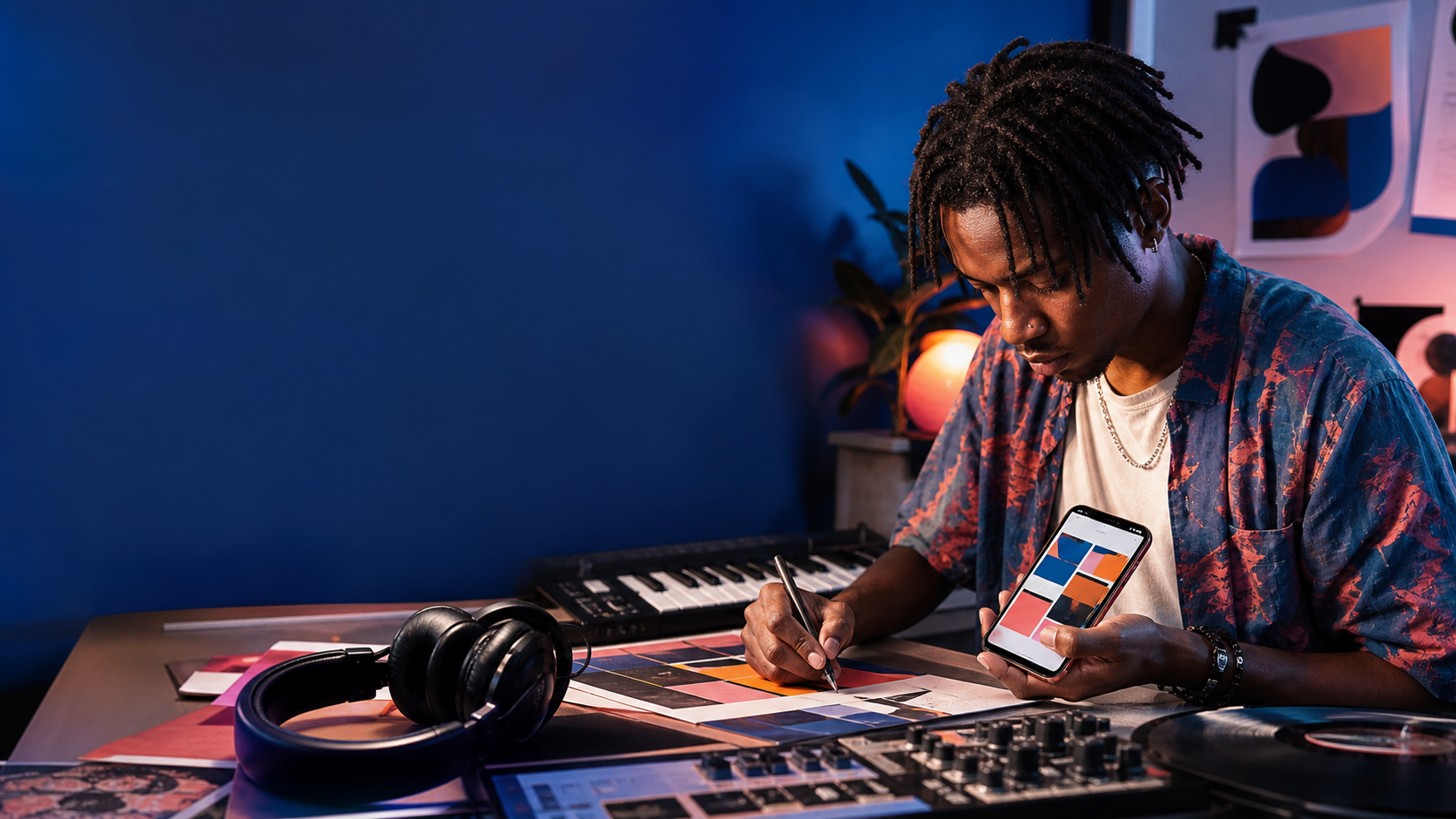
Point your phone at your equipment. DAW screen, MIDI keyboard, synthesizer knobs, studio monitor, vinyl record spinning. These work because they establish authenticity — you're a real producer making real music — without requiring you to be on camera.
The framing matters: shoot from slightly above (bird's eye over the keyboard), from the side (profile of the gear), or close-up on knobs and screens. Never a straight-on face shot.
Caption approach: "made this in 20 minutes, don't know what to call it" or "beat #47 of 2026" — the process angle builds a following of people who come back to see what you make next.
Strategy 4: Waveform visualizers
Waveform animations — the audio-reactive bars you've seen under every podcast clip on the internet — are a legitimate TikTok format for music. Pair your waveform with your cover art or a static background image and you have a simple, clean video that works.
Tools: Canva (free), Adobe Express (free tier), or Headliner. All three generate waveform animations from your audio in under 2 minutes.
This format works best for new releases where you want to announce the track. It's clean, professional, and clearly positions you as an artist rather than a content creator — which actually helps your brand.
Strategy 5: Let AI run the whole thing
All of the above requires your time. You have to find the footage, edit the clip, write the caption, post at the right time, do it again tomorrow. Most artists do it for a week, then stop. That's why it doesn't work.
The artists with growing audiences are the ones posting every single day for months. Not because they have more time — because they built a system.
Marketplaces like Autohype let you hire real TikTok creators who make and post the content for you: you share your track and a short brief, and a real person promotes it to their audience. No editing, no scheduling, no showing your face — ever. Your music gets promoted while you focus on making more of it.
What actually gets results
Posting once is not a strategy. One video that flops proves nothing. TikTok's algorithm is essentially a sample size game — it shows your video to a small group, measures reaction, and either expands or kills it. A different thumbnail, caption, or timing can flip the result entirely.
The artists who succeed without showing their face share two traits: they post every day (or close to it), and they try different clips of the same song until one hits. The first video almost never goes viral. The fourteenth one sometimes does.
No-face content also compounds differently than face content. Rather than building a 'creator' audience who follows you personally, you build a music audience — people who follow your channel specifically because they like what you make. These listeners are more likely to save songs, follow on Spotify, and buy merch.
Choose the next step for your release.
Compare Instagram repost campaigns and independent Spotify curator submissions. See which format fits your release, the deliverables, service fees and terms before ordering. No guaranteed views, streams or playlist placement.
Compare artist campaigns →📋 Copy-paste TikTok caption templates
made this at 2am and I can't stop replaying it 🌙

sound on 🔊

#producer #beatmaker #darkphonk #newbeat #undergroundmusic
Click to copy ↑
beat #47 this year 🎹 the workflow that actually clicks

link in bio → free download

#homestudio #beatmaking #producer #musicproducer #lofi
Click to copy ↑
this is what 3am sounds like 🌫️

new single out now → link in bio

#nightvibes #phonk #ambientmusic #independentartist #newmusic
Click to copy ↑
the drop that changed everything for my sound 🔥

full track on Spotify → link in bio

#producer #beatdrop #musicmaker #darkambient #originalmusic
Click to copy ↑
Frequently asked questions
Can I really grow a music audience on TikTok without showing my face?
Yes — in fact, for genres like lofi, ambient, phonk, and instrumental music, no-face content often outperforms face-to-camera. The algorithm rewards watch time and saves, not selfies. Channels with millions of followers post nothing but aesthetic B-roll with music.
Which genres work best for no-face TikTok promotion?
Lofi, phonk, dark ambient, house, EDM, jazz, classical, and any instrumental genre. Genres where lyrics and personal storytelling are central (pop, hip-hop, country) can still work no-face, but face-to-camera tends to outperform for lyric-heavy music.
How many videos do I need to post before seeing results?
Most artists see first meaningful traction between day 14 and day 30 of daily posting. The first week rarely produces results — that's normal and expected. The compounding starts after the algorithm has enough data on your channel's content to know who to show it to.
Does TikTok penalize AI-generated content or stock footage videos?
No — TikTok has no policy against AI-generated videos or licensed stock footage. What it penalizes is watermarks (especially from other platforms like CapCut's own watermark) and copyrighted music you don't own. Original music + licensed B-roll is fully compliant.
What's the best caption format for no-face music content?
First-person process captions work best: 'made this at 3am', 'beat #12 of this month', 'the drop I can't stop listening to'. They create authenticity without requiring you on camera. Avoid generic captions like 'new music out now' — they perform poorly.