Running a music promotion marketplace gives us one unfair advantage: we see thousands of campaigns from above. What artists order, what they pitch, what they post, what they abandon. And from up here, four lanes are visibly, permanently empty. Not because they don't work — because they don't feel like playing the lottery. So here they are, free: the B-side pitch, the named thank-you, the messy making-of, and the re-promotion of the "old" song. For each one you get the psychology of why it works and a concrete three-step way to run it this week. Take them. They're free. (The moves. Not the campaigns. We run a business.)
Move No. 1: Pitch the B-side
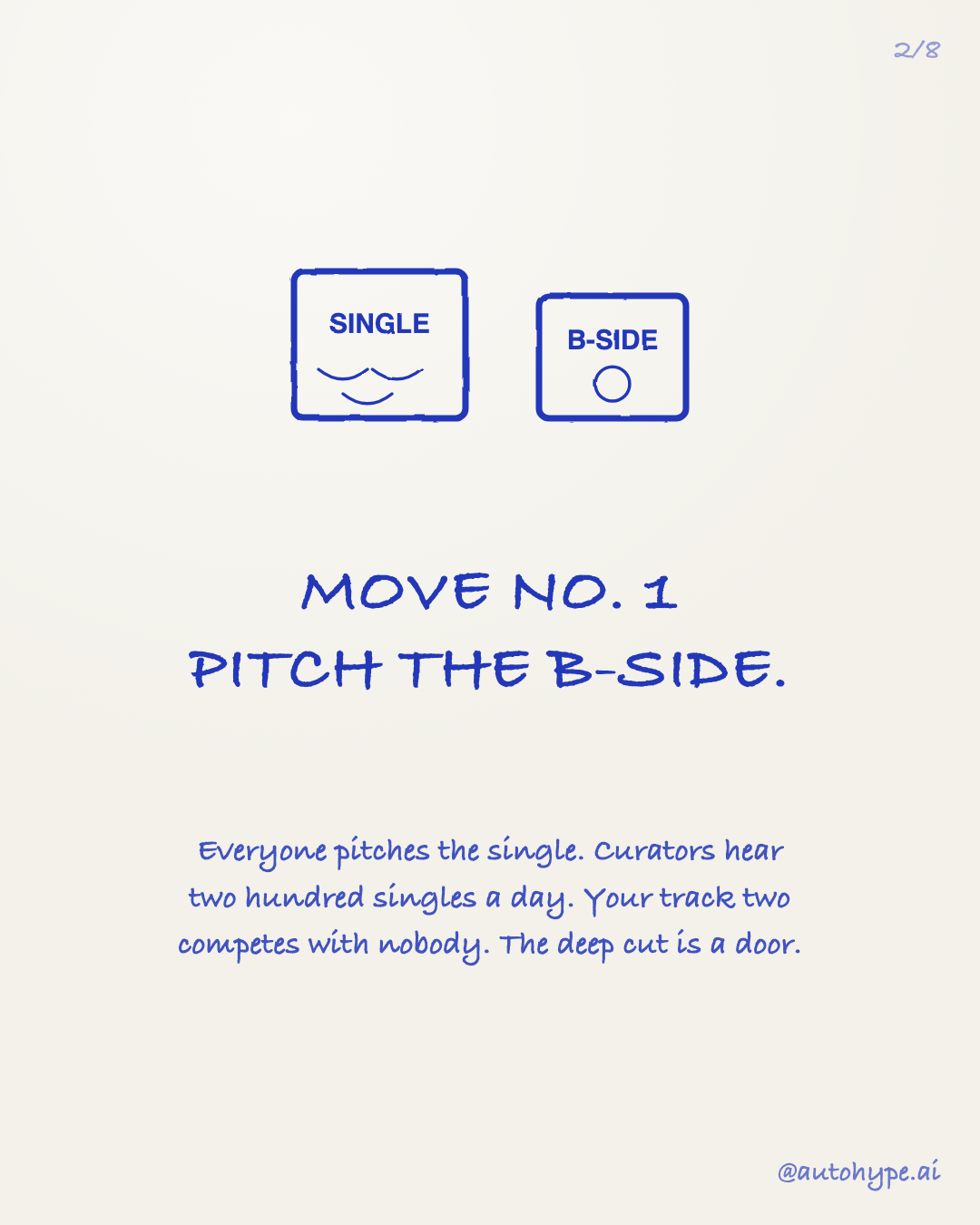
Why it works: curators hear two hundred singles a day, and every one arrives wearing the same outfit — lead track, big push, "this is the one." Attention is a competition, and everyone chose the same battlefield. Your track two, the deep cut, competes with nobody. Pitching it signals confidence ("the whole record holds up") and gives the curator something no other inbox offered them today. The deep cut is a door.
How to run it in three steps. One: pick the non-single that listeners quietly repeat — check your stats for the track with the best save or replay behavior relative to its exposure. Two: pitch it explicitly as a B-side: "everyone sends you singles, here's the album track that people keep saving." That sentence alone separates you from the pile. Three: route the pitch to smaller, genre-specific curators first — deep cuts thrive with curators who pride themselves on digging.
Cost if you outsource the outreach: playlist pitching floors sat at $10 on our marketplace as of July 17, 2026. A pitch, not a placement — the curator can still say no, which is exactly why their yes means something.
Move No. 2: Thank your first 100 fans. By name.
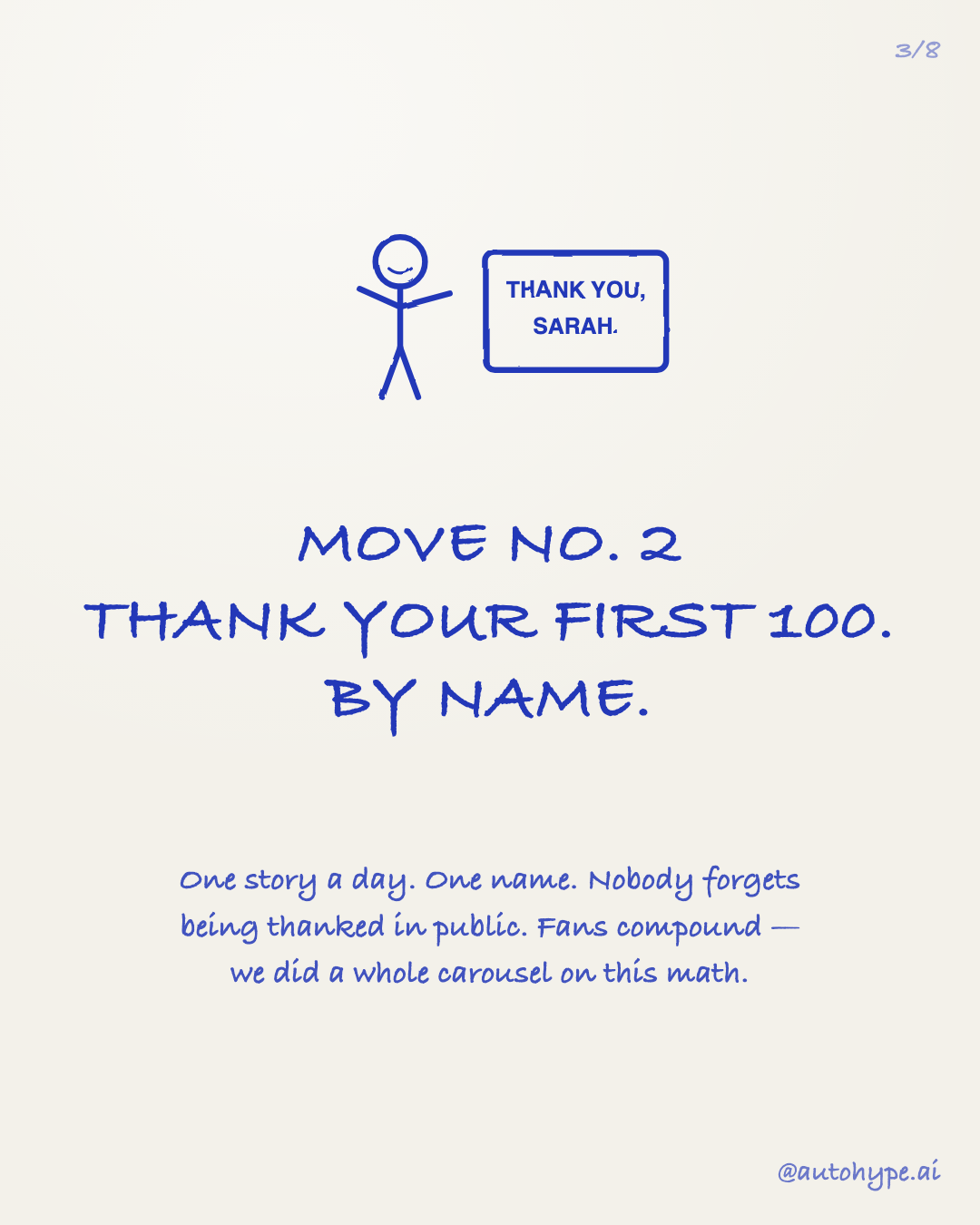
Why it works: nobody forgets being thanked in public. Being named by an artist they discovered early converts a passive listener into a personal stakeholder — your win becomes their win, and they now have a story about you ("she thanked me by name") that they'll retell without being asked. Word of mouth is just fans with a story. Also, your mum is 12 of your streams; she's earned a shout-out too.
How to run it in three steps. One: build the list — the people who commented early, pre-saved, shared the link, showed up. If you can't name 100, name 20; the move scales down perfectly. Two: post one story a day, one name at a time — "Thank you, Sarah." — with something specific if you have it. Slow-dripping it turns gratitude into a running series instead of a one-off post. Three: when someone reacts to their thank-you, reply like a human, not a brand. That conversation is the actual product.
The math behind it is the compounding we keep preaching: numbers are people, and people who feel seen bring more people. No budget required for this one — just consistency and the humility to notice who was there first.
Move No. 3: Post the messy 30 seconds
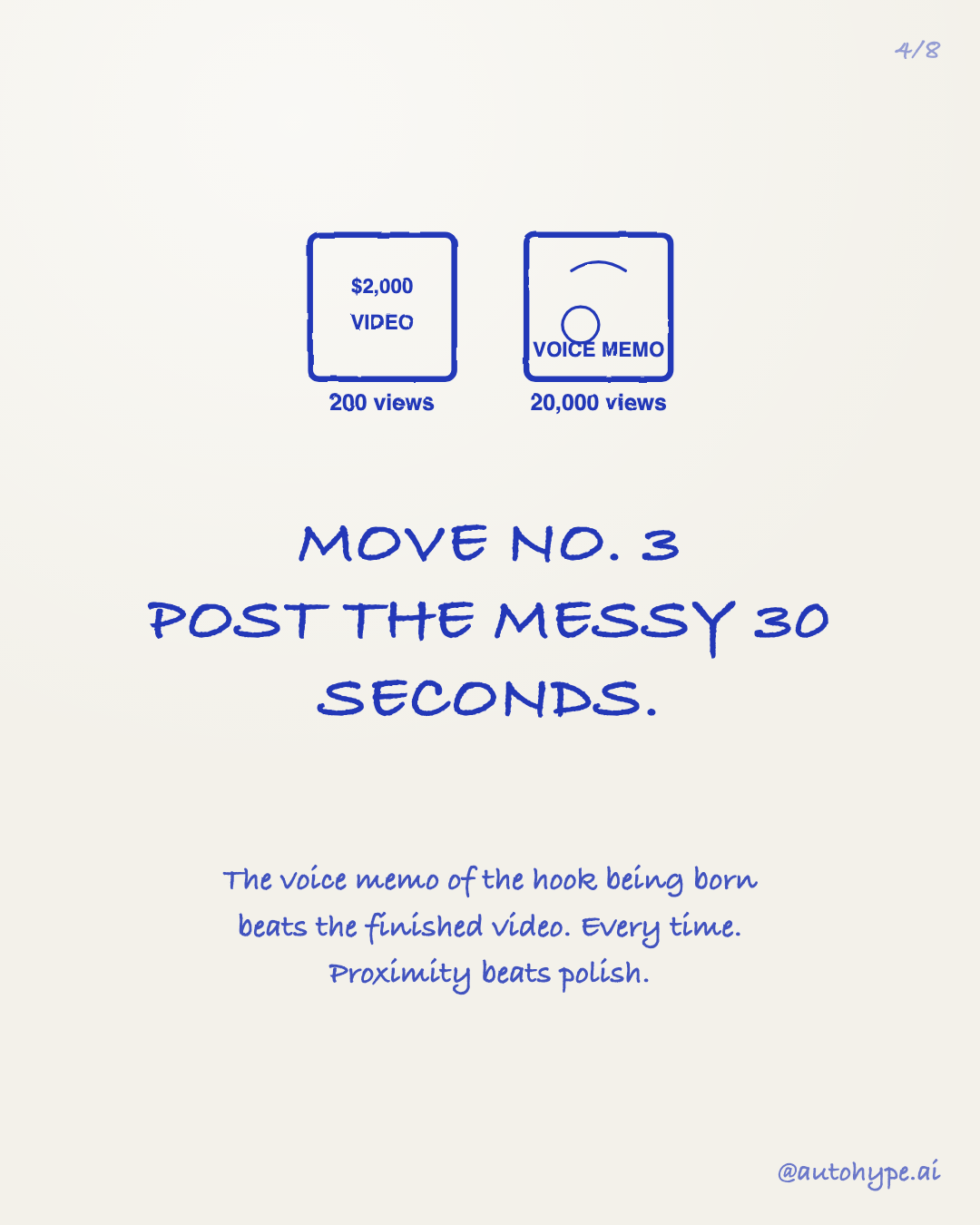
Why it works: proximity beats polish. A finished music video is content about a product; a voice memo of the hook being born is content about a person, and strangers bond with people. Polished content also triggers ad-filters in the viewer's brain, while mess reads as true. As an illustrative order of magnitude — not a promise, not our data, just the shape of the pattern — a $2,000 video can do 200 views while the 30-second phone clip of the idea arriving does 20,000. The asymmetry is the point.
How to run it in three steps. One: excavate — scroll your voice memos and camera roll for the moment the song first existed: the hummed melody, the laptop demo, the lyric scribbled on a receipt. Two: pair the mess with the finished version — before/after is the most durable format in music content because it lets the viewer feel the distance. Three: caption it with the true story in one sentence, no marketing voice: "wrote this in a parking lot at 2am" outperforms "OUT NOW" forever.
If you want the messy clip actually filmed, cut and posted by someone with an audience, that's a creator-video order — floors at $20 on July 17, 2026, delivered in 48h or refunded.
Compare Instagram repost campaigns and independent Spotify curator submissions. See which format fits your release, the deliverables, service fees and terms before ordering. No guaranteed views, streams or playlist placement.
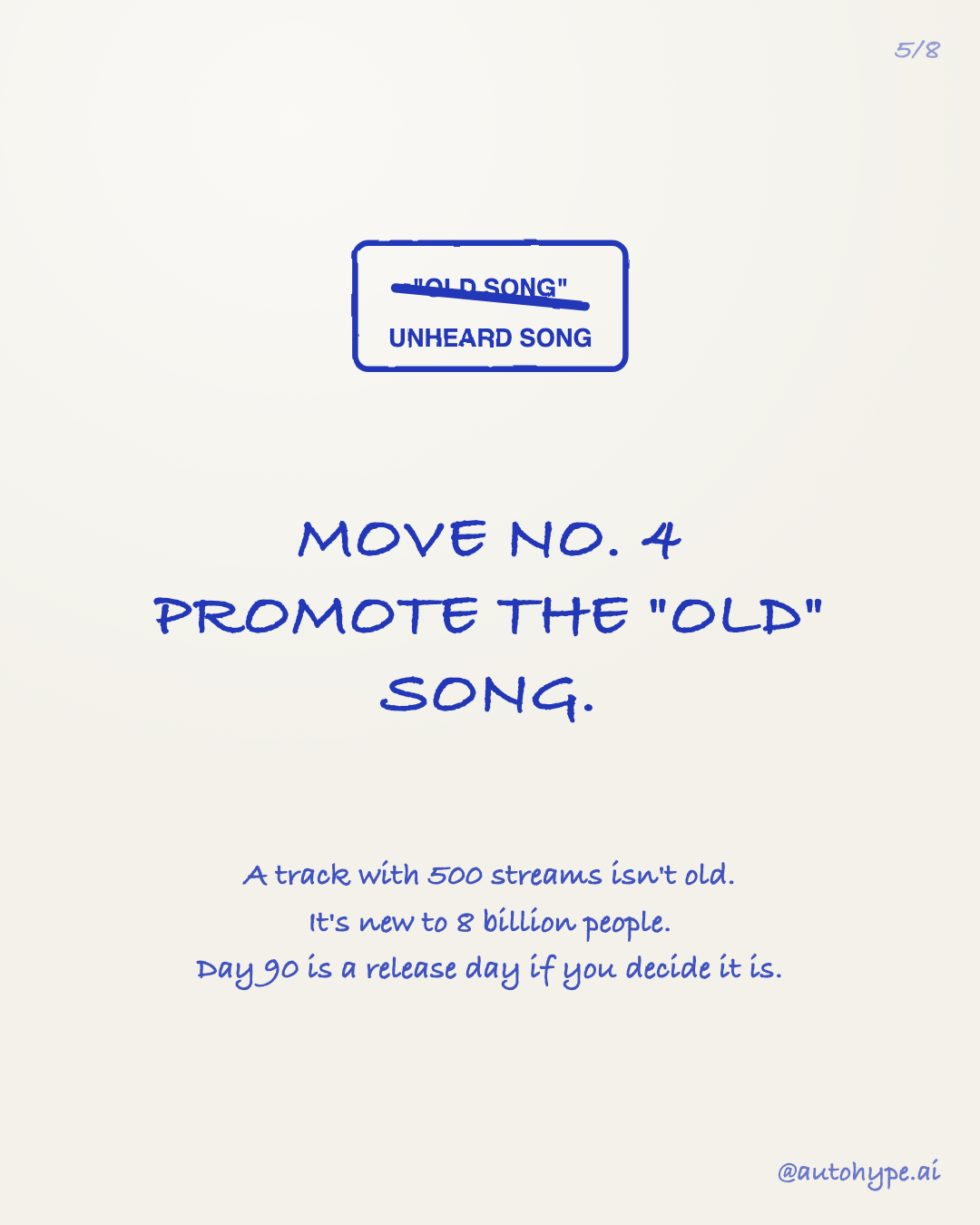
Move No. 4: Promote the "old" song
Why it works: "old" is a feeling you have about your own catalog, not a fact about the audience. A track with 500 streams isn't old — it's unheard. It's brand new to eight billion people, and unlike your next single it's already finished, already mixed, already paid for. Artists retire songs at the exact moment the sunk cost ends and the pure upside begins, because promoting the new thing feels like progress and promoting the catalog feels like admitting defeat. It isn't.
How to run it in three steps. One: pick the catalog track with the best listener behavior — saves, repeats, playlist adds per listener — regardless of age. Evidence beats sentiment. Two: declare a release day. Day 90 is a release day if you decide it is: new visual, new clip, new pitch, zero apology for the song's birthday. Nobody checks the date before pressing play. Three: run the same small promo you'd run for a new single — a $10 pitch, a $20 creator video — and let the song compete as what it is: new to everyone who hasn't heard it.
This is the highest-leverage move on the list for artists with more than three releases, because it multiplies the value of work you already did.
Why is nobody doing these?
Because none of them feel like a jackpot. They feel like work. The B-side pitch is unglamorous. Thanking fans one name at a time takes a hundred days. The messy clip requires posting something imperfect. Re-promoting the old song means admitting the first push didn't finish the job. Every move on this list is boring, incremental and slightly ego-bruising — which is why the lanes are empty and why they work.
The viral jackpot fantasy has better marketing, but it isn't a strategy; it's a scratch card. These four are the opposite: repeatable actions whose worst case is "a few more real people heard the song" and whose best case compounds. Boring? Yes. Working? Also yes. You've read our pinned post — you knew that was coming.
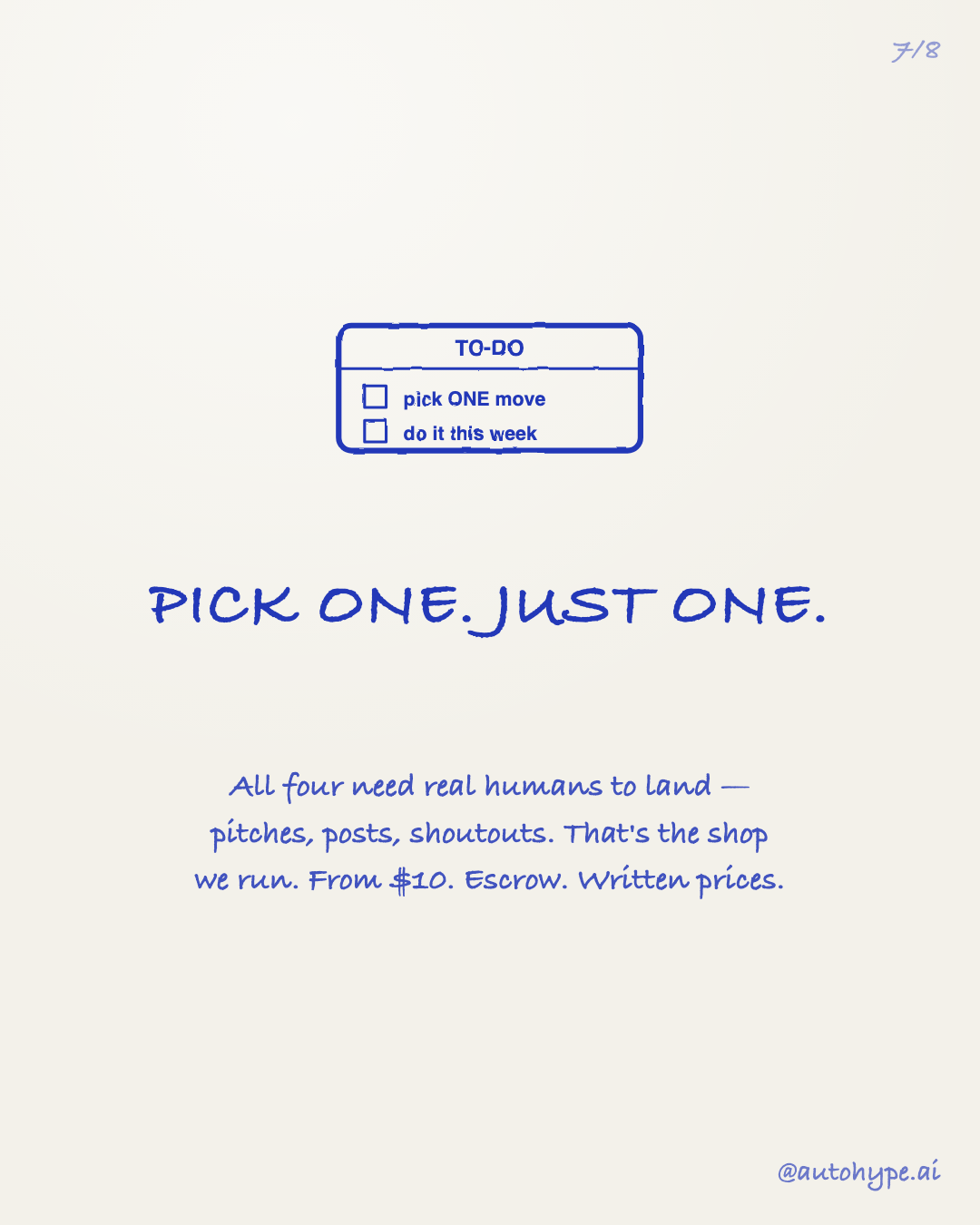
Pick one. Just one.
The failure mode of an article like this is nodding along and doing zero of it. So shrink the ask: pick one move and do it this week. Not four moves. Not a content calendar. One B-side pitch, or one thank-you story, or one voice memo posted, or one old song given a second release day.
Where the moves need other humans — curators to pitch, creators to post, audiences to reach — that's the shop we run: verified sellers, written prices from $10, money held in escrow, auto-refund if delivery is late. We guarantee delivery, not results; the moves above are how you stack the odds on the results side yourself.
Part 2 exists, with four weirder gaps. It drops when it drops — following @autohype.ai is the reliable way to catch it. The button is right there.
Choose the next step for your release.
Compare Instagram repost campaigns and independent Spotify curator submissions. See which format fits your release, the deliverables, service fees and terms before ordering. No guaranteed views, streams or playlist placement.
Compare artist campaigns →Frequently asked questions
Why would I pitch a B-side instead of my single?
Because the single competes with two hundred other singles in the curator's inbox that day, and the B-side competes with nobody. Pitching a deep cut signals that your whole project holds up, gives curators something novel, and works especially well with smaller genre playlists whose curators pride themselves on digging deeper than everyone else.
Is it too late to promote a song I released months ago?
No. A track with a few hundred streams is functionally unheard — it's new to everyone who hasn't played it, and listeners don't check release dates before pressing play. Pick the catalog track with the best save and repeat behavior, declare a new push day, and promote it exactly like a fresh single.
Do these strategies require a budget?
Two of the four cost nothing: thanking your first fans by name and posting your messy demo clips are free, and arguably outperform paid polish. The B-side pitch and the catalog re-push can be run for $10–$20 each through marketplace sellers if you outsource the outreach — prices verified July 17, 2026.
What results should I expect from these moves?
Honestly: nobody can promise you numbers, and you should run from anyone who does. These moves improve your odds by putting real songs in front of real people repeatedly — the compounding is real but not guaranteed on any single attempt. Paid orders through the marketplace guarantee delivery of the work, never the outcome.