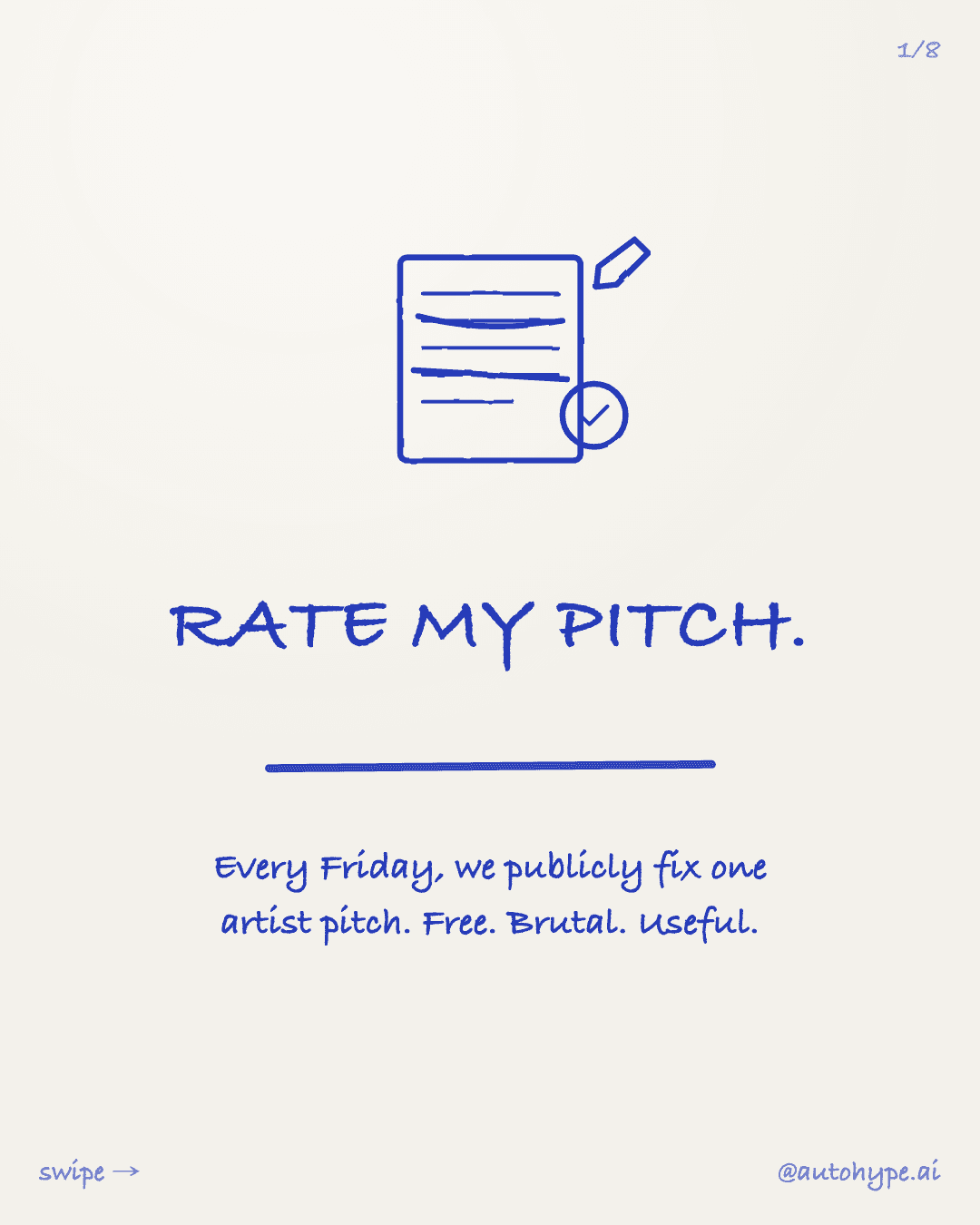
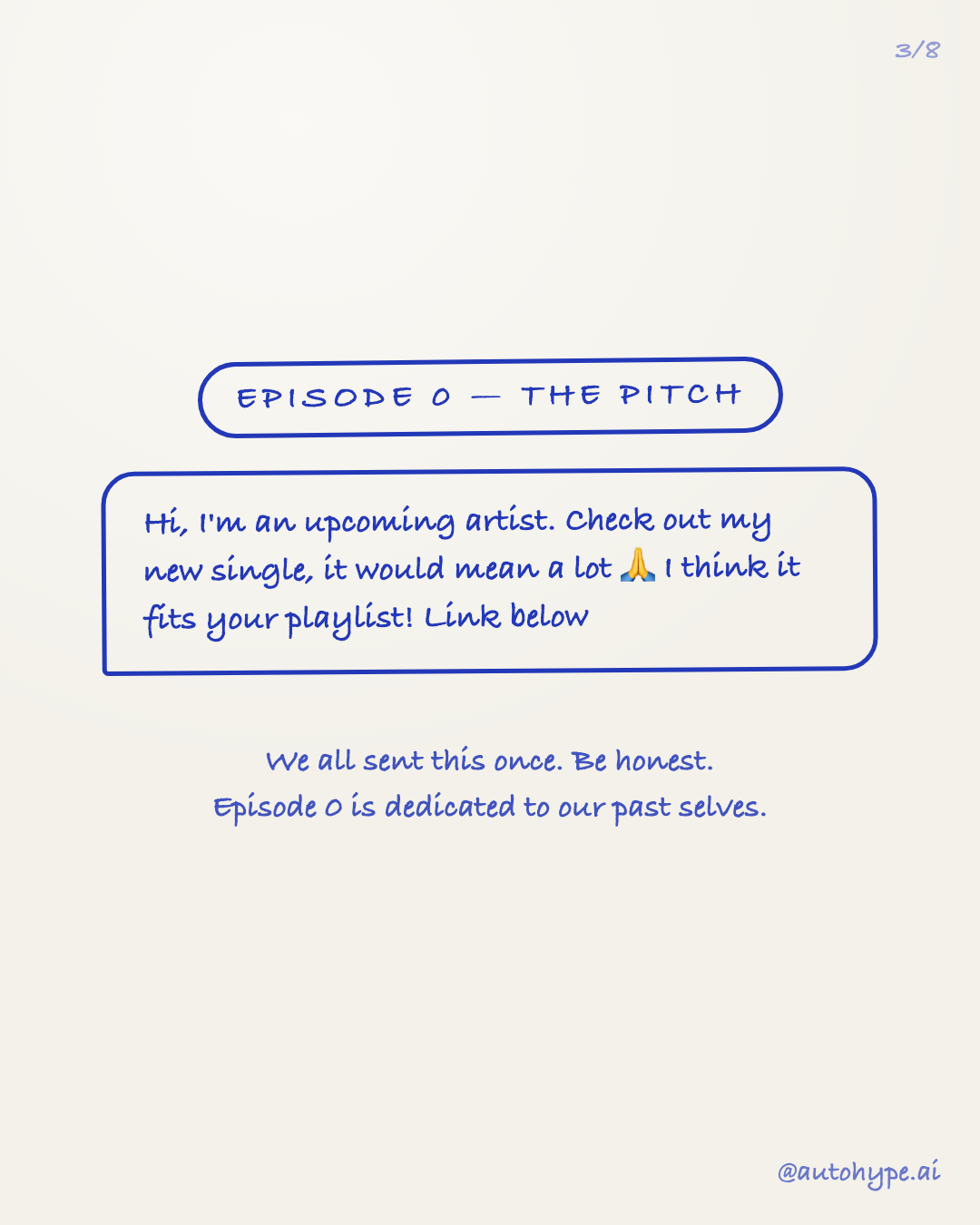
Every Friday on our Instagram we publicly fix one artist pitch — free, brutal, useful. Episode 0 starts with the pitch we ALL sent once: "Hi, I'm an upcoming artist. Check out my new single, it would mean a lot 🙏 I think it fits your playlist! Link below." If you've never sent that message, you're either lying or you haven't pitched yet. This episode is dedicated to our past selves. This article is the full autopsy: why every single phrase in that pitch fails, what the rewrite looks like word by word, and the three rules that govern every pitch that ever got a reply — name the fit, do the work, make "no" easy. Curators, TikTok creators, bloggers and DJs all read pitches the same way, so learn it once and it works everywhere.
![Slide 6 — The rewrite: 'Hi Sam — Nightdrive is moody synthwave, 96 BPM. It sits well next to Kavinsky on your Late Loops playlist. Hook at 0:45: [link]. Not a fit? No worries.' Specific. Did the homework. Easy to say no to — which is exactly why it gets a yes.](/promo/06-rate-my-pitch/slide-06.png)
The 20-second reality of the person you're pitching
Before fixing the pitch, understand the inbox it lands in. An active playlist curator receives around two hundred submissions a day — that's an illustrative volume, but ask any of them and they'll nod grimly. At that volume, reading isn't evaluation; it's triage. Your pitch gets roughly 20 seconds of attention, and its only job in those seconds is to answer one question: "is this relevant to my audience?"
This reframes everything. A pitch isn't a request for kindness — it's a relevance signal, and every word that doesn't carry signal is noise stealing your 20 seconds. "Hope this finds you well" costs two seconds and carries zero signal. So does your life story, your influences paragraph, and your apology for reaching out.
The good news hiding in the volume: most of those two hundred pitches are terrible in the exact same way, which means a competent pitch doesn't need to be brilliant. It needs to be specific.
The roast, part 1: you told them nothing and gave them homework
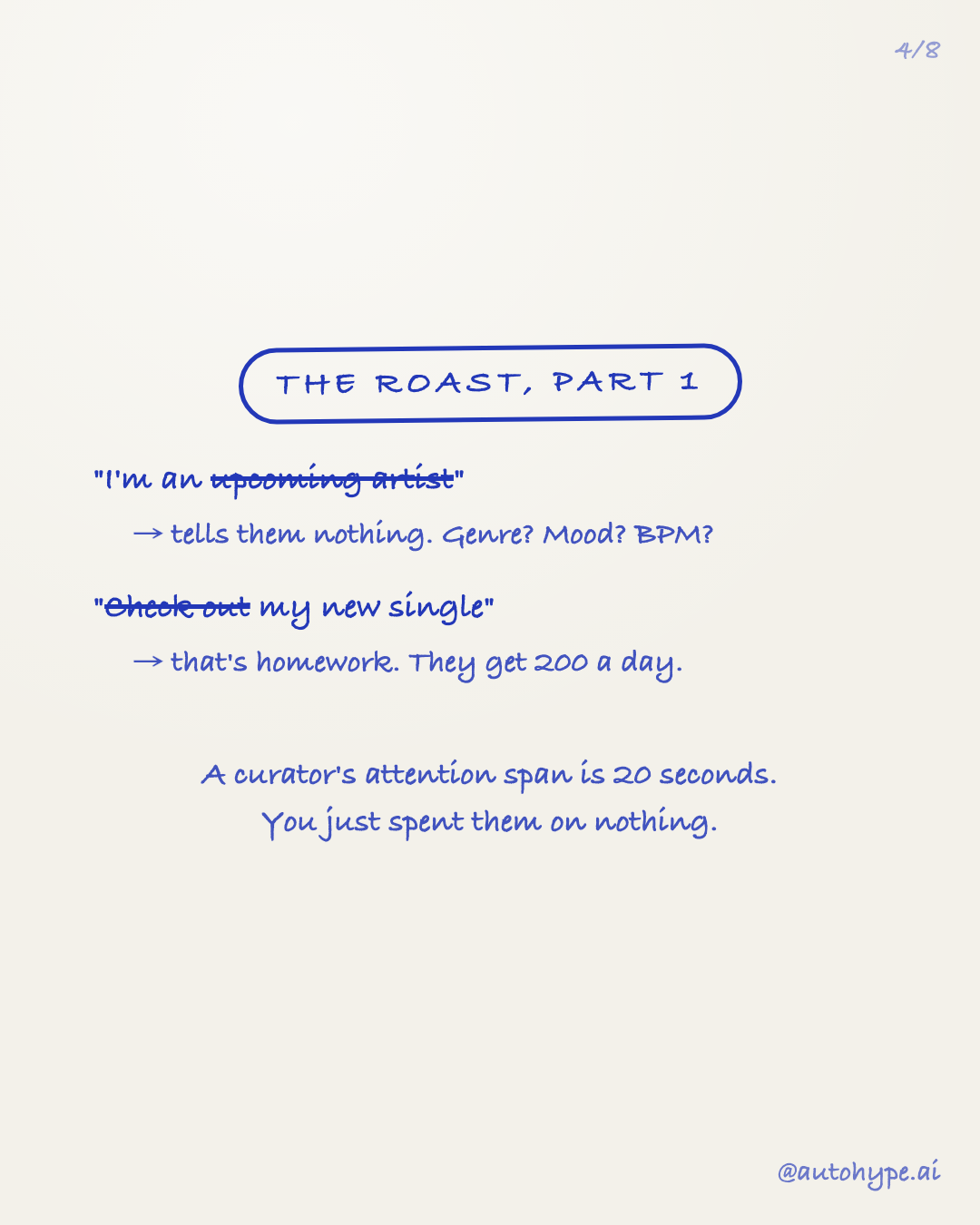
"I'm an upcoming artist" — this tells the curator nothing. Genre? Mood? BPM? Every artist in their inbox is an upcoming artist; the phrase is the pitching equivalent of describing yourself as "a person." The 20-second clock is running and the reader still doesn't know what your music sounds like.
"Check out my new single" — that's homework. You've asked a stranger processing two hundred submissions to click a blind link, listen, form an opinion and figure out where you might fit — the work that was yours to do. Curators don't skip these pitches out of cruelty; they skip them out of arithmetic.
The pattern in both failures is the same: the pitch centers the sender. What I am, what I made, what I'd like you to do for me. The reader's question — "what is this and why is it for my audience?" — never gets answered.
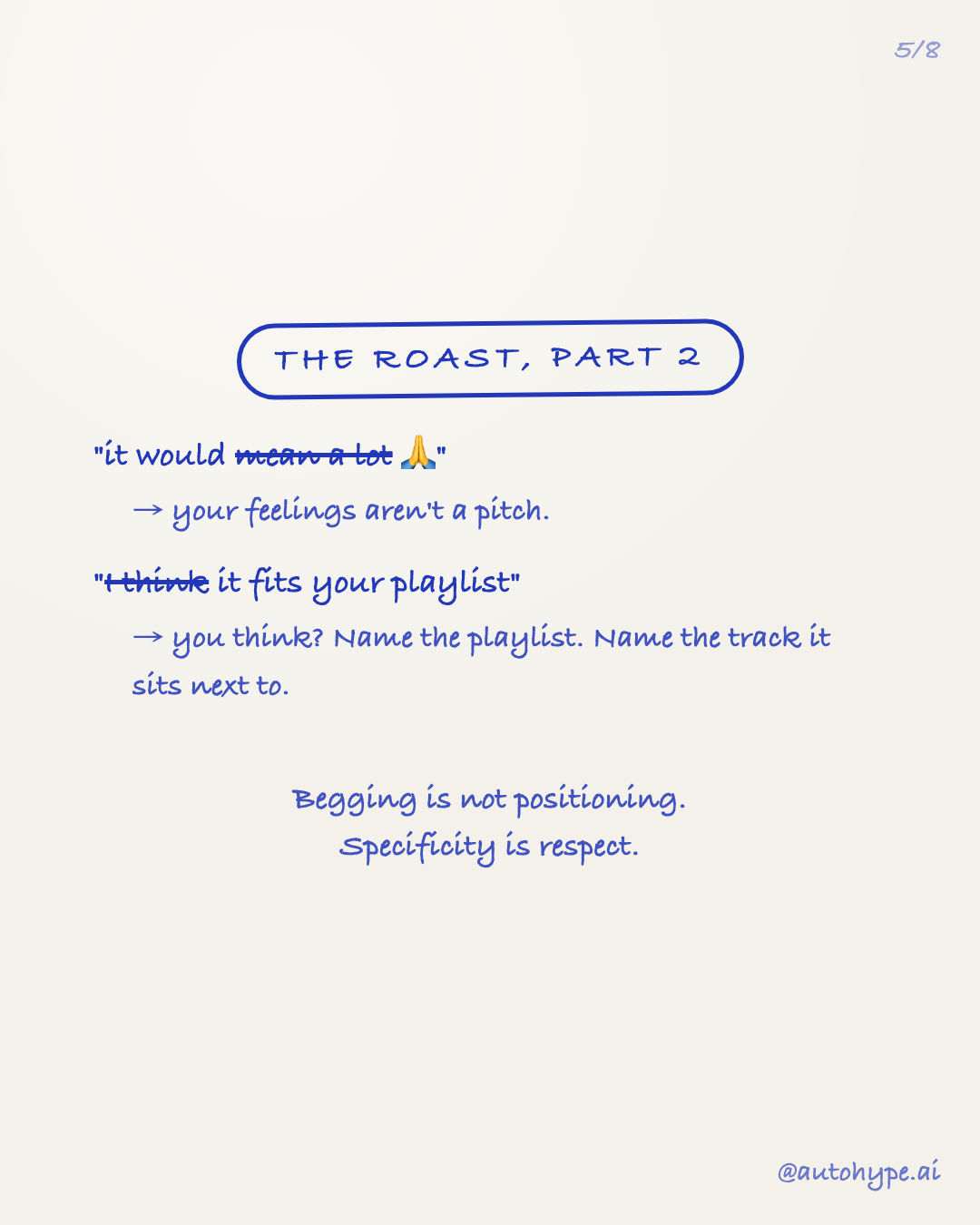
The roast, part 2: feelings aren't a pitch
"It would mean a lot 🙏" — your feelings aren't a pitch. It would mean a lot to all two hundred people in the inbox. Emotional appeals ask the curator to make a charity decision, and charity isn't why they curate; their playlist's quality is why they curate. Begging is not positioning.
"I think it fits your playlist" — you think? Which playlist? They may run nine. Name the playlist. Name the track your song sits next to. An unverifiable claim of fit is worse than no claim, because it proves you didn't check — and if you didn't do the two minutes of homework, why should they do three?
Specificity is respect. Every concrete detail — the playlist's actual name, an artist actually on it, a timestamp — is proof you spent time before asking them to spend theirs. That proof is what 95% of pitches are missing.
Compare Instagram repost campaigns and independent Spotify curator submissions. See which format fits your release, the deliverables, service fees and terms before ordering. No guaranteed views, streams or playlist placement.
The rewrite, word by word
Here's the same pitch after surgery: "Hi Sam — 'Nightdrive' is moody synthwave, 96 BPM. It sits well next to Kavinsky on your Late Loops playlist. Hook at 0:45: [link]. Not a fit? No worries." Four sentences. Every one carries signal.
"Hi Sam" — a name, proving this isn't a mass blast. "Moody synthwave, 96 BPM" — the genre, mood and tempo the first pitch never mentioned; the curator can now hear the song before clicking. "Next to Kavinsky on your Late Loops playlist" — the fit, named and checkable; the sender demonstrably listened to the playlist. "Hook at 0:45" — respect for the 20-second clock; the curator is told exactly where to drop the needle instead of being assigned a full listen.
And then the ending that beginners fear most: "Not a fit? No worries." This is the highest-leverage sentence in the pitch. It removes all social pressure, which paradoxically makes replying easy — and people reply to messages that are easy to answer. Specific, homework done, easy to say no to. Which is exactly why it gets a yes.
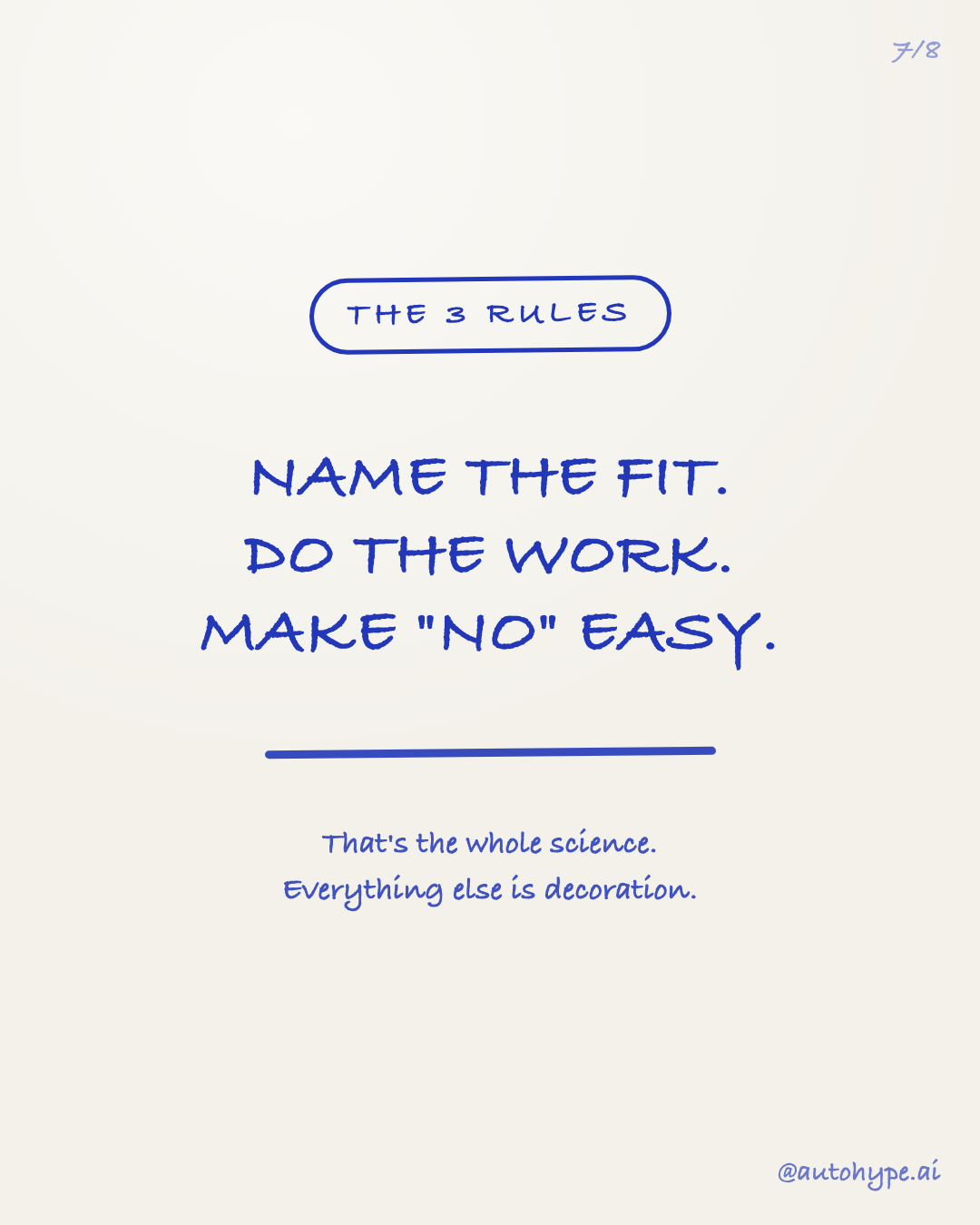
The 3 rules (that's the whole science)
Rule one: name the fit. Not "I think it fits" — name the playlist, the channel, the show, and the specific artist or track your song belongs next to. If you can't name the fit, you haven't found it yet, and the pitch isn't ready to send.
Rule two: do the work. Listen to the playlist before pitching it. Provide genre, mood, BPM, the hook timestamp, and one clean link. Every minute of homework you do is a minute the curator doesn't have to — you're pitching to the arithmetic, not the emotions.
Rule three: make "no" easy. One ask, no guilt, explicit permission to pass. Low-pressure pitches get more replies, and a fast no is a gift: it frees you to pitch the next, better-fitting curator instead of haunting an inbox that was never going to answer. That's the whole science. Everything else is decoration.
One-sentence pitch killers, and where to send the good one
Quick kill-list — each of these ends a pitch in one sentence: sending a mass BCC with no name. Attaching five links ("whichever you prefer!"). Following up daily with "bro did you listen." Pitching a metal track to a lo-fi playlist because it has followers. Offering "exposure" to the person you're asking a favor from. Getting the curator's name wrong — worse than no name at all. And promising your song will "blow up their playlist": you don't know that, they know you don't know that.
Where to send the good pitch: for Spotify editorial playlists, use the free submission tool in Spotify for Artists — and know that editorial access is never for sale; anyone charging for it is lying about a thing that cannot be bought. For independent curators, creators, bloggers and DJs, a marketplace listing puts the price and the deliverable in writing before you commit — playlist pitching from $10 as of July 17, 2026, always sold as a pitch to humans who are allowed to say no, never as a guaranteed placement. We guarantee delivery, not results — in pitching, nobody honest can promise more.
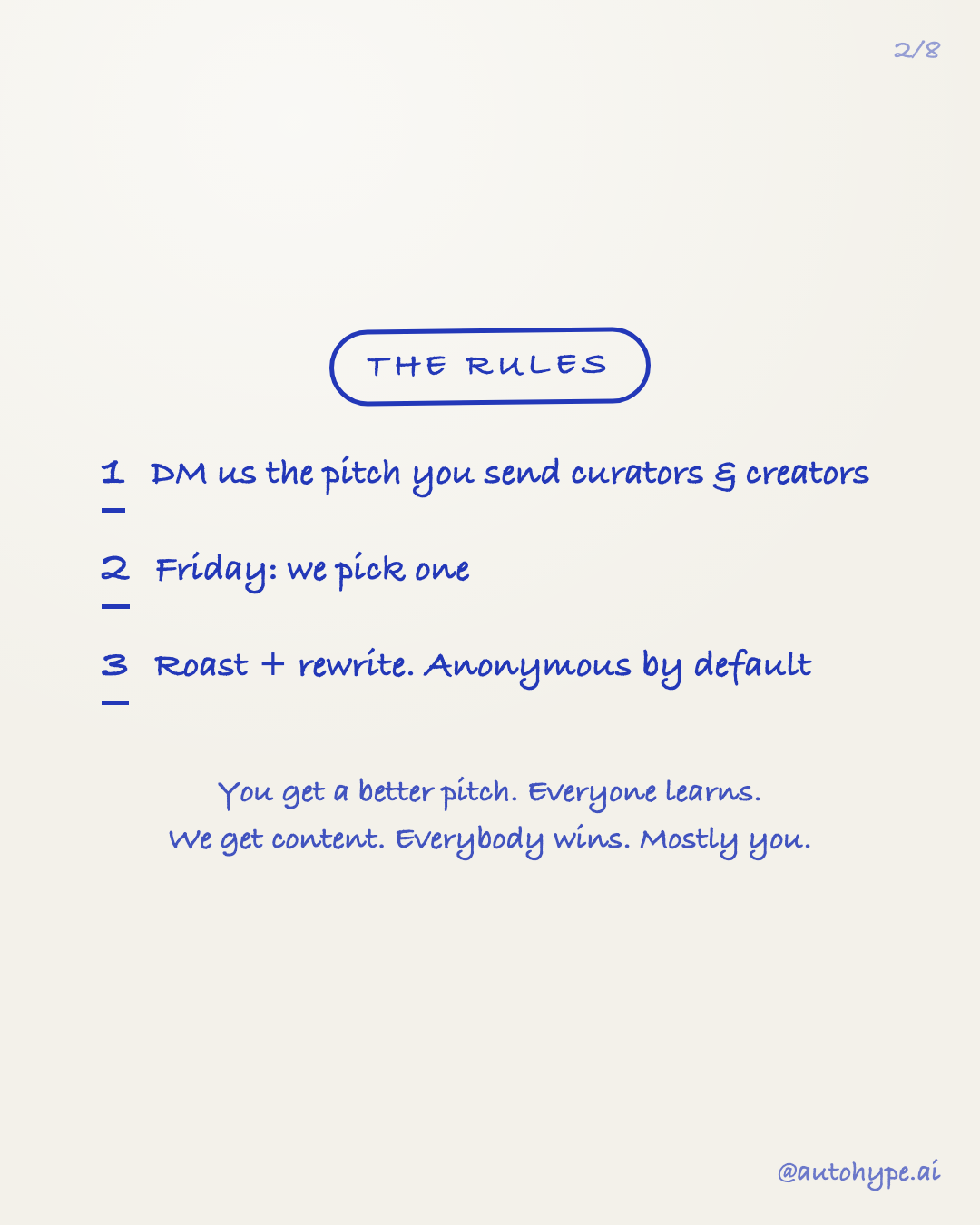
And if your current pitch deserves a public roasting before it costs you another month of silence: DM "PITCH" to @autohype.ai. Friday. No mercy. (Some mercy.)
Choose the next step for your release.
Compare Instagram repost campaigns and independent Spotify curator submissions. See which format fits your release, the deliverables, service fees and terms before ordering. No guaranteed views, streams or playlist placement.
Compare artist campaigns →Frequently asked questions
How long should a music pitch be?
Three to five sentences. A curator gives a pitch about 20 seconds, so every sentence must carry information: who it's for by name, what the song is (genre, mood, BPM), where it fits (the named playlist and a neighboring artist), the hook timestamp with one link, and an easy out. Anything longer is decoration being skimmed.
Should I follow up if a curator doesn't reply?
Once, after about a week, in one polite sentence — then move on. Silence usually means no, and repeated follow-ups convert 'not this song' into 'never this artist.' Your time is better spent pitching ten better-fitting curators than chasing one inbox.
Can I just pay to skip pitching entirely?
You can pay for the pitching work — marketplace sellers handle curator outreach from $10 — but nobody honest sells the yes itself. Spotify editorial playlists can't be bought at any price; anyone selling 'guaranteed editorial placement' is lying. Legitimate paid pitching buys professional outreach to real curators who remain free to decline.
What if I can't find the curator's name?
Look at the playlist description, their profile, and their linked socials — it's usually there, and finding it is exactly the homework that makes a pitch stand out. If it's genuinely nowhere, open with the playlist's name instead: 'Hi — pitching this for Late Loops.' That still proves you know exactly where you want the song to live.