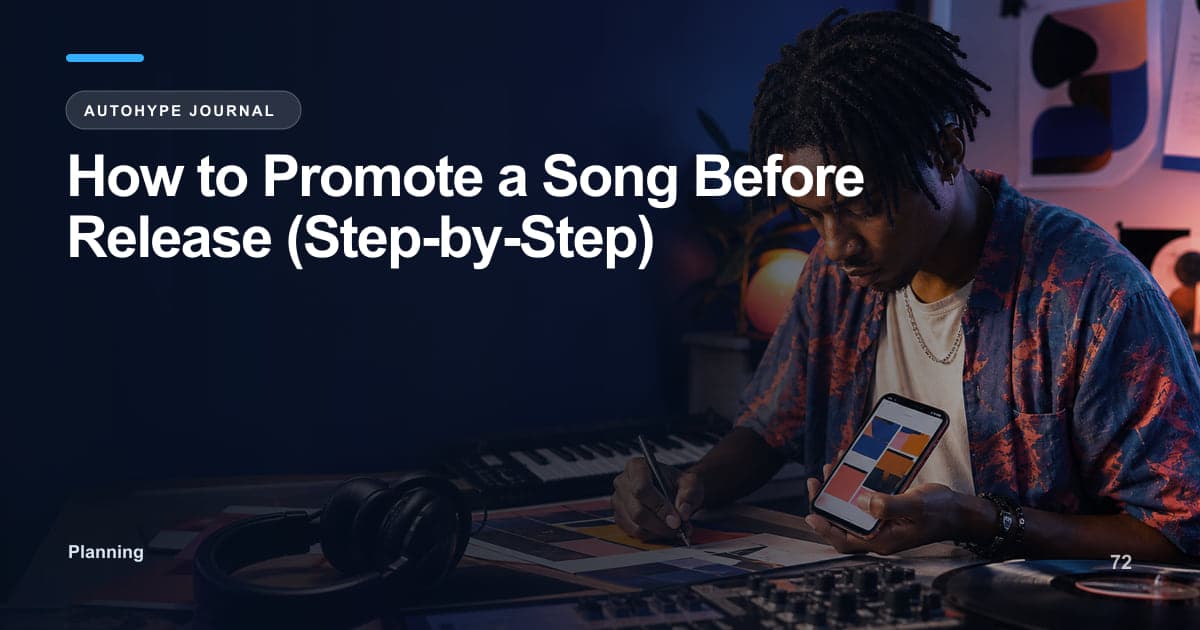
Most independent artists treat release day like a finish line. They pour months into writing, recording and mixing, then upload the track, post a single 'out now' graphic, and quietly hope the algorithm does the rest. The problem is that release day is actually the worst day to start promoting, because by then you are asking strangers to care about something they have never heard of. The work that moves the needle happens in the weeks before the song is live. Promoting a song before release is about building a small group of people who already want it, so that when it drops there is genuine momentum instead of silence. This guide walks through a practical, week-by-week pre-release plan: setting up a pre-save link, teasing the cover and story, testing your hooks, building a daily content runway, and pitching editorial early. None of it requires a budget or a label, just a clear plan and consistent reps.
Why pre-release promotion actually matters
When you drop a song with no warm-up, you are competing for attention against everything else in someone's feed while starting from zero. There is no anticipation, no saved interest, and no audience primed to listen in the first hours, which is exactly the window streaming platforms tend to watch most closely.
Pre-release promotion solves this by spreading the work out. Instead of trying to manufacture excitement in a single day, you give people multiple small chances to discover the track, react to it, and decide they want it the moment it lands. You also get something just as valuable as attention: feedback. Testing snippets and visuals early tells you which hook, caption or cover actually pulls people in before you commit your launch energy to it.
The other reason to start early is logistical. Pre-saves, smart links and editorial pitches all need lead time to work at all, and you cannot add that time back once the song is live. Want this mapped to your release date? Generate a free music promotion plan and work backwards from the day you drop.
Set up a pre-save and smart link (3-4 weeks out)
Your first concrete task is giving people somewhere to go. A pre-save lets fans commit to your song now so it automatically lands in their library on release day, and a smart link is a single URL that routes each listener to their preferred platform. Together they turn casual interest into a small but real launch-day audience.
Set these up at least three to four weeks before release using any of the common distribution or link tools. Put the link everywhere your audience already is: your social bios, pinned posts, email signature and any pre-release content you start posting.
Treat the pre-save link as the call to action behind every teaser. Every snippet, every story, every caption should quietly point back to it. The goal is not a huge number of pre-saves; it is building the habit of giving people one clear next step every time they engage with your music.
Tease the cover art and the story behind the song
People connect with stories far more easily than with a finished product, so start sharing the context around your song before the song itself. Talk about what it is about, why you wrote it, where you recorded it, or the moment that sparked it. This works because it invites people in while the track is still a mystery.
Reveal your cover art as its own moment rather than burying it in the release post. A cover reveal gives you a clean, visual piece of content and a natural reason to mention the release date and pre-save link again without feeling repetitive.
Mix formats so you do not exhaust one idea: a behind-the-scenes studio clip, a lyric written on paper, a short voice note about the meaning, a photo from the day you wrote it. Each of these is a reason to show up in feeds during the quiet pre-release window, and each one can end with the same gentle nudge toward your link.
Compare Instagram repost campaigns and independent Spotify curator submissions. See which format fits your release, the deliverables, service fees and terms before ordering. No guaranteed views, streams or playlist placement.
Test 2-3 hooks before you launch
One of the biggest advantages of promoting early is that you can find your best hook before it matters most. Pick two or three short moments from the song, the most singable line, the drop, the most emotional phrase, and build a quick piece of content around each one.
Post them as separate teasers over a week or two and pay attention to which one people actually respond to. You are looking for qualitative signals: comments, saves, shares, people quoting the lyric back to you, or simply watching to the end. The exact metric matters less than noticing which clip makes people lean in.
If you are stuck on what to lead with, a free TikTok Hook Generator can help you draft caption and opening-line variations to test. Whatever wins becomes the centerpiece of your launch content. This is real audience research, and it is far cheaper to learn now than after the song is live.
Build a daily content runway
Single posts get buried. What gives a release momentum is consistency: a steady stream of short clips in the days leading up to and following the drop, so the song keeps reappearing instead of vanishing after one upload. Think of it as a runway the release rolls down rather than a single launch event.
Plan your runway as a simple calendar. In the final two weeks, aim for something small most days: a hook test, a cover reveal, a story snippet, a countdown, a duet-friendly clip, a lyric moment. None of these need to be polished; raw and authentic usually travels further than overproduced.
The hardest part is sustaining this every single day while also being an artist, which is exactly the problem Autohype is built to solve. It is a marketplace where you hire real TikTok creators, playlist curators, DJs and bloggers per order, from $10, with the price, deliverable and delivery window written on each listing and payment held until the work is delivered. Book a few orders across your runway and part of it gets covered by other people instead of depending on you remembering to post. That consistency is what keeps a release visible long enough to find its audience.
Pitch Spotify editorial at least 7 days early
If you distribute through a service that connects to Spotify for Artists, you can submit your unreleased song to Spotify's editorial team for playlist consideration. This must be done before release, and Spotify recommends at least seven days of lead time, so put it on your calendar as a hard deadline.
A submission is not a guarantee of placement, and most pitches do not get added, so treat it as one upside rather than your plan. What you can control is the pitch itself: choose accurate genres and moods, write a clear and honest description of the song, and explain the context, the story and any momentum you are building around it.
Even when a pitch is not picked up, submitting it still tells Spotify's algorithm about your track ahead of release, which feeds the personalized systems like Release Radar. If you want help structuring the submission, a Spotify editorial pitch tool can help you draft a tight, well-organized description.
Your release-day checklist
By the time release day arrives, most of the heavy lifting should already be done. The day itself is about converting the interest you have built, not creating it from scratch. Keep it simple so you are not scrambling.
Run through this on the day: confirm the song is live everywhere and your smart link now points to the released track; post your strongest hook clip first thing; thank everyone who pre-saved and ask them to add the song and share it; update every bio, pinned post and story with the live link; and send a short message to your email list or close fans who said they wanted it.
Then keep going. The week after release is part of the runway too, so continue posting clips, reply to comments, and keep pointing people to the song. Release day is a milestone in the campaign, not the end of it, and the artists who keep showing up afterward give their songs the best chance to keep finding listeners.
Choose the next step for your release.
Compare Instagram repost campaigns and independent Spotify curator submissions. See which format fits your release, the deliverables, service fees and terms before ordering. No guaranteed views, streams or playlist placement.
Compare artist campaigns →Frequently asked questions
How far in advance should I start promoting my song?
A practical window is three to four weeks out. That gives you time to set up a pre-save and smart link, tease the cover and story, test a few hooks, and submit your Spotify editorial pitch with the recommended seven-plus days of lead time.
What is the difference between a pre-save and a smart link?
A pre-save lets fans commit to your song now so it drops into their library automatically on release day. A smart link is a single URL that sends each listener to their preferred platform. You use the pre-save link before release and switch the same smart link to the live song on release day.
Do I need a budget to promote a song before release?
No. The most effective pre-release work, teasing the story, testing hooks, posting consistently and pitching editorial, costs only time and consistency. Paid ads are optional, but they are not what builds early anticipation; showing up regularly with your music is.
Will pitching Spotify editorial guarantee a playlist placement?
No. Most editorial pitches are not added, so it should be treated as one possible upside rather than the foundation of your plan. Even when a pitch is not picked up, submitting early still informs Spotify's algorithm about your release, which can help with personalized features like Release Radar.